Town Hall Meetings in Hof: Experience & Participate in City Politics
Citizens' Assembly Hof 2026: Dates, Procedure and Preparation
At the citizens' assemblies in Hof, the city leadership and administration inform about planned city policies, projects, and initiatives for 2026. Those who prepare can ask concrete questions, bring up concerns, and thus actively help shape topics such as traffic, urban development, and climate adaptation in Hof.
What is a citizens' assembly in Hof?
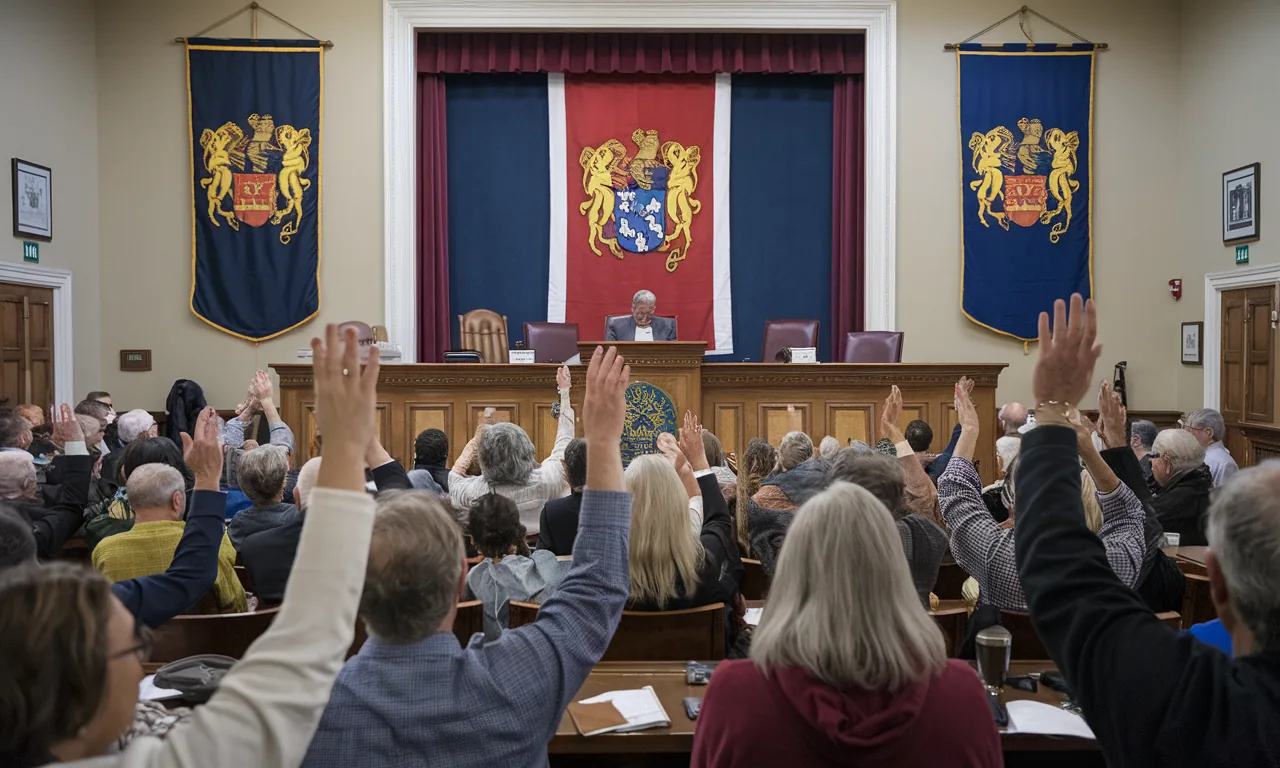
A citizens' assembly is a public event organized by the city of Hof, where citizens receive information about planned initiatives and can present their own concerns. The city leadership and specialist departments provide an overview of topics in the respective district, explain intended steps, and take questions and suggestions.
The focus is on everyday concerns – for example, safe school routes, cycling, green spaces, precautions for heavy rain, social services, or specific projects in the respective district.
Citizens' Assembly Hof 2026: Finding Dates and Understanding Invitations
- Announcement of Dates: The city of Hof publishes the dates for the 2026 citizens' assemblies (with district assignment, time, and place) prior to the respective events through official channels.
- Official Invitation: The official invitations and announcements of the city of Hof are binding. They regulate location, time, district assignment, as well as possible special features (e.g. admission, speaking times, accessibility notes).
- Where are the dates published? A central point of contact is the city website. There you will find invitations, information on key topics, and supplementary information.
- Direct Access: Official information can be found at hof.de.
Note on reliability: If information from social media, notices, or private groups differs from the official information, the official announcement applies.
Participation in the Citizens' Assembly: How to Take Part
- Participation without registration: Unless otherwise stated in the invitation, participation is generally possible without prior registration. Details are in the respective invitation.
- Submit questions in advance: Many concerns can be effectively submitted in advance via the contact channels specified by the city. This allows responsibilities to be clarified and information to be prepared for the event.
- Speak up during the event: During the assembly, citizens can speak up, ask questions, and make suggestions. The moderation ensures orderly contributions and a respectful process.
- Bring documents: A brief written summary (1–2 paragraphs), location details (street/intersection), possibly a sketch, and the key question you want answered are helpful.
Typical Procedure of a Citizens' Assembly in Hof (2026)
- Opening: Welcome, organizational notes, procedure and rules for speaking (e.g. order, speaking time, tone).
- City Overview: Presentation of planned measures and work priorities with reference to the district.
- District Priorities: Classification of specific projects in the neighborhood (e.g. construction site management, school route safety, climate adaptation, drainage/heavy rain).
- Open Question Round: Contributions from the audience; answers by responsible persons or acceptance for further review.
- Outlook: Notes on next steps, responsibilities, and ways to track results after the event (e.g. via city publications).
Practical tip: Formulate your question so that a verifiable answer is possible (e.g. "Which measure will be examined/implemented by when, and who is responsible?" instead of "Couldn't something be done...?").
Key Topics 2026: What Will Likely Be Frequently on the Agenda
The specific topics depend on the respective district and the concerns there. For the 2026 citizens' assemblies, the following areas will often be relevant, among others:
- Traffic and Cycling: Crossings, closing gaps in the cycling network, parking facilities, traffic calming, and safe routes to daycare centers and schools.
- Urban Development and Housing: Design of squares and street spaces, use of areas, quality of stay, and neighborhood development.
- Climate Adaptation and Green Spaces: Unsealing, tree planting, heat protection, and upgrading green spaces.
- Heavy Rain and Flood Protection: Drainage, retention and runoff routes, and protection of particularly vulnerable areas.
- Social, Education, Participation: Accessibility, meeting points, offers for families, young people, and seniors.
- Economy and Accessibility: Construction site coordination, delivery traffic, accessibility, and impacts on trade and services.
If the city publishes documents such as maps, plans, or visualizations for a citizens' assembly, it is worth taking a look in advance: This allows questions to be formulated more precisely and priorities to be better justified.
Well Prepared for the Citizens' Assembly 2026
- Assign correctly: Check the invitation to see which citizens' assembly is intended for your district and plan your arrival and departure.
- Make concerns concrete: Note the location (street/junction), time (e.g. school start), observation, and effects. Photos or sketches can help describe the concern comprehensibly.
- Formulate a key question: Start with a main question (e.g. "Which specific measure is planned by when?") and add at most two to three sub-questions.
- Appear together: Coordinate with neighbors, school, club, or initiative to bundle overlaps and clearly state priorities.
- Request low-barrier participation early: If you need support (e.g. sign language interpretation or accessible documents), ask early via the contact channels specified in the invitation.
- Follow up on results: After the citizens' assembly, check the city's publications to track the processing status of your concern.
Example: Ask Briefly and Effectively (in advance or at the event)
Topic: School route safety at an intersection in the district
Key statement: "At the start of school, conflicts arise between turning vehicles and crossing children. Visibility may be restricted by parked vehicles."
Three precise questions:
- Which short-term measures are possible (e.g. marking, visibility triangles, temporary controls) and in what time frame?
- Who is responsible at this location (road authority/traffic authority) and what is the review process?
- Which long-term solution is being considered (e.g. crossing aid, changed right of way/traffic light), and when can a decision be expected?
Digital and Low-Barrier Participation Options (if offered)
For the 2026 citizens' assemblies, supplementary formats such as livestreams, online question options, or accessible information materials may be provided, if offered by the city. Whether and to what extent such offers are available can be found in the respective invitation or the information on hof.de.
Data Protection Principle: If image or sound recordings are planned, this is usually indicated on site or communicated in the information. For binding information, rely on the invitation or notices from the city.
Sources and Further Information
- Bavarian Municipal Code (BayGO), Art. 18 "Citizens' Assembly" — Legal basis in Bavaria (accessed 2026-08-09)
- City of Hof – Official Website — Invitations, information, and publications (accessed 2026-08-09)
- Federal Agency for Civic Education (bpb): Local Politics — Background on municipal participation (accessed 2026-08-09)