Volunteering in Hof: Engagement, Meeting Point, and Volunteer Card
Volunteering & Volunteer Work in Hof – Here’s How You Can Get Involved in the Coming Months
Do you want to get involved in Hof? This overview shows you how to find suitable volunteering opportunities in the future, which fields of engagement are particularly in demand in Hof, how recognition via the Bavarian Volunteer Card works, and how you can support planned small projects through funding opportunities.
Why Now is a Good Time to Start Volunteering in Hof
If you plan to do something meaningful regularly or occasionally in the near future, volunteering in Hof is a realistic and well-organized way to start: You can flexibly get involved depending on your life phase – from one-off actions to fixed roles in clubs and initiatives. The key is to find opportunities that fit your time budget, interests, and comfort zone.
So you don’t have to search for long, Hof relies on central contact points and digital channels through which volunteering opportunities are continuously published, filtered, and requested. This guide is based exactly on that.
Volunteer Meeting Point Hof: Your Central Contact for Upcoming Engagement Opportunities
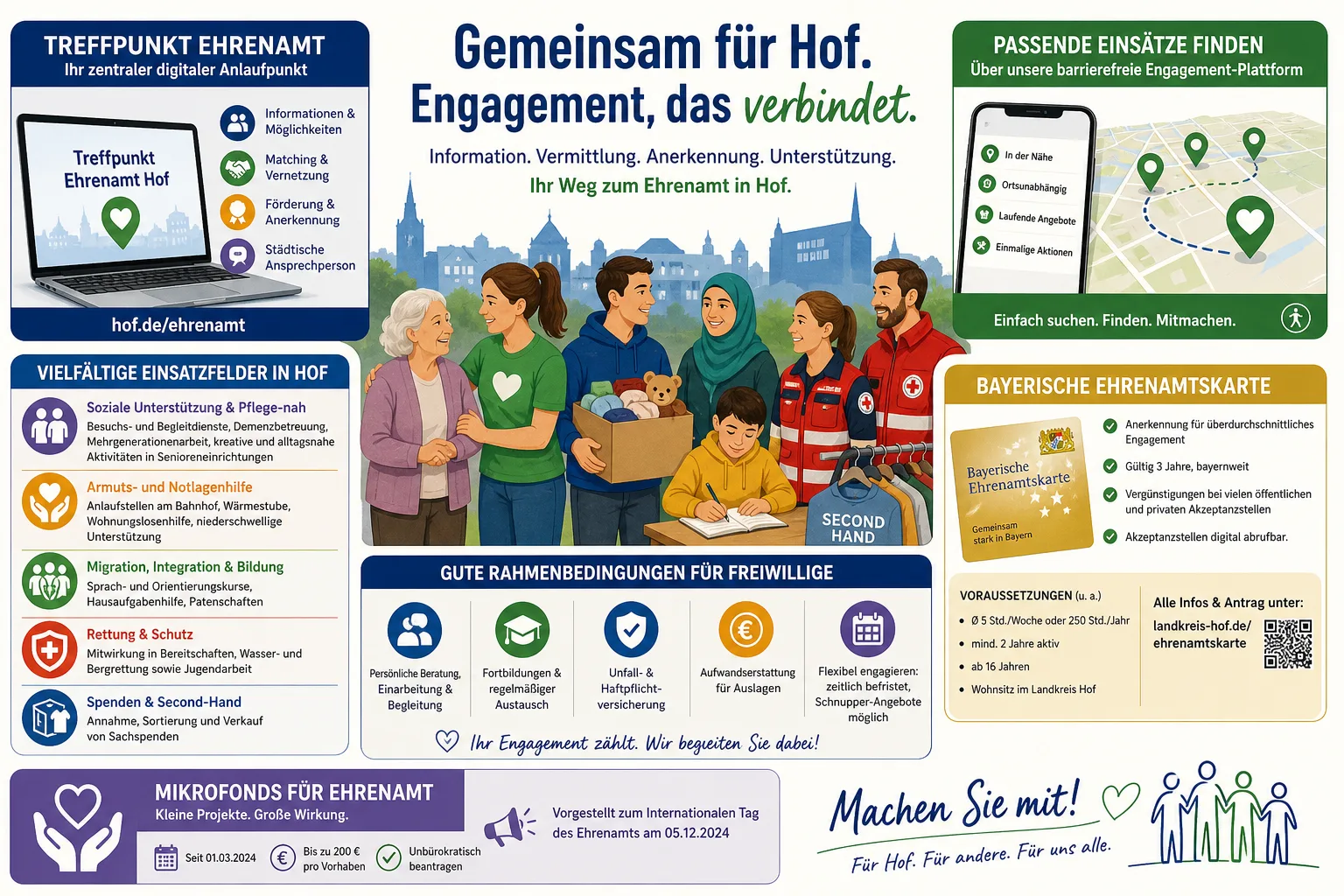
For your start in the next weeks and months, the “Volunteer Meeting Point” is the most sensible first stop: Here, information about voluntary engagement in Hof comes together – from orientation and placement to information on recognition and funding. Instead of contacting many places individually, you use a bundled entry point and are specifically directed to suitable offers.
- Orientation: Which fields in Hof are currently looking for volunteers (e.g. social, education, integration, rescue, culture).
- Placement: How to select and request suitable tasks according to time commitment and interests.
- Framework conditions: What organizations typically offer in terms of induction, contacts, and coordination.
- Recognition & Funding: How you can use benefits (volunteer card) and support for small projects (microfunds) in the future.
If you are still unsure, the meeting point is especially helpful for “matching”: You start with what you can give (time, strengths, limits) – and find a task that you can sustain in the long term.
Digital Engagement Platform: How You’ll Soon Find a Suitable Opportunity with Just a Few Clicks
A practical way for your engagement in the near future is a low-barrier, digital engagement platform where organizations continuously post their needs. For you, this means: You can filter future opportunities by criteria and make direct contact as soon as an offer fits your schedule.
This is how you proceed (planable for the next weeks)
- Set search filters: Field (e.g. “Social”, “Education”, “Rescue”), time commitment, possibly location/radius.
- Check task profile: What exactly needs to be done, what skills are helpful, and whether induction is offered.
- Make contact: A short message with your time window (e.g. “2 hours per week” or “once a month”).
- Arrange a meeting: Many places offer an initial, non-binding conversation or a trial appointment.
This is especially helpful for people with changing work schedules or family obligations: In the future, you can also choose project-based or time-limited assignments without having to commit long-term right away.
Fields of Engagement in Hof: Where Your Volunteering Will Be Especially Needed in the Future
In Hof, there are several areas of engagement that typically seek volunteers again and again in the coming months. Which offers are specifically available depends on current postings – but the following fields are reliable “docking points” if you want to start soon.
Social Support & Senior Work
If you want to regularly give your time in the future, visiting and escorting services, reading aloud, joint walks, or group activities in senior work are obvious choices. Such tasks are especially suitable if you like to listen, communicate calmly, and value reliability.
- Accompanying small everyday errands (e.g. walks, playing together)
- Supporting activation offers (creative, music, discussion groups)
- Relieving “time donations” for those affected and their relatives within the respective provider’s offers
Help in Emergencies: Low-Threshold Support
If you want to get involved practically in the coming weeks, low-threshold help often offers a quick entry: assisting with distribution, sorting, preparation, or logistical tasks. It is important here that you follow procedures and deal respectfully with very different life situations.
- Distribution and organizational tasks (after induction)
- Donation logistics (acceptance, sorting, provision)
- Support in the background (preparation, tidying up, coordination)
Migration, Integration & Education
For the near future, learning and language support, mentoring, or practical everyday assistance are also available – for example, practicing German, learning, or finding your way in everyday life. The focus is on patience, clarity, and reliability; professional advice remains the responsibility of the respective organization.
- Homework and learning support (depending on the offer, on-site or digital)
- Language practice in tandems or group formats
- Everyday orientation within the respective programs
Rescue, Protection & Youth Work
If you want to grow into structured teams in the medium term, aid and rescue organizations as well as youth work are good contact points. Engagement roles are often combined with training and further education so that you can act safely in future assignments.
- Support with training, exercises, and event services
- Youth work and supervision (after qualification/induction)
- Organizational tasks (planning, materials, communication)
Donation Logistics & Second-Hand Projects
If you like to get involved and organize, second-hand and donation projects are very suitable for your next entry. At the same time, you support social participation and resource conservation.
- Acceptance and sorting of goods according to the criteria of the place
- Presentation/organization of distribution or sales
- Team tasks in the background (cash register support, storage, transport by arrangement)
Good Framework Conditions: What You Should Pay Attention to When Starting in the Coming Months
To ensure your engagement works well in the long term, it’s worth doing a quick check of the framework conditions before you start. Serious organizations clarify transparently what you do (and what you don’t), how coordination works, and what support you get.
Practical Checklist for Your First Meeting
- Time commitment: How often, how long, how flexible?
- Task profile: Specific activities, responsibilities, boundaries.
- Induction: Who will train you? Are there guidelines or fixed contacts?
- Protection & Safety: What rules apply (e.g. data protection, dealing with sensitive situations)?
- Insurance & Expenses: How are accident/liability issues regulated, is there reimbursement of costs according to the organization’s guidelines?
If you basically like an area but are unsure, start with a limited trial assignment. This way you can test whether the task, team, and rhythm suit you.
Bavarian Volunteer Card: How You Can Use Recognition and Benefits in the Future
If you get particularly reliably and extensively involved in Hof in the coming years, the Bavarian Volunteer Card may become relevant for you. It serves as recognition and enables benefits at participating acceptance points in Bavaria. The specific requirements (e.g. minimum age, minimum scope and duration of engagement) are officially regulated and should be checked according to the current guidelines before applying.
For your planning, it is important: The volunteer card is typically useful if you are not only “occasionally” but constantly active over a longer period. If you start today, you can already note when you are likely to meet the criteria and which proofs your organization provides for this.
Microfunds & Funding: How You’ll Soon Get Small Projects Rolling in Hof
In addition to time donations, small, local projects in Hof can also be supported by microfunding in the future. Such programs are especially helpful if you have a concrete idea – such as a get-together, a neighborhood afternoon, a small cultural or educational format – and want to finance materials, room rental, or public relations for it.
In practice: Funding programs usually have criteria, application procedures, and deadlines. Therefore, plan ahead and inform yourself in good time about the currently published conditions and submission dates via the official city information channels. This way you can prepare your project properly and start implementation within a realistic timeframe.
Your Start in Hof: 3 Steps to the Right Volunteering (Implementable from Now On)
- Choose your “feasibility framework”: realistic hours per week/month and preferred type of assignment (regular vs. project-based).
- Decide on a field: Social, education/integration, rescue/youth, logistics/second-hand, or culture/organization.
- Contact & Get to Know: Use the meeting point/platform for an inquiry and arrange a first meeting. Pay attention to clear agreements and good induction.
This way, volunteering won’t become overwhelming, but rather a fixed, positive appointment in your calendar – with impact for others and for your own sense of belonging in Hof.