Cultural Education in Hof: Practice, Diversity, Discourse
Cultural Education & Societal Discourse in Hof: An Agenda for Upcoming Formats (2027)
This article consistently looks ahead: It describes how, in Hof, new formats of cultural education can strengthen societal discourse in the coming months and in 2027 – in youth centers, schools, clubs, cultural initiatives, and public spaces.
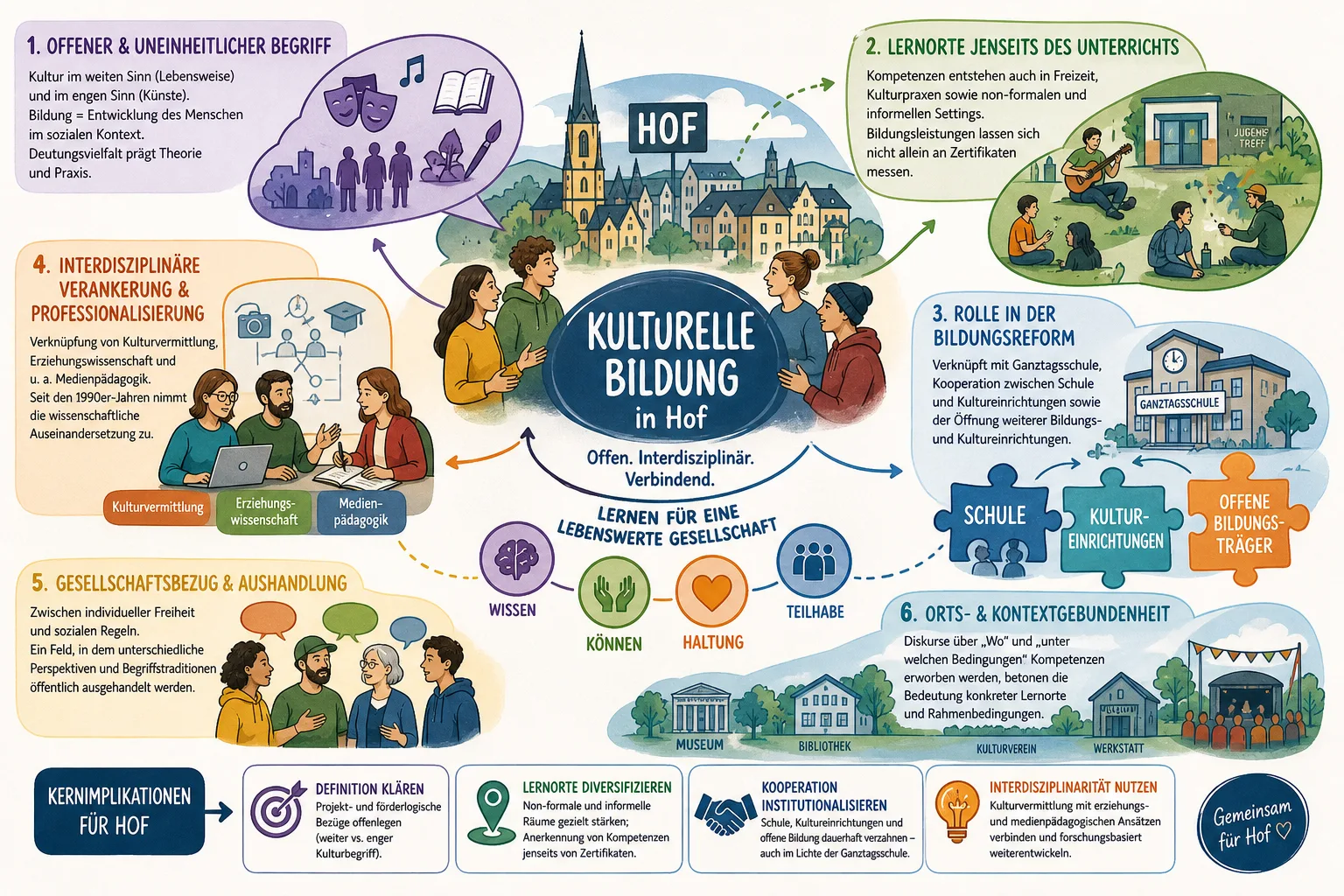
Learning Spaces Beyond the Classroom: What Should Become More Visible in 2027
For the upcoming development in Hof, it will be especially important in 2027 that learning and educational processes do not only take place within the formal system. Non-formal and informal learning spaces should be considered and made visible as part of the educational infrastructure.
Non-formal Learning Spaces (2027): Organized, Voluntary, Outside of School
- Workshops and course formats in cultural clubs and initiatives
- Theater, music, media, and writing projects in youth facilities
- Group offerings in youth and adult education with a cultural focus
- Projects in urban spaces (e.g., temporary exhibitions, artistic interventions, audio walks)
Informal Learning Processes (2027): Everyday, Self-organized, Effective
- Collaborative production of music, videos, or digital formats in peer groups
- Neighborhood festivals, club life, and intergenerational tradition maintenance
- Public discussions and participation opportunities that use cultural forms of expression
In 2027, such spaces can specifically help to strengthen cultural, social, and media competencies: finding expression, changing perspectives, negotiating rules, resolving conflicts fairly, taking responsibility, and creating public visibility. Especially since these competencies are rarely reflected in certificates, they should be consciously recognized and communicated in Hof in the future.
Discourse Formats for Hof: Negotiating Culture, Pedagogy, and Diversity Together in the Future
In 2027, cultural education in Hof will not only consist of individual projects, but function as a space for discourse: Different ideas of culture, education, quality, participation, and protection should not stand side by side in the future, but enter into productive dialogue with each other.
In a city society that will continue to be shaped by different life situations, milieus, and biographies, in 2027 the following questions should be asked more strongly: Which stories become visible? Which languages and forms of expression get a stage? Who feels invited – and who does not? The planned discourse logic will not rely on buzzwords, but on concrete barriers (time, costs, language, routes, access, role models) and practical solutions.
At the same time, pedagogy in the cultural field will continue in 2027 to be characterized by the tension between freedom and responsibility: artistic experimentation, participation, and self-efficacy on the one hand – protection, supervision, clear rules, youth protection, and discrimination-sensitive action on the other. Future-proof formats in Hof should not hide this tension, but make it transparent.
Cooperation 2027: All-Day, Networks, and Shared Responsibility
If Hof wants to effectively expand cultural education in 2027, cooperation between schools, cultural institutions, youth and adult education, and civil society organizations will be the central lever. Especially in the context of all-day structures, "more time" can become "more cultural practice" – provided the cooperation is reliably planned.
- For students, offerings should be created in 2027 in which culture can be experienced as practice (e.g., theater, music, media production, design in urban spaces).
- For cultural workers and mediators, clear cooperation frameworks should apply (roles, times, communication, protection standards, evaluation).
- For the city society, a networked educational landscape should become recognizable in 2027, connecting formal, non-formal, and informal learning spaces.
To ensure that cooperation is not just short-term, 2027 should be thought of structurally: fixed contact persons, recurring coordination, joint quality criteria, and training formats that combine artistic, pedagogical, and socio-spatial perspectives.
Interdisciplinarity 2027: Connecting Media Education and Cultural Competence
In 2027, cultural education in Hof will be particularly sustainable if it is planned interdisciplinarily: cultural mediation, social work, urban development, and media education should not stand side by side, but work together in project design.
Media educational perspectives will play a key role in 2027 because cultural practice already takes place digitally: Young people produce, comment, remix, and publish content. Future-proof projects in Hof should use this reality as a resource and at the same time promote critical media literacy.
Competencies That Can Be Specifically Strengthened in Projects in 2027
- Aesthetic competence: finding and reflecting on one's own forms of expression
- Media competence: using tools safely, creatively, and critically
- Social competence: planning in a team, giving feedback, dealing with conflicts
- Democratic competence: setting topics, organizing participation, responsibly creating public visibility
Roadmap 2027: Proposal for a Discourse and Project Structure (purely future-oriented)
The following structure describes a possible approach for Hof in the calendar year 2027. It is intended as a future-oriented planning framework, which can be adapted locally, without already claiming concrete organizers, locations, or confirmed programs.
Phase 1 (January–March 2027): Concept and Goal Clarification
- Definition of key terms for each project (concept of culture, educational goals, target groups, expected impacts)
- Coordination of joint minimum standards (transparency, protection concepts, low barriers, feedback channels)
- Planning of a public kick-off format that enables low-threshold participation
Phase 2 (April–July 2027): Pilot Formats in Different Learning Spaces
- Pilot projects in non-formal settings (youth and cultural work) and in cooperation with school structures
- At least one format that connects digital and analog cultural practice (e.g., podcast, short film, exhibition in urban space)
- Accompanying feedback from participants and partners as a fixed project step
Phase 3 (September–November 2027): Public Discourse & Visibility
- Public presentations that explain processes (not just show results)
- Discussion formats in which experiences from projects are translated into concrete municipal questions (access, spaces, times, resources)
- Documentation in plain language so that results become usable for the city society
Phase 4 (December 2027): Evaluation & Next Steps
- Joint evaluation based on previously defined criteria (goals, participation, learning experiences, safety, cooperation)
- Preparation for decisions on continuation and scaling in the following year (2028)
- Publication of a compact annual review that names transparent learning points and improvements
Quality & Trust: How Projects Can Be Implemented Transparently and Safely in 2027
In order for cultural education formats to build trust in Hof in 2027, they should not only be creative, but also organized in a comprehensible and safe way. This includes clear responsibilities, understandable communication with participants and guardians, as well as binding standards for cooperation.
- Transparency: Goals, target groups, roles, and responsibilities are published in an understandable way before the project starts.
- Protection & Supervision: For offerings involving minors, clear rules apply regarding supervision, behavior, image/audio recordings, and complaint channels.
- Low Barriers: Times, language, costs, and access are planned so that participation is realistically possible.
- Evaluation: Participant feedback is planned as a standard and visibly flows into improvements.
In this way, a reliable cultural and educational landscape can emerge from individual activities in 2027, which not only describes societal discourse, but makes it practically possible.