Discover Spiritual Places & Meditation in Hof
Spiritual Places & Meditation in Hof: Finding Silence in the City
If you want to consciously slow down in the coming days or weeks, you can find surprisingly many ways to access silence in Hof and its surroundings: in city parks, by bodies of water, in open church spaces, and in small practice groups. This guide helps you realistically plan future time-outs—without having to travel far.
Spiritual Places in Hof: How They Can Be Useful for You in the Future
A spiritual place does not have to be spectacular. What matters is that you can use it regularly in the future, that it feels safe, and that it fits your life reality. In Hof, you can especially plan for three categories:
1) City Green & Water: Natural Meditation Spaces You Can Visit Repeatedly
If you soon walk through Hof with a "contemplative lens," you will find spots suitable for silent walking or short sitting meditation: a quiet path section, a bench away from main paths, a stretch of shore where you can breathe undisturbed. Plan this as a recurring ritual instead of a one-time inspiration.
- Your Outdoor Zendo: Choose a fixed spot that you visit 1–3 times a week for 10 minutes.
- Silent Circuit: Set a route (e.g., 20–30 minutes) and walk it regularly in silence.
- Arrival Ritual: Before you start walking or sitting: 5 deep breaths, then begin.
This way, a place becomes not just "nice," but reliable—and that's what makes it helpful in the long run.
2) Churches, Chapels, and Open Spaces: Silence with a Clear Atmosphere
If a church or chapel in Hof is open during the day in the coming weeks, it can be an uncomplicated space for silent sitting or prayer—regardless of whether you feel connected to a denomination. Such spaces support many people through acoustics, light, and "slow" architecture.
If you want to practice together with others, you can imagine low-threshold formats in Hof for the future that require little organizational effort:
- Midday Silence (20–30 minutes): short impulse, then shared silence.
- Introduction to Silent Sitting: clear body posture, breath focus, dealing with thoughts—without performance pressure.
- Contemplative Evening: 2–3 short sitting phases, mindful walking in between, ending in gratitude.
If you do not want to lead an offer yourself, you can ask congregations, educational centers, or course providers about open times before you go—this increases reliability and builds trust.
3) Community Spaces & Small Groups: Practicing with Support, Without Pressure
If you want to stick with it in the coming months, a small practice group is often more helpful than a single "perfect" place. In Hof, cultural and community spaces, yoga studios, or private initiatives may be suitable. In the future, pay attention to a setting that is both safe and open.
- Simple Start: Breath or body awareness, 5–10 minutes of silent sitting, brief reflection.
- Consciously Designed Silence: clear instructions (start/end), no unexpected exercises.
- Respectful Exchange: speak voluntarily, no judgment, no missionary dynamic.
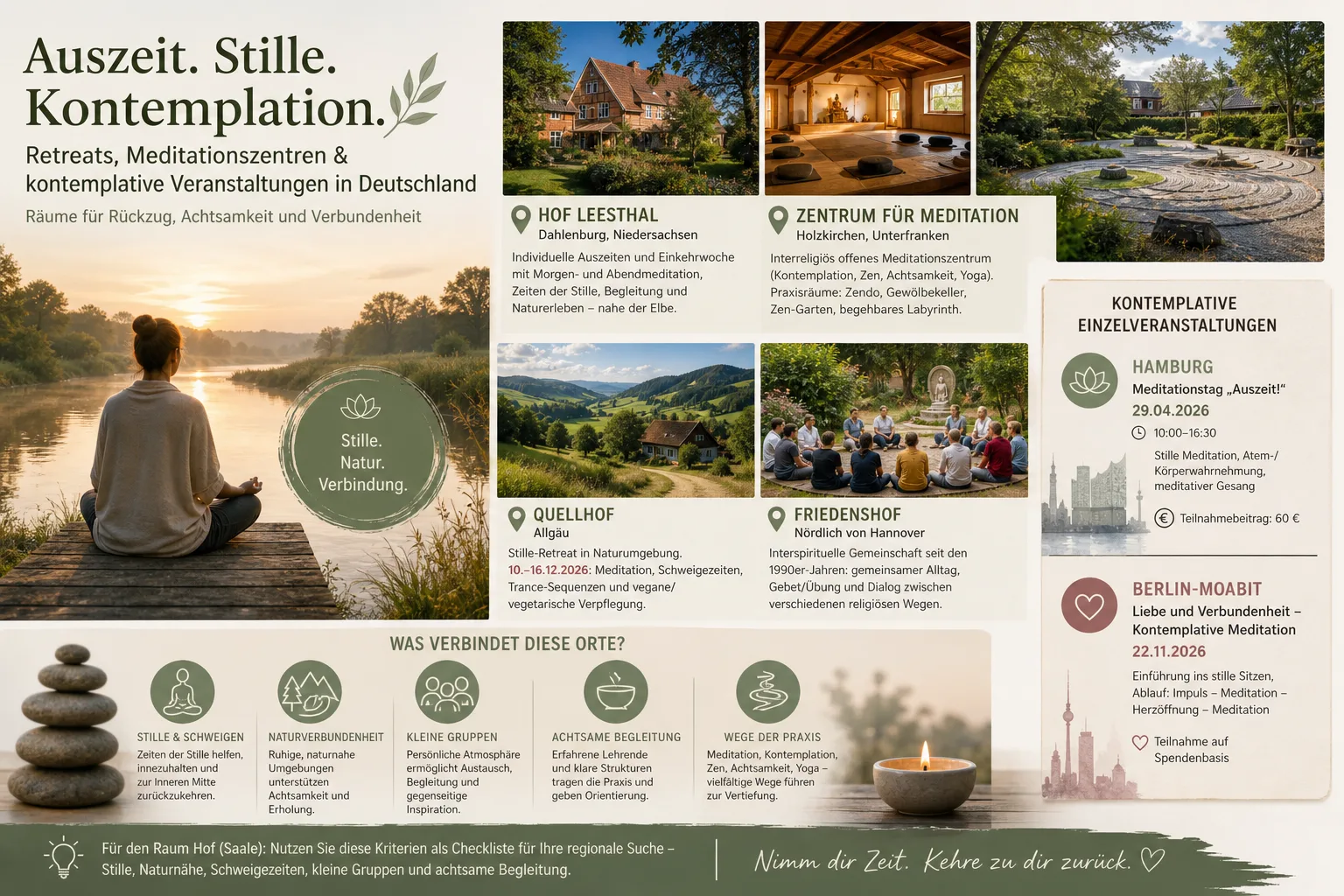
If you want to respect different traditions, an interspiritual approach may be a good fit for the future: people from different backgrounds sit together in silence, without everyone having to commit to the same language or worldview.
Planning a Micro-Retreat in Hof: 2 Hours, 1 Evening, or 1 Day
A multi-day retreat will not fit every life phase. So that you can still experience noticeable calm soon, a "micro-retreat" can be designed to remain realistic and repeatable. The following plans are deliberately concrete—you can implement them directly in the coming days.
Option A: 2-Hour "Silence Reset" (After Work or on the Weekend)
- Preparation (5 minutes): Put your phone on airplane mode, set the end time.
- Arrival (10 minutes): Slow walking, count breaths (1 to 10, repeat).
- Sitting Meditation (10 minutes): Focus on breath or body contact (feet on the ground).
- Silent Walking (20 minutes): Consciously slow, without music/podcast.
- Sitting Meditation (10 minutes): As above; let thoughts come and go.
- Conclusion (5 minutes): Brief note: "What was different today than usual?"
Option B: A Contemplative Evening at Home (60–90 Minutes)
- Clear the Space (5 minutes): Dim the lights, comfortable seat, have a blanket ready.
- Body Arrival (10 minutes): Gentle stretching, then sit in silence.
- Silence (2 × 10 minutes): Two sitting phases, 5 minutes mindful walking in between.
- Maintain Silence (10 minutes): No messages, no conversations, only tea/water.
- Calm Ending (10 minutes): Short gratitude or reflection question, then go to bed early.
Option C: 1 Day Micro-Retreat in Hof (Without Overnight Stay)
If you have a free day soon, plan it like a simple retreat day: fewer goals, more rhythm.
- 3 Fixed Anchors: 15 minutes sitting in the morning, 20 minutes silent walking at noon, 15 minutes sitting in the evening.
- 1 Silent Place Outdoors: A spot you don't "optimize," just visit.
- Silence Time: At least 2 consecutive hours without conversations and without media.
- Gentle Movement: Mindful walking or light stretching instead of intense performance.
The goal is not to meditate "perfectly," but that at the end of the day you can recognize: This is what a calmer rhythm feels like.
Checklist: Choosing Suitable Meditation and Silence Offers in Hof
If you check courses, open groups, or individual events in Hof in the future, these criteria will help you assess quality and suitability—without having to rely on advertising promises.
- Transparent Framework: Are procedure, duration, costs (if any), and goals clearly described?
- Leader's Qualifications: Is training/experience clearly stated (e.g., MBSR, yoga training, contemplative training, years of practice)?
- Group Size & Protection: Are there rules for confidentiality, respectful communication, and voluntary participation?
- Practice over Ideology: Is the practice the focus, without pressure, ideology, or promises of healing?
- Place & Atmosphere: Quiet, safe, easily accessible; enough time to settle in.
- Aftercare: Are there notes on how participants can deal with restlessness, emotional reactions, or overwhelm?
Practicing Safely and Mindfully: What You Should Know in Advance
Meditation can feel very supportive in the future—but it can also trigger unfamiliar inner processes (e.g., more thought activity, restlessness, or strong emotions). This is not automatically "bad," but should be taken seriously.
- Start Small: 5–10 minutes are often more sensible at the beginning than long sitting times.
- Choose a Safe Setting: Especially with intensive exercises, experienced guidance can be helpful.
- Seek Help if Needed: If meditation intensifies distressing symptoms or you do not feel stable, it may be advisable to seek medical or psychotherapeutic advice.
Note: This article is for informational purposes and does not replace medical, psychotherapeutic, or pastoral advice.