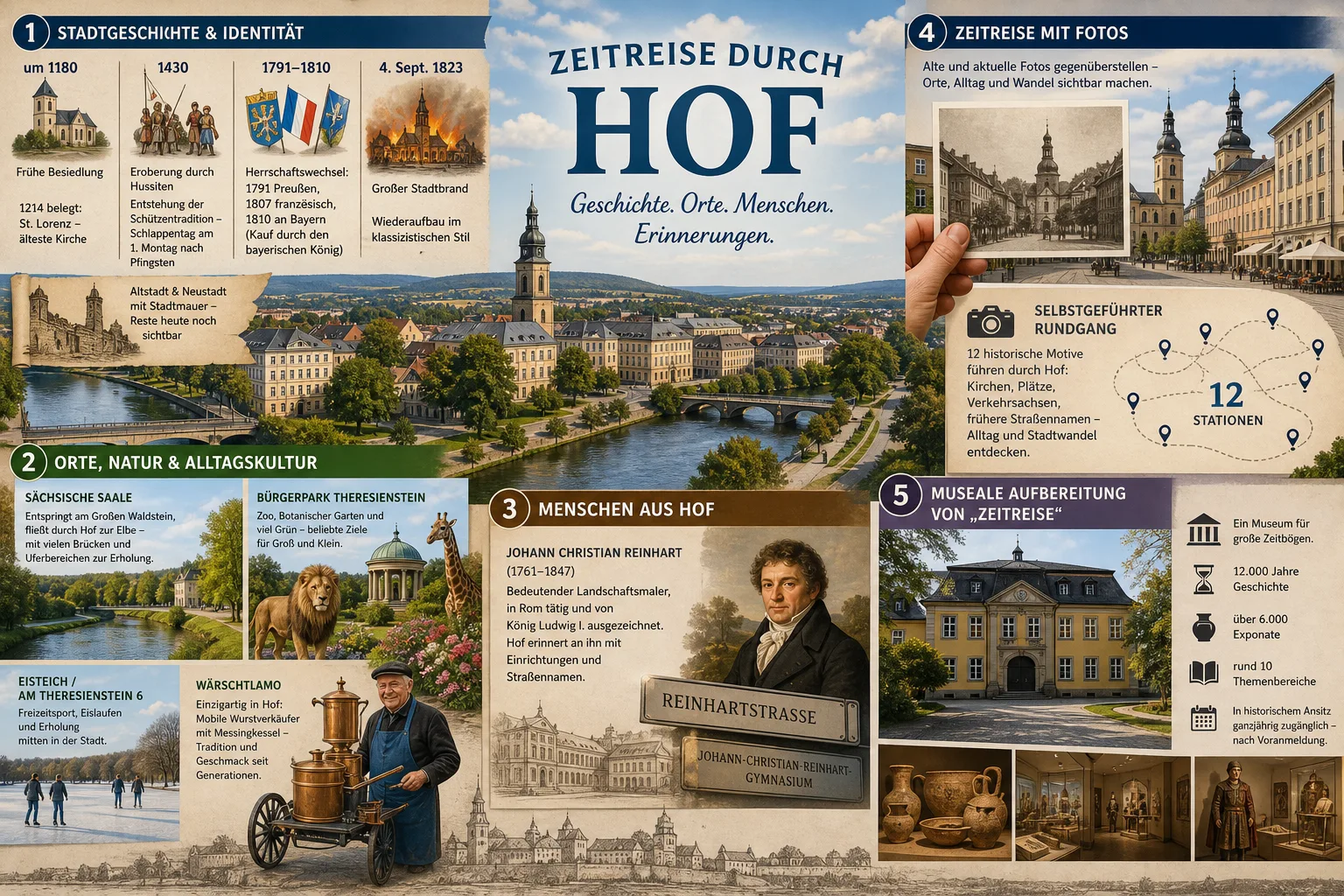
Time Travel through Hof: Discovering History in Old Photos
Time Travel through Hof: Old Photos, Stories & People – Upcoming Activities & Participation Formats
This page bundles future opportunities for you to experience a personal "time travel" in Hof with old photos, stories, and city walks: as a family, as a photo group, as a school class, or alone. All formats are described so that they can be planned and carried out as upcoming events (e.g., for a neighborhood festival, a club evening, or a holiday program).
Goal: New perspectives on familiar places emerge from private pictures, archive material (used legally), and today's photos – without prior knowledge, but with lots of curiosity.
Format 1: "Then & Now" Photo Walk (90–120 minutes)
The photo walk is an upcoming participation format for anyone who wants to recreate old scenes at today's locations. Participants bring one or more old photos (copy or digital) and photograph the same perspective anew.
Procedure (Suggestion)
- Meeting Point & Warm-up (10 min): Briefly clarify who has which pictures and which scenes are easy to "recreate" (corners, bridges, squares, park views).
- Route Block 1 (30–40 min): 3–4 stops, each: show photo → find viewpoint → take new photo → short exchange.
- Route Block 2 (30–40 min): Another 3–4 stops (preferably with contrasting scenes: narrow/wide, quiet/busy, green/stone).
- Mini-Evaluation (15–20 min): Choose favorite comparison, optionally share directly on site via phone (with consent).
Tips for Better "Then-and-Now" Photos
- Choose the same height: Hold the camera roughly at the eye level of the person in the old photo (or deliberately vary and document).
- Look for lines: Edges of facades, railings, street lines help with alignment.
- Pay attention to light: If possible, plan the photo walk at a time of day similar to the old photo (shadow patterns).
- Take a variant: Once "exactly recreated," once creative (detail, wide angle, people in the picture).
Format 2: Family Tour with Puzzle Stations (60–90 minutes)
For upcoming holiday programs, Sunday activities, or club offers, a tour with child-friendly tasks is suitable. The stations are based on photos: children compare details, look for clues, and collect small "evidence" (sketches, their own photos, notes).
Station Types (not location-bound, flexible use in Hof)
- Detail Safari: "Find three things missing from the old photo – and three that have remained."
- Perspective Detective: "From where was the photo taken? Mark the spot."
- Sound Note: "What sounds do you hear here today? Record 10 seconds (or write them down)."
- Mini Interview: "Ask a companion: What do they associate with this place?"
This is how it remains family-friendly
- Short distances, regular breaks, clear ending (e.g., joint photo of the "best comparison").
- Clear photo rule: Do not photograph strangers recognizably (or ask politely beforehand).
- Reward at the end: "Time Travel Certificate" or group photo together (only with consent).
Format 3: Story Café "Hof in Pictures" (2 hours)
The story café is a future indoor format (e.g., in a neighborhood meeting place, club house, or cultural space). People bring photos, tell short stories about them, and everything is digitized and labeled if desired.
Moderation Structure
- Introduction (10 min): Goal, rules, consents (especially if photos are copied or shown).
- Photo Rounds (3×25 min): Each round 4–6 contributions of 3–5 minutes each.
- "What do I see?" instead of "What was?" (15 min): Collect image details together: clothing, signs, viewpoint, weather, time of day, mood.
- Conclusion (10 min): What's next? (next photo walk, small exhibition, online album).
Quality & Trust (E-E-A-T in Practice)
To ensure later publications remain reliable, at least the following metadata will be recorded for each photo in the future: approximate year (if known), location (as precise as possible), source (private/archives), rights (release yes/no), contact for queries.
Format 4: Pop-up Exhibition & Photo Collection Point (1–4 weeks)
A pop-up exhibition is an upcoming format that can be easily combined with markets, theme weeks, or neighborhood activities. It shows "Then & Now" pairs, short captions, and QR codes to extended stories.
Building Blocks That Can Be Implemented Quickly
- Before-and-After Wall: For each scene, an old photo (as reproduction) next to the new photo.
- "What do you recognize?" Small signage inviting visitors to mark or note details.
- Digitization Slot: Fixed times when volunteers scan and properly name photos.
- Rights Station: A short notice explains what may and may not be done with the photos.
Important: For each exhibited photo, it will be clarified in advance whether the exhibition may be public (copyright/licenses, personal rights for recognizable people).
Format 5: Digital Map & Audio Stations (continuously expandable)
As a long-term, future project, a digital map can be created on which scenes are located. In addition, short audios (30–90 seconds) with image descriptions or memory prompts work well. This way, individual photos become a growing city memory.
Content That Works Well
- Photo Pair + Short Text: What does the old photo show? What does the new photo show? What differences are visible?
- Mini Interview: A person tells why this scene is important to them (without sensitive details).
- Route Suggestions: 5 scenes for 45 minutes, 10 scenes for 2 hours (can be planned barrier-free).
Accessibility
- Texts in plain language, large font on on-site signage.
- Alt texts for images, transcripts for audio.
- Option for "short route" with few inclines and seating options.
Material, Rights & Data Protection – Brief and Practical
Copyright (Photos)
Old photos are not automatically free to use. For upcoming publications (website, social media, exhibition), you should only use images for which you either own the rights, have a suitable license, or have explicit permission. For archive material, the usage conditions of the respective institution often apply.
Personal Rights
If people are recognizable in photos, consent is advisable or required for public use in many cases. For future activities, a clear rule is recommended: No close-ups of strangers without prior consent; group photos only after transparent notice and with opt-out option.
Data Protection for Contact Lists
If you collect email addresses for upcoming events, use purpose-bound consent (only for time travel activities) and always offer an opt-out.
Checklist for Organizers
- Set format: Photo walk, family tour, story café, pop-up, or mix.
- Participation rules: Photo rights, respectful photography, child supervision.
- Materials: Prints/tablet, clipboards, pens, optional scanner.
- Documentation: Metadata sheet per photo (source, approximate year, location, release).
- Plan barrier-free: Short route, seating breaks, clear route description.
- Clarify publication: Which photos may be online later? Which only internal?
- Conclusion: Date for photo viewing or small exhibition as next step.
Sources & Further Information
- Copyright Act (UrhG) — Legal basis for the use of photos in Germany (accessed 2026-07-29)
- Art Copyright Act (KunstUrhG) — Regulations on the right to one's own image (accessed 2026-07-29)
- EU GDPR Portal (GDPR Overview) — Overview of data protection principles and consent (accessed 2026-07-29)
- Creative Commons Licenses — Understandable license models for legal image use (accessed 2026-07-29)
- Wikimedia Commons: Licensing — Practical tips for license checking and attribution (accessed 2026-07-29)