
Hof
Kirchpl. 4, 95028 Hof, Deutschland
St. Michaelis Hof | Photos & History
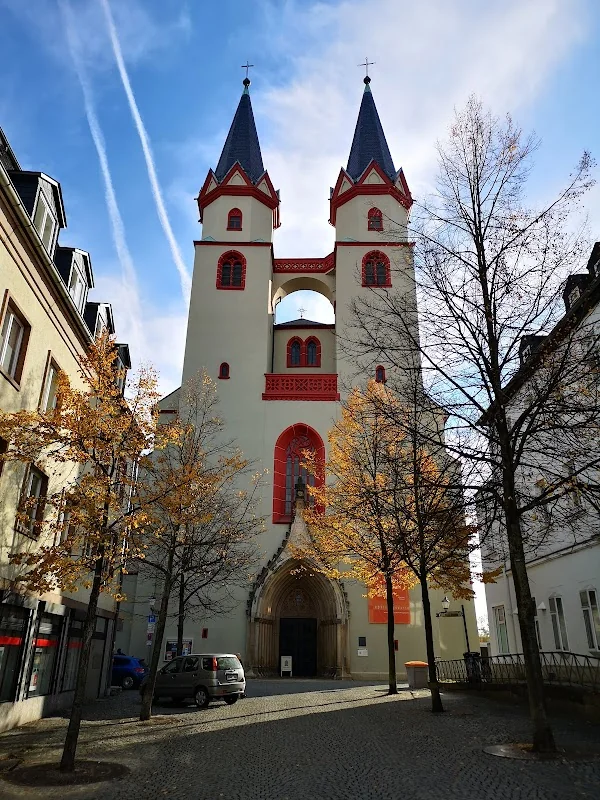
St. Michaelis in Hof is a place where images immediately tell a story. Those who see the church for the first time recognize the two tall towers that, along with the town hall, shape the cityscape on Ludwigstraße, and quickly sense why this house of worship is considered a trademark of the city. Inside, a spacious area opens up, which impressively serves not only for worship services but also for concerts, church music, and quiet visits. The parish of Hof Mitte describes St. Michaelis as the main church of the city and the seat of the dean; the municipal representation refers to its significance as one of the most important churches in the center of Hof. For all those searching for photos, images, and visual impressions, the church is particularly interesting because architecture, light, organ, and windows work together here, offering very different motifs. ([st-michaeliskirche-hof.de](https://st-michaeliskirche-hof.de/unsere-kirchen/kirche-st-michaelis))
St. Michaelis is not a building that can be captured in one sentence. The church connects history, art, and community life in a compact space and shows a different facet from almost every angle. The current building was created according to the plans of the Hof master builder Georg Erhard Saher and combines neo-Gothic, classicist, and Biedermeier elements into a harmonious sacred building. At the same time, the church is deeply inscribed in the city’s history: its origins date back to a chapel around 1230, it was elevated to the Protestant main church in 1536, and was severely damaged in the city fire of 1823 before being rebuilt between 1826 and 1834. Those who know this background see the church with different eyes and understand why it is not only a religious center in Hof but also a historical memory. ([st-michaeliskirche-hof.de](https://st-michaeliskirche-hof.de/unsere-kirchen/kirche-st-michaelis))
Photos, Architecture, and First Impressions
The best motifs of St. Michaelis Hof arise where architecture and spatial feeling come together. Just the view of the facade is worth it: the church stands confidently in the center of the city with its two towers and forms a striking urban landmark together with the town hall. Inside, the space follows a clear order, which is vividly described in the small church tour. There, the path from the entrance area under the organ loft through five pairs of columns and three galleries to the altar is explained. This very structure makes the church so attractive for photos because depth, height, and light interact in a single image. The mix of simple structure and decorative details is also photogenic, as the architecture moves between Biedermeier classicism and emerging neo-Gothic. ([st-michaeliskirche-hof.de](https://st-michaeliskirche-hof.de/unsere-kirchen/kirche-st-michaelis))
Those looking for images of St. Michaelis should not only consider the main entrance and the nave but also include views of the chancel, the galleries, and the organ. The official church tour describes the space as open, bright, and clearly structured. At the center stands the altar with its neo-Gothic high altar by Anselm Sickinger, which was erected in 1866 and depicts the Last Supper scene as a detailed figurative group. The space thrives on contrasts: darker entrance area, wide central aisle, bright chancel, then the view back to the organ. For content with image references, this is ideal because it offers many different motifs without needing to invent anything. The church also offers digital content, a small tour, and even a live falcon cam on its website, allowing the location to be explored virtually. ([st-michaeliskirche-hof.de](https://st-michaeliskirche-hof.de/kleine-kirchenfuehrung))
Another reason why St. Michaelis is so exciting for photos and visual contributions lies in the dimensions of the building. The church is considered the largest Protestant house of worship in Upper Franconia and is described as having about 2,000 seats. Such numbers are not just statistics but explain the impact of the interior: it is large enough to feel festive during events while being structured in such a way that the gaze is continually guided. This is particularly important in church photography because it is not just a single motif that counts, but the atmosphere of the entire place. St. Michaelis provides exactly that: historical substance, spatial breadth, and a strong silhouette in the urban space. ([st-michaeliskirche-hof.de](https://st-michaeliskirche-hof.de/unsere-kirchen/kirche-st-michaelis))
History from the Chapel to the Present Main Church
The history of St. Michaelis is closely linked to the development of Hof. Its origins date back to a chapel around 1230, a time when the present city center looked very different. During the Reformation, the church was elevated to the Protestant main church in 1536 and subsequently shaped the spiritual life of the city. The building experienced several destructions and reconstructions in the following centuries, including the shelling during the siege of 1553, which still leaves cannonballs on church elements as reminders. These traces are important historical markers because they show that St. Michaelis is not to be understood as a static monument but as a building that has actually survived the conflicts and upheavals of the city’s history. ([stiftung-kirchen-bewahren-hof.de](https://www.stiftung-kirchen-bewahren-hof.de/kirchen-im-dekanat-hof/hof-st-michaelis))
Particularly formative was the city fire of 1823, which destroyed large parts of the medieval city center and almost completely annihilated the Michaeliskirche. According to the official account, hardly more than the masonry remained. The subsequent reconstruction between 1826 and 1834 created the current form of the church according to the plans of Georg Erhard Saher from Hof. This reconstruction is crucial for the overall picture of the church because it explains the connection of various styles. Neo-Gothic, classicism, and Biedermeier merge here into a building that is historically rooted but does not appear museum-like. This very mixture makes St. Michaelis one of the most distinctive Protestant churches in Franconia. ([st-michaeliskirche-hof.de](https://st-michaeliskirche-hof.de/unsere-kirchen/kirche-st-michaelis))
The municipal perspective also emphasizes that the church is deeply anchored in the center of Hof. The city describes St. Michaelis as one of four particularly important church buildings in the city center, which are connected like a string of pearls through the center. In this context, the Michaeliskirche is highlighted alongside the town hall as a dominant landmark of Ludwigstraße. The historical significance is thus evident not only in the interior of the church but also in the cityscape. Those exploring Hof encounter St. Michaelis not as an isolated object but as part of a coherent historical space where alleys, squares, and sacred buildings complement each other. ([hof.de](https://www.hof.de/en/live-experience/sights-in-hof/churches))
Stained Glass Windows and Image Programs with Biblical Scenes
Among the most impressive details of St. Michaelis are the stained glass windows. The official church site describes them as beautiful windows that tell various Bible stories. They were created in 1884 based on designs by Professor Dr. Carl Gottfried Pfannschmidt from Berlin and Adolf Müller from Munich; they were produced by the Munich court art institute F.X. Zettler and installed in 1885. Stylistically, they belong to the Nazarene school, which aimed to represent biblical scenes with historical accuracy. Especially for people searching for photos or images of the church, these windows are a central attraction because they combine colors, figures, and narrative. ([st-michaeliskirche-hof.de](https://st-michaeliskirche-hof.de/buntglasfenster))
The windows are not only beautiful but also historically significant. The church site refers to them as a much-envied rarity because such stained glass windows were removed from churches in many places during the 20th century. St. Michaelis has thus preserved a collection that has become rare today. Additionally, the windows on the south side were destroyed in 1945 by a shock wave and later restored to their original state, thanks to the efforts of the action circle for church windows. This mixture of original substance and careful restoration is important for understanding the building: the windows are not mere decoration but part of a vibrant culture of restoration and remembrance. ([st-michaeliskirche-hof.de](https://st-michaeliskirche-hof.de/buntglasfenster))
Content-wise, the windows are also very rich. In the upper area to the left of the altar, one window depicts the Annunciation to Mary, next to it the Christmas window with the birth of Jesus; both date back to 1884. In the lower row, among others, the Wedding at Cana and the Sermon on the Mount with the Beatitudes can be found. On the other side of the chancel, the Easter window with the Resurrection of Jesus, the encounter of the Risen One with Thomas, and other scenes appear. This creates a continuous image program that shapes the church space both theologically and artistically. Therefore, those photographing or describing the windows should not only speak of color but also of their narrative function in the space. ([st-michaeliskirche-hof.de](https://st-michaeliskirche-hof.de/buntglasfenster))
Heidenreich Organ, Music, and Concerts at St. Michaelis
The Heidenreich organ is one of the outstanding features of St. Michaelis Hof. The official organ site explains that it is the largest surviving instrument of the Heidenreich family of organ builders, who have been based in Hof since 1782. After the city fire of 1823, which also destroyed the previous organ, the brothers Georg Christian and Georg Adam Friedrich Heidenreich were commissioned to build a new one. Between 1828 and 1834, an instrument with 34 stops on two manuals and pedal in mechanical action was created. This data is not only technically interesting but also explains why the organ enjoys a special reputation among experts and visitors. ([st-michaeliskirche-hof.de](https://st-michaeliskirche-hof.de/die-heidenreichorgel))
The small church tour adds that the organ today has nearly 4,000 pipes and 63 stops and was further developed technically in 1967 and 2007. Thus, it is not only a historical instrument but also a living concert and liturgical instrument that has evolved with the development of church music. The church itself emphasizes its excellent acoustics and regularly uses the space for concerts of various kinds. For visitors, this means that those who want to not only see St. Michaelis but also hear it experience one of Hof's most important musical venues. The connection of architecture and sound makes the church particularly valuable for culture enthusiasts. ([st-michaeliskirche-hof.de](https://st-michaeliskirche-hof.de/kleine-kirchenfuehrung))
The church musical life is also well organized. The annual program of the parish describes the St. Michaelis choir with around 80 singers; the CVJM brass choir Hof has about 20 active brass players and musically accompanies services, visits to nursing homes, and clinics in over 40 engagements. Additionally, there are organ meditations during market time: from Pentecost to the harvest festival on Saturdays from 10:45 to 11:15 AM and during Advent on all Advent Saturdays at the same time. These formats show that St. Michaelis is not just a monument but a place of regular musical practice. For those looking for concerts or organ events, this is a central point of reference. ([st-michaeliskirche-hof.de](https://st-michaeliskirche-hof.de/system/files/dateien/programm_kirchenmusik_2025.pdf))
The ticket sales and the maintenance of the musical offerings are also specifically regulated. For oratorio performances, the advance sale begins three weeks before the concert date according to the annual program; tickets are available at the overall church administration. A friends' circle has supported the choir work and thus the church musical offerings of the community since 1962. Such facts show that musical culture at St. Michaelis does not arise by chance but is supported by stable structures. This makes the church equally attractive for concertgoers, choir fans, and organ enthusiasts. ([st-michaeliskirche-hof.de](https://st-michaeliskirche-hof.de/system/files/dateien/programm_kirchenmusik_2025.pdf))
Worship Services, Community Life, and Open Church in the Center of Hof
St. Michaelis is known not only for history and music but above all as a vibrant place of worship. The parish Hof Mitte describes that in the two city center churches, different worship and devotion formats are regularly celebrated. On Sundays, services usually take place at 9:30 AM in both churches unless another format is planned. This is complemented by joint services, communion services, international services, and other special forms. For visitors, this is important because one can experience the church not only as a sight but also as an active community space. ([st-michaeliskirche-hof.de](https://st-michaeliskirche-hof.de/angebote-aktivitaeten/gottesdienste))
Particularly interesting are the international services at St. Michaelis. Under the motto Christ connects worlds, the community celebrates with people of different backgrounds and in several languages, including German, English, Farsi, and Ukrainian. This is a strong signal for openness and urban diversity. Additionally, a small snack or church coffee is often offered afterward. The church is thus not only a place of devotion but also of encounter. Those looking for a location with social and cultural outreach will find here a space that goes far beyond mere building use. ([st-michaeliskirche-hof.de](https://st-michaeliskirche-hof.de/angebote-aktivitaeten/gottesdienste))
The community also works with a wide range of groups and formats. The website lists not only the worship services but also offers, activities, groups, and circles, as well as digital content and a YouTube channel. This shows that the church consciously understands its location as a modern communication and meeting place. For SEO and content focused on photos, this is also relevant because it creates further motifs: vibrant community work, musical events, open doors, digital insights, and the interplay of tradition and present. St. Michaelis is thus not only historically significant but also actively present today. ([st-michaeliskirche-hof.de](https://st-michaeliskirche-hof.de/unsere-kirchen/kirche-st-michaelis))
Directions and Parking in the Hof City Center
St. Michaelis is centrally located in Hof and is thus well integrated into the inner-city traffic area. The city of Hof points out in its parking overview more than 2,200 parking spaces in the city center and in the immediate vicinity of the center. The major offerings include, among others, the underground garage at the town hall, the parking garage Altstadt-Passage, and the parking lot Sigmundsgraben. Additionally, individual short-term and disabled parking spaces are mentioned along Ludwigstraße, for example, in front of the Sparkasse branch at the town hall, at the junction of Maxgasse, or on Klosterstraße at the town hall. This is useful for visitors planning a church visit, a tour, or a concert. ([hof.de](https://www.hof.de/bauen-wirtschaft/wirtschaftsstandort-hof/verkehrsanbindung/parken-in-hof))
The location in the city center has the advantage that St. Michaelis is easily accessible in the city center and can be combined with a stroll through Hof. The city’s sightseeing page places the Michaeliskirche among the most significant churches in the city center, which stretch like a string of pearls through the center. For practical planning, this means: those searching for parking should best orient themselves to the central parking garages and underground garages in the city center and continue on foot from there. A direct parking facility at the church itself is not explicitly mentioned in the sources, so the city center parking spaces are the most reliable orientation. ([hof.de](https://www.hof.de/en/live-experience/sights-in-hof/churches))
For people looking for accessibility or short-term options, it is also worth taking a look at the municipal overview. Several disabled parking spaces are listed along Ludwigstraße and in neighboring streets. Thus, St. Michaelis is practically well embedded despite its central location in a dense urban area. For tourist content, this is a valuable point because visitors often seek not only beautiful motifs but also a stress-free arrival. Hof offers a wide selection of parking spaces in the city center and remains accessible compared to many other city centers. ([hof.de](https://www.hof.de/bauen-wirtschaft/wirtschaftsstandort-hof/verkehrsanbindung/parken-in-hof))
St. Michaelis Hof is thus a place for several target groups at once: for people who appreciate photos and architecture, for visitors with historical interest, for music lovers, and for community members seeking a vibrant worship space. The church connects visible presence in the cityscape with a rich interior and active use in everyday life. This very complexity makes it one of the most important addresses in Hof. Those visiting the church experience not only a building but a developed cultural history in a single space. ([st-michaeliskirche-hof.de](https://st-michaeliskirche-hof.de/unsere-kirchen/kirche-st-michaelis))
Sources:
Mehr anzeigenWeniger anzeigen
St. Michaelis Hof | Photos & History
St. Michaelis in Hof is a place where images immediately tell a story. Those who see the church for the first time recognize the two tall towers that, along with the town hall, shape the cityscape on Ludwigstraße, and quickly sense why this house of worship is considered a trademark of the city. Inside, a spacious area opens up, which impressively serves not only for worship services but also for concerts, church music, and quiet visits. The parish of Hof Mitte describes St. Michaelis as the main church of the city and the seat of the dean; the municipal representation refers to its significance as one of the most important churches in the center of Hof. For all those searching for photos, images, and visual impressions, the church is particularly interesting because architecture, light, organ, and windows work together here, offering very different motifs. ([st-michaeliskirche-hof.de](https://st-michaeliskirche-hof.de/unsere-kirchen/kirche-st-michaelis))
St. Michaelis is not a building that can be captured in one sentence. The church connects history, art, and community life in a compact space and shows a different facet from almost every angle. The current building was created according to the plans of the Hof master builder Georg Erhard Saher and combines neo-Gothic, classicist, and Biedermeier elements into a harmonious sacred building. At the same time, the church is deeply inscribed in the city’s history: its origins date back to a chapel around 1230, it was elevated to the Protestant main church in 1536, and was severely damaged in the city fire of 1823 before being rebuilt between 1826 and 1834. Those who know this background see the church with different eyes and understand why it is not only a religious center in Hof but also a historical memory. ([st-michaeliskirche-hof.de](https://st-michaeliskirche-hof.de/unsere-kirchen/kirche-st-michaelis))
Photos, Architecture, and First Impressions
The best motifs of St. Michaelis Hof arise where architecture and spatial feeling come together. Just the view of the facade is worth it: the church stands confidently in the center of the city with its two towers and forms a striking urban landmark together with the town hall. Inside, the space follows a clear order, which is vividly described in the small church tour. There, the path from the entrance area under the organ loft through five pairs of columns and three galleries to the altar is explained. This very structure makes the church so attractive for photos because depth, height, and light interact in a single image. The mix of simple structure and decorative details is also photogenic, as the architecture moves between Biedermeier classicism and emerging neo-Gothic. ([st-michaeliskirche-hof.de](https://st-michaeliskirche-hof.de/unsere-kirchen/kirche-st-michaelis))
Those looking for images of St. Michaelis should not only consider the main entrance and the nave but also include views of the chancel, the galleries, and the organ. The official church tour describes the space as open, bright, and clearly structured. At the center stands the altar with its neo-Gothic high altar by Anselm Sickinger, which was erected in 1866 and depicts the Last Supper scene as a detailed figurative group. The space thrives on contrasts: darker entrance area, wide central aisle, bright chancel, then the view back to the organ. For content with image references, this is ideal because it offers many different motifs without needing to invent anything. The church also offers digital content, a small tour, and even a live falcon cam on its website, allowing the location to be explored virtually. ([st-michaeliskirche-hof.de](https://st-michaeliskirche-hof.de/kleine-kirchenfuehrung))
Another reason why St. Michaelis is so exciting for photos and visual contributions lies in the dimensions of the building. The church is considered the largest Protestant house of worship in Upper Franconia and is described as having about 2,000 seats. Such numbers are not just statistics but explain the impact of the interior: it is large enough to feel festive during events while being structured in such a way that the gaze is continually guided. This is particularly important in church photography because it is not just a single motif that counts, but the atmosphere of the entire place. St. Michaelis provides exactly that: historical substance, spatial breadth, and a strong silhouette in the urban space. ([st-michaeliskirche-hof.de](https://st-michaeliskirche-hof.de/unsere-kirchen/kirche-st-michaelis))
History from the Chapel to the Present Main Church
The history of St. Michaelis is closely linked to the development of Hof. Its origins date back to a chapel around 1230, a time when the present city center looked very different. During the Reformation, the church was elevated to the Protestant main church in 1536 and subsequently shaped the spiritual life of the city. The building experienced several destructions and reconstructions in the following centuries, including the shelling during the siege of 1553, which still leaves cannonballs on church elements as reminders. These traces are important historical markers because they show that St. Michaelis is not to be understood as a static monument but as a building that has actually survived the conflicts and upheavals of the city’s history. ([stiftung-kirchen-bewahren-hof.de](https://www.stiftung-kirchen-bewahren-hof.de/kirchen-im-dekanat-hof/hof-st-michaelis))
Particularly formative was the city fire of 1823, which destroyed large parts of the medieval city center and almost completely annihilated the Michaeliskirche. According to the official account, hardly more than the masonry remained. The subsequent reconstruction between 1826 and 1834 created the current form of the church according to the plans of Georg Erhard Saher from Hof. This reconstruction is crucial for the overall picture of the church because it explains the connection of various styles. Neo-Gothic, classicism, and Biedermeier merge here into a building that is historically rooted but does not appear museum-like. This very mixture makes St. Michaelis one of the most distinctive Protestant churches in Franconia. ([st-michaeliskirche-hof.de](https://st-michaeliskirche-hof.de/unsere-kirchen/kirche-st-michaelis))
The municipal perspective also emphasizes that the church is deeply anchored in the center of Hof. The city describes St. Michaelis as one of four particularly important church buildings in the city center, which are connected like a string of pearls through the center. In this context, the Michaeliskirche is highlighted alongside the town hall as a dominant landmark of Ludwigstraße. The historical significance is thus evident not only in the interior of the church but also in the cityscape. Those exploring Hof encounter St. Michaelis not as an isolated object but as part of a coherent historical space where alleys, squares, and sacred buildings complement each other. ([hof.de](https://www.hof.de/en/live-experience/sights-in-hof/churches))
Stained Glass Windows and Image Programs with Biblical Scenes
Among the most impressive details of St. Michaelis are the stained glass windows. The official church site describes them as beautiful windows that tell various Bible stories. They were created in 1884 based on designs by Professor Dr. Carl Gottfried Pfannschmidt from Berlin and Adolf Müller from Munich; they were produced by the Munich court art institute F.X. Zettler and installed in 1885. Stylistically, they belong to the Nazarene school, which aimed to represent biblical scenes with historical accuracy. Especially for people searching for photos or images of the church, these windows are a central attraction because they combine colors, figures, and narrative. ([st-michaeliskirche-hof.de](https://st-michaeliskirche-hof.de/buntglasfenster))
The windows are not only beautiful but also historically significant. The church site refers to them as a much-envied rarity because such stained glass windows were removed from churches in many places during the 20th century. St. Michaelis has thus preserved a collection that has become rare today. Additionally, the windows on the south side were destroyed in 1945 by a shock wave and later restored to their original state, thanks to the efforts of the action circle for church windows. This mixture of original substance and careful restoration is important for understanding the building: the windows are not mere decoration but part of a vibrant culture of restoration and remembrance. ([st-michaeliskirche-hof.de](https://st-michaeliskirche-hof.de/buntglasfenster))
Content-wise, the windows are also very rich. In the upper area to the left of the altar, one window depicts the Annunciation to Mary, next to it the Christmas window with the birth of Jesus; both date back to 1884. In the lower row, among others, the Wedding at Cana and the Sermon on the Mount with the Beatitudes can be found. On the other side of the chancel, the Easter window with the Resurrection of Jesus, the encounter of the Risen One with Thomas, and other scenes appear. This creates a continuous image program that shapes the church space both theologically and artistically. Therefore, those photographing or describing the windows should not only speak of color but also of their narrative function in the space. ([st-michaeliskirche-hof.de](https://st-michaeliskirche-hof.de/buntglasfenster))
Heidenreich Organ, Music, and Concerts at St. Michaelis
The Heidenreich organ is one of the outstanding features of St. Michaelis Hof. The official organ site explains that it is the largest surviving instrument of the Heidenreich family of organ builders, who have been based in Hof since 1782. After the city fire of 1823, which also destroyed the previous organ, the brothers Georg Christian and Georg Adam Friedrich Heidenreich were commissioned to build a new one. Between 1828 and 1834, an instrument with 34 stops on two manuals and pedal in mechanical action was created. This data is not only technically interesting but also explains why the organ enjoys a special reputation among experts and visitors. ([st-michaeliskirche-hof.de](https://st-michaeliskirche-hof.de/die-heidenreichorgel))
The small church tour adds that the organ today has nearly 4,000 pipes and 63 stops and was further developed technically in 1967 and 2007. Thus, it is not only a historical instrument but also a living concert and liturgical instrument that has evolved with the development of church music. The church itself emphasizes its excellent acoustics and regularly uses the space for concerts of various kinds. For visitors, this means that those who want to not only see St. Michaelis but also hear it experience one of Hof's most important musical venues. The connection of architecture and sound makes the church particularly valuable for culture enthusiasts. ([st-michaeliskirche-hof.de](https://st-michaeliskirche-hof.de/kleine-kirchenfuehrung))
The church musical life is also well organized. The annual program of the parish describes the St. Michaelis choir with around 80 singers; the CVJM brass choir Hof has about 20 active brass players and musically accompanies services, visits to nursing homes, and clinics in over 40 engagements. Additionally, there are organ meditations during market time: from Pentecost to the harvest festival on Saturdays from 10:45 to 11:15 AM and during Advent on all Advent Saturdays at the same time. These formats show that St. Michaelis is not just a monument but a place of regular musical practice. For those looking for concerts or organ events, this is a central point of reference. ([st-michaeliskirche-hof.de](https://st-michaeliskirche-hof.de/system/files/dateien/programm_kirchenmusik_2025.pdf))
The ticket sales and the maintenance of the musical offerings are also specifically regulated. For oratorio performances, the advance sale begins three weeks before the concert date according to the annual program; tickets are available at the overall church administration. A friends' circle has supported the choir work and thus the church musical offerings of the community since 1962. Such facts show that musical culture at St. Michaelis does not arise by chance but is supported by stable structures. This makes the church equally attractive for concertgoers, choir fans, and organ enthusiasts. ([st-michaeliskirche-hof.de](https://st-michaeliskirche-hof.de/system/files/dateien/programm_kirchenmusik_2025.pdf))
Worship Services, Community Life, and Open Church in the Center of Hof
St. Michaelis is known not only for history and music but above all as a vibrant place of worship. The parish Hof Mitte describes that in the two city center churches, different worship and devotion formats are regularly celebrated. On Sundays, services usually take place at 9:30 AM in both churches unless another format is planned. This is complemented by joint services, communion services, international services, and other special forms. For visitors, this is important because one can experience the church not only as a sight but also as an active community space. ([st-michaeliskirche-hof.de](https://st-michaeliskirche-hof.de/angebote-aktivitaeten/gottesdienste))
Particularly interesting are the international services at St. Michaelis. Under the motto Christ connects worlds, the community celebrates with people of different backgrounds and in several languages, including German, English, Farsi, and Ukrainian. This is a strong signal for openness and urban diversity. Additionally, a small snack or church coffee is often offered afterward. The church is thus not only a place of devotion but also of encounter. Those looking for a location with social and cultural outreach will find here a space that goes far beyond mere building use. ([st-michaeliskirche-hof.de](https://st-michaeliskirche-hof.de/angebote-aktivitaeten/gottesdienste))
The community also works with a wide range of groups and formats. The website lists not only the worship services but also offers, activities, groups, and circles, as well as digital content and a YouTube channel. This shows that the church consciously understands its location as a modern communication and meeting place. For SEO and content focused on photos, this is also relevant because it creates further motifs: vibrant community work, musical events, open doors, digital insights, and the interplay of tradition and present. St. Michaelis is thus not only historically significant but also actively present today. ([st-michaeliskirche-hof.de](https://st-michaeliskirche-hof.de/unsere-kirchen/kirche-st-michaelis))
Directions and Parking in the Hof City Center
St. Michaelis is centrally located in Hof and is thus well integrated into the inner-city traffic area. The city of Hof points out in its parking overview more than 2,200 parking spaces in the city center and in the immediate vicinity of the center. The major offerings include, among others, the underground garage at the town hall, the parking garage Altstadt-Passage, and the parking lot Sigmundsgraben. Additionally, individual short-term and disabled parking spaces are mentioned along Ludwigstraße, for example, in front of the Sparkasse branch at the town hall, at the junction of Maxgasse, or on Klosterstraße at the town hall. This is useful for visitors planning a church visit, a tour, or a concert. ([hof.de](https://www.hof.de/bauen-wirtschaft/wirtschaftsstandort-hof/verkehrsanbindung/parken-in-hof))
The location in the city center has the advantage that St. Michaelis is easily accessible in the city center and can be combined with a stroll through Hof. The city’s sightseeing page places the Michaeliskirche among the most significant churches in the city center, which stretch like a string of pearls through the center. For practical planning, this means: those searching for parking should best orient themselves to the central parking garages and underground garages in the city center and continue on foot from there. A direct parking facility at the church itself is not explicitly mentioned in the sources, so the city center parking spaces are the most reliable orientation. ([hof.de](https://www.hof.de/en/live-experience/sights-in-hof/churches))
For people looking for accessibility or short-term options, it is also worth taking a look at the municipal overview. Several disabled parking spaces are listed along Ludwigstraße and in neighboring streets. Thus, St. Michaelis is practically well embedded despite its central location in a dense urban area. For tourist content, this is a valuable point because visitors often seek not only beautiful motifs but also a stress-free arrival. Hof offers a wide selection of parking spaces in the city center and remains accessible compared to many other city centers. ([hof.de](https://www.hof.de/bauen-wirtschaft/wirtschaftsstandort-hof/verkehrsanbindung/parken-in-hof))
St. Michaelis Hof is thus a place for several target groups at once: for people who appreciate photos and architecture, for visitors with historical interest, for music lovers, and for community members seeking a vibrant worship space. The church connects visible presence in the cityscape with a rich interior and active use in everyday life. This very complexity makes it one of the most important addresses in Hof. Those visiting the church experience not only a building but a developed cultural history in a single space. ([st-michaeliskirche-hof.de](https://st-michaeliskirche-hof.de/unsere-kirchen/kirche-st-michaelis))
Sources:
St. Michaelis Hof | Photos & History
St. Michaelis in Hof is a place where images immediately tell a story. Those who see the church for the first time recognize the two tall towers that, along with the town hall, shape the cityscape on Ludwigstraße, and quickly sense why this house of worship is considered a trademark of the city. Inside, a spacious area opens up, which impressively serves not only for worship services but also for concerts, church music, and quiet visits. The parish of Hof Mitte describes St. Michaelis as the main church of the city and the seat of the dean; the municipal representation refers to its significance as one of the most important churches in the center of Hof. For all those searching for photos, images, and visual impressions, the church is particularly interesting because architecture, light, organ, and windows work together here, offering very different motifs. ([st-michaeliskirche-hof.de](https://st-michaeliskirche-hof.de/unsere-kirchen/kirche-st-michaelis))
St. Michaelis is not a building that can be captured in one sentence. The church connects history, art, and community life in a compact space and shows a different facet from almost every angle. The current building was created according to the plans of the Hof master builder Georg Erhard Saher and combines neo-Gothic, classicist, and Biedermeier elements into a harmonious sacred building. At the same time, the church is deeply inscribed in the city’s history: its origins date back to a chapel around 1230, it was elevated to the Protestant main church in 1536, and was severely damaged in the city fire of 1823 before being rebuilt between 1826 and 1834. Those who know this background see the church with different eyes and understand why it is not only a religious center in Hof but also a historical memory. ([st-michaeliskirche-hof.de](https://st-michaeliskirche-hof.de/unsere-kirchen/kirche-st-michaelis))
Photos, Architecture, and First Impressions
The best motifs of St. Michaelis Hof arise where architecture and spatial feeling come together. Just the view of the facade is worth it: the church stands confidently in the center of the city with its two towers and forms a striking urban landmark together with the town hall. Inside, the space follows a clear order, which is vividly described in the small church tour. There, the path from the entrance area under the organ loft through five pairs of columns and three galleries to the altar is explained. This very structure makes the church so attractive for photos because depth, height, and light interact in a single image. The mix of simple structure and decorative details is also photogenic, as the architecture moves between Biedermeier classicism and emerging neo-Gothic. ([st-michaeliskirche-hof.de](https://st-michaeliskirche-hof.de/unsere-kirchen/kirche-st-michaelis))
Those looking for images of St. Michaelis should not only consider the main entrance and the nave but also include views of the chancel, the galleries, and the organ. The official church tour describes the space as open, bright, and clearly structured. At the center stands the altar with its neo-Gothic high altar by Anselm Sickinger, which was erected in 1866 and depicts the Last Supper scene as a detailed figurative group. The space thrives on contrasts: darker entrance area, wide central aisle, bright chancel, then the view back to the organ. For content with image references, this is ideal because it offers many different motifs without needing to invent anything. The church also offers digital content, a small tour, and even a live falcon cam on its website, allowing the location to be explored virtually. ([st-michaeliskirche-hof.de](https://st-michaeliskirche-hof.de/kleine-kirchenfuehrung))
Another reason why St. Michaelis is so exciting for photos and visual contributions lies in the dimensions of the building. The church is considered the largest Protestant house of worship in Upper Franconia and is described as having about 2,000 seats. Such numbers are not just statistics but explain the impact of the interior: it is large enough to feel festive during events while being structured in such a way that the gaze is continually guided. This is particularly important in church photography because it is not just a single motif that counts, but the atmosphere of the entire place. St. Michaelis provides exactly that: historical substance, spatial breadth, and a strong silhouette in the urban space. ([st-michaeliskirche-hof.de](https://st-michaeliskirche-hof.de/unsere-kirchen/kirche-st-michaelis))
History from the Chapel to the Present Main Church
The history of St. Michaelis is closely linked to the development of Hof. Its origins date back to a chapel around 1230, a time when the present city center looked very different. During the Reformation, the church was elevated to the Protestant main church in 1536 and subsequently shaped the spiritual life of the city. The building experienced several destructions and reconstructions in the following centuries, including the shelling during the siege of 1553, which still leaves cannonballs on church elements as reminders. These traces are important historical markers because they show that St. Michaelis is not to be understood as a static monument but as a building that has actually survived the conflicts and upheavals of the city’s history. ([stiftung-kirchen-bewahren-hof.de](https://www.stiftung-kirchen-bewahren-hof.de/kirchen-im-dekanat-hof/hof-st-michaelis))
Particularly formative was the city fire of 1823, which destroyed large parts of the medieval city center and almost completely annihilated the Michaeliskirche. According to the official account, hardly more than the masonry remained. The subsequent reconstruction between 1826 and 1834 created the current form of the church according to the plans of Georg Erhard Saher from Hof. This reconstruction is crucial for the overall picture of the church because it explains the connection of various styles. Neo-Gothic, classicism, and Biedermeier merge here into a building that is historically rooted but does not appear museum-like. This very mixture makes St. Michaelis one of the most distinctive Protestant churches in Franconia. ([st-michaeliskirche-hof.de](https://st-michaeliskirche-hof.de/unsere-kirchen/kirche-st-michaelis))
The municipal perspective also emphasizes that the church is deeply anchored in the center of Hof. The city describes St. Michaelis as one of four particularly important church buildings in the city center, which are connected like a string of pearls through the center. In this context, the Michaeliskirche is highlighted alongside the town hall as a dominant landmark of Ludwigstraße. The historical significance is thus evident not only in the interior of the church but also in the cityscape. Those exploring Hof encounter St. Michaelis not as an isolated object but as part of a coherent historical space where alleys, squares, and sacred buildings complement each other. ([hof.de](https://www.hof.de/en/live-experience/sights-in-hof/churches))
Stained Glass Windows and Image Programs with Biblical Scenes
Among the most impressive details of St. Michaelis are the stained glass windows. The official church site describes them as beautiful windows that tell various Bible stories. They were created in 1884 based on designs by Professor Dr. Carl Gottfried Pfannschmidt from Berlin and Adolf Müller from Munich; they were produced by the Munich court art institute F.X. Zettler and installed in 1885. Stylistically, they belong to the Nazarene school, which aimed to represent biblical scenes with historical accuracy. Especially for people searching for photos or images of the church, these windows are a central attraction because they combine colors, figures, and narrative. ([st-michaeliskirche-hof.de](https://st-michaeliskirche-hof.de/buntglasfenster))
The windows are not only beautiful but also historically significant. The church site refers to them as a much-envied rarity because such stained glass windows were removed from churches in many places during the 20th century. St. Michaelis has thus preserved a collection that has become rare today. Additionally, the windows on the south side were destroyed in 1945 by a shock wave and later restored to their original state, thanks to the efforts of the action circle for church windows. This mixture of original substance and careful restoration is important for understanding the building: the windows are not mere decoration but part of a vibrant culture of restoration and remembrance. ([st-michaeliskirche-hof.de](https://st-michaeliskirche-hof.de/buntglasfenster))
Content-wise, the windows are also very rich. In the upper area to the left of the altar, one window depicts the Annunciation to Mary, next to it the Christmas window with the birth of Jesus; both date back to 1884. In the lower row, among others, the Wedding at Cana and the Sermon on the Mount with the Beatitudes can be found. On the other side of the chancel, the Easter window with the Resurrection of Jesus, the encounter of the Risen One with Thomas, and other scenes appear. This creates a continuous image program that shapes the church space both theologically and artistically. Therefore, those photographing or describing the windows should not only speak of color but also of their narrative function in the space. ([st-michaeliskirche-hof.de](https://st-michaeliskirche-hof.de/buntglasfenster))
Heidenreich Organ, Music, and Concerts at St. Michaelis
The Heidenreich organ is one of the outstanding features of St. Michaelis Hof. The official organ site explains that it is the largest surviving instrument of the Heidenreich family of organ builders, who have been based in Hof since 1782. After the city fire of 1823, which also destroyed the previous organ, the brothers Georg Christian and Georg Adam Friedrich Heidenreich were commissioned to build a new one. Between 1828 and 1834, an instrument with 34 stops on two manuals and pedal in mechanical action was created. This data is not only technically interesting but also explains why the organ enjoys a special reputation among experts and visitors. ([st-michaeliskirche-hof.de](https://st-michaeliskirche-hof.de/die-heidenreichorgel))
The small church tour adds that the organ today has nearly 4,000 pipes and 63 stops and was further developed technically in 1967 and 2007. Thus, it is not only a historical instrument but also a living concert and liturgical instrument that has evolved with the development of church music. The church itself emphasizes its excellent acoustics and regularly uses the space for concerts of various kinds. For visitors, this means that those who want to not only see St. Michaelis but also hear it experience one of Hof's most important musical venues. The connection of architecture and sound makes the church particularly valuable for culture enthusiasts. ([st-michaeliskirche-hof.de](https://st-michaeliskirche-hof.de/kleine-kirchenfuehrung))
The church musical life is also well organized. The annual program of the parish describes the St. Michaelis choir with around 80 singers; the CVJM brass choir Hof has about 20 active brass players and musically accompanies services, visits to nursing homes, and clinics in over 40 engagements. Additionally, there are organ meditations during market time: from Pentecost to the harvest festival on Saturdays from 10:45 to 11:15 AM and during Advent on all Advent Saturdays at the same time. These formats show that St. Michaelis is not just a monument but a place of regular musical practice. For those looking for concerts or organ events, this is a central point of reference. ([st-michaeliskirche-hof.de](https://st-michaeliskirche-hof.de/system/files/dateien/programm_kirchenmusik_2025.pdf))
The ticket sales and the maintenance of the musical offerings are also specifically regulated. For oratorio performances, the advance sale begins three weeks before the concert date according to the annual program; tickets are available at the overall church administration. A friends' circle has supported the choir work and thus the church musical offerings of the community since 1962. Such facts show that musical culture at St. Michaelis does not arise by chance but is supported by stable structures. This makes the church equally attractive for concertgoers, choir fans, and organ enthusiasts. ([st-michaeliskirche-hof.de](https://st-michaeliskirche-hof.de/system/files/dateien/programm_kirchenmusik_2025.pdf))
Worship Services, Community Life, and Open Church in the Center of Hof
St. Michaelis is known not only for history and music but above all as a vibrant place of worship. The parish Hof Mitte describes that in the two city center churches, different worship and devotion formats are regularly celebrated. On Sundays, services usually take place at 9:30 AM in both churches unless another format is planned. This is complemented by joint services, communion services, international services, and other special forms. For visitors, this is important because one can experience the church not only as a sight but also as an active community space. ([st-michaeliskirche-hof.de](https://st-michaeliskirche-hof.de/angebote-aktivitaeten/gottesdienste))
Particularly interesting are the international services at St. Michaelis. Under the motto Christ connects worlds, the community celebrates with people of different backgrounds and in several languages, including German, English, Farsi, and Ukrainian. This is a strong signal for openness and urban diversity. Additionally, a small snack or church coffee is often offered afterward. The church is thus not only a place of devotion but also of encounter. Those looking for a location with social and cultural outreach will find here a space that goes far beyond mere building use. ([st-michaeliskirche-hof.de](https://st-michaeliskirche-hof.de/angebote-aktivitaeten/gottesdienste))
The community also works with a wide range of groups and formats. The website lists not only the worship services but also offers, activities, groups, and circles, as well as digital content and a YouTube channel. This shows that the church consciously understands its location as a modern communication and meeting place. For SEO and content focused on photos, this is also relevant because it creates further motifs: vibrant community work, musical events, open doors, digital insights, and the interplay of tradition and present. St. Michaelis is thus not only historically significant but also actively present today. ([st-michaeliskirche-hof.de](https://st-michaeliskirche-hof.de/unsere-kirchen/kirche-st-michaelis))
Directions and Parking in the Hof City Center
St. Michaelis is centrally located in Hof and is thus well integrated into the inner-city traffic area. The city of Hof points out in its parking overview more than 2,200 parking spaces in the city center and in the immediate vicinity of the center. The major offerings include, among others, the underground garage at the town hall, the parking garage Altstadt-Passage, and the parking lot Sigmundsgraben. Additionally, individual short-term and disabled parking spaces are mentioned along Ludwigstraße, for example, in front of the Sparkasse branch at the town hall, at the junction of Maxgasse, or on Klosterstraße at the town hall. This is useful for visitors planning a church visit, a tour, or a concert. ([hof.de](https://www.hof.de/bauen-wirtschaft/wirtschaftsstandort-hof/verkehrsanbindung/parken-in-hof))
The location in the city center has the advantage that St. Michaelis is easily accessible in the city center and can be combined with a stroll through Hof. The city’s sightseeing page places the Michaeliskirche among the most significant churches in the city center, which stretch like a string of pearls through the center. For practical planning, this means: those searching for parking should best orient themselves to the central parking garages and underground garages in the city center and continue on foot from there. A direct parking facility at the church itself is not explicitly mentioned in the sources, so the city center parking spaces are the most reliable orientation. ([hof.de](https://www.hof.de/en/live-experience/sights-in-hof/churches))
For people looking for accessibility or short-term options, it is also worth taking a look at the municipal overview. Several disabled parking spaces are listed along Ludwigstraße and in neighboring streets. Thus, St. Michaelis is practically well embedded despite its central location in a dense urban area. For tourist content, this is a valuable point because visitors often seek not only beautiful motifs but also a stress-free arrival. Hof offers a wide selection of parking spaces in the city center and remains accessible compared to many other city centers. ([hof.de](https://www.hof.de/bauen-wirtschaft/wirtschaftsstandort-hof/verkehrsanbindung/parken-in-hof))
St. Michaelis Hof is thus a place for several target groups at once: for people who appreciate photos and architecture, for visitors with historical interest, for music lovers, and for community members seeking a vibrant worship space. The church connects visible presence in the cityscape with a rich interior and active use in everyday life. This very complexity makes it one of the most important addresses in Hof. Those visiting the church experience not only a building but a developed cultural history in a single space. ([st-michaeliskirche-hof.de](https://st-michaeliskirche-hof.de/unsere-kirchen/kirche-st-michaelis))
Sources:
Frequently Asked Questions
Reviews
No reviews found