
Berliner Ensemble
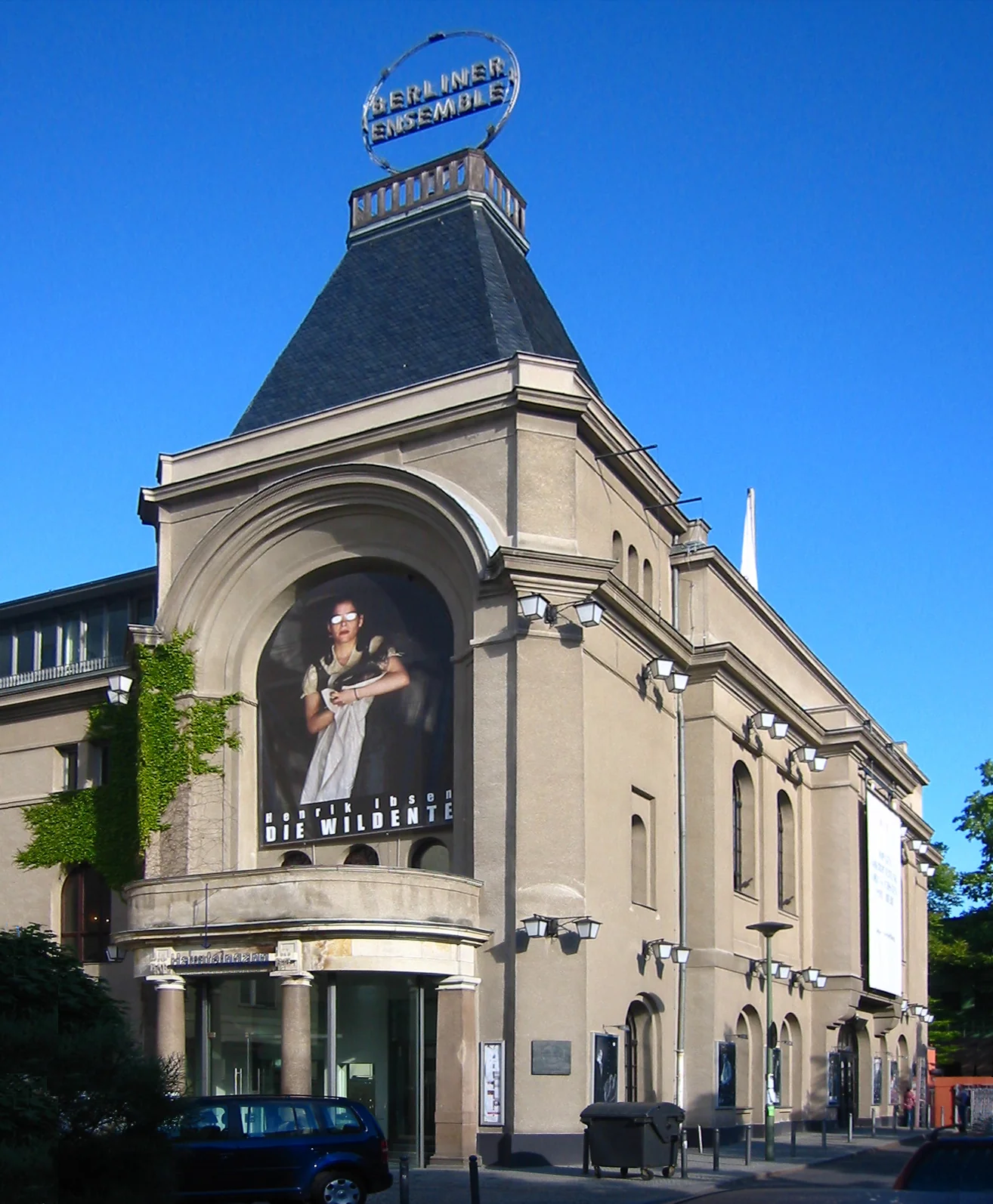
Image from Wikipedia
Image from Wikipedia
Berliner Ensemble – The Stage That Negotiates Society
A Theatre That Made History – and Shapes the Present
The Berliner Ensemble is one of the most influential stages in the German-speaking world. Founded in 1949 by Bertolt Brecht and Helene Weigel, the theater continues to stand for political theater, precise ensemble work, and an uncompromising engagement with reality. Since 1954, the ensemble has performed at the historic Theater am Schiffbauerdamm – the very place where The Threepenny Opera premiered in 1928. The artistic legacy of a theater is measured not in chart hits, but in productions, impact, and discourse: it is this artistic development, the stage presence of a strong ensemble, and its radiance in culture and society that make the Berliner Ensemble unique.
With the beginning of Oliver Reese's artistic directorship (season 2017/18), contemporary drama, new materials, and fresh voices have come more into focus – without departing from the historically rooted DNA of the Brecht tradition. The result is a repertoire that reexamines classics, presents contemporary drama with vitality, and engages audiences with great artistic authority in the debates of our time.
Biography and Founding: Brecht's Laboratory for Epic Theatre
The story of the Berliner Ensemble begins in January 1949 in East Berlin. From a split of the Deutsches Theater, Brecht and Helene Weigel shaped their own company that followed his ideas of epic theatre. Precise rehearsal work, dramaturgical model books, and a strong collective handwriting characterized these early days. In 1954, the company found a permanent home at Schiffbauerdamm – an architectural gem from 1892 that has since become inextricably linked with the Berliner Ensemble brand. After Brecht's death in 1956, Helene Weigel continued to lead the theater along a clear artistic path until 1971.
The artistic development during the following years remained dynamic: Ruth Berghaus introduced new impulses from 1971 with visually striking, experimental interpretations, and Manfred Wekwerth redefined the stage from 1977 in the tension between tradition and modernity. With Heiner Müller, the ensemble gained a director in the 1990s whose radical thought and precise arrangements broke open the Brecht universe for postmodernism and garnered international reception.
The House at Schiffbauerdamm: Place, Myth, Workshop
The Theater am Schiffbauerdamm tells the history of theater. Here, architecture, history, and the present merge into an artistic powerhouse. The stage is considered a laboratory where directorial handwriting, acting styles, and aesthetics clash. Central to this is ensemble work: a permanent, cohesive collective of actors that deepens role profiles, refines nuances, and develops a unique scenic musicality. This interplay is the "discography" of the house: productions, revivals, reruns – a catalog of works in stage images, roles, and conceptual thoughts.
The Berliner Ensemble carefully documents its productions, maintains dramaturgical reflection, and utilizes digital formats to make rehearsal processes, compositions, and scenic arrangements visible. Thus, a canon of the present is created, which is continuously developed during the theater seasons.
Artistic Directorship of Oliver Reese: Contemporary Drama, Handwriting, and Social Relevance
Since 2017/18, artistic director Oliver Reese has emphasized the focus on current topics. Directorial positions such as Frank Castorf, Barrie Kosky, Mateja Koležnik, Luk Perceval, or Ersan Mondtag create a curated diversity of handwriting. In this programming, classic materials connect with contemporary narrative economics, precisely composed scenes with pointed visual concepts. The artistic management responds to societal upheavals with productions that explore questions of identity, democracy, freedom, and responsibility.
The results reflect the reception: record attendance, a growing, diverse audience, and proof that theater functions as a public resonating space. The stage acts as a discourse machine – aesthetically advanced, critically focused, and yet close to the audience.
Repertoire Highlights: From Brecht to Bowie – Theater as a Resonant Image
The current dramaturgy spans classics and the contemporary: Brecht's works like The Threepenny Opera encounter Waiting for Godot, major social novels are adapted for the stage, and pop iconographies – such as in the Bowie homage “Heroes” – are theatrically translated. Even politically charged evenings like 1984 or thematic series with discursive accompanying programs mark the spectrum. For the second half of the 2025/26 season, the house announces new premieres; a production of Antigone will kick off the year 2026 and again highlights the dialogical intertwining of tradition and modernity.
The dramaturgical arrangement of these works showcases the expertise of the house: text versions, musical layers, spatial and light composition, and precise acting styles coalesce into pointed theater evenings. The production here is more than craftsmanship – it is aesthetic research at the open heart of the present.
Theater Seasons, Key Figures, and Recent Developments
In the 2024/25 season, the Berliner Ensemble opened with prominent direction, presenting nine premieres across all three venues from September to December. A technical incident – a water damage in the Main House on April 5 – was swiftly overcome; since mid-April, performances have returned to normal. Until March, the season recorded an average attendance of 97 percent – a strong signal of the program's appeal.
The house will continue this line into 2025/26: new materials, sharp classics, discursive series. In addition to premieres, the ensemble is focusing on backstage insights, audio introductions, and discussion formats to engage the audience more deeply in the processes of composition and arrangement. An award – the Helene Weigel Theater Prize – acknowledges artistic excellence and fosters talent.
Ensemble Culture: Actors, Handwriting, Hands-On Aesthetics
The core of the house is the permanent ensemble with over 20 actors. Sustainable role work, trust, and a willingness to take risks shape the rehearsal culture. The artistic development is reflected in long-term role stories, the precision of the performance, and stylistic diversity: from sparse, reduced acting to expressive approaches, from meticulous timing to performative positioning.
The stage continuously collaborates with influential directors. From the friction of various handwritings arises a program that knows theater history, reflects the present, and tests the future. This authority is derived from experience, expertise, and a clear artistic compass.
Critical Reception and Cultural Influence
Internationally, the Berliner Ensemble is regarded as a historically rich yet constantly renewed institution. Critics appreciate its ability to intertwine political and aesthetic questions at a high level. Its reputation stems from the Brecht legacy, the Heiner Müller era, and current repertoire successes. Among leading German-language stages, the house asserts a clear, independent voice – a touchstone for theater fans, scholars, and critics.
Culturally, the Berliner Ensemble impacts far beyond the capital: guest performances, invitations, and collaborations connect Berlin with European theater landscapes. Digitally, the house expands its reach – via video content, audio introductions, and editorial magazines that make artistic processes transparent and strengthen the community.
Formats and Digital Presence: Media Library, Audio, Discourse
With a well-stocked media library, podcasts, and audio introductions, the Berliner Ensemble opens rehearsal spaces and aesthetic decisions to the audience. Discussion series – focused on philosophical, legal, or political topics – frame productions and deepen the discourse. This strengthens the trustworthiness of the house: art is not only shown but explained, questioned, and opened to debate.
This transparency – from backstage reports to insights into scenography, music dramaturgy, and production processes – meets the highest EEAT standards: Experience (lived stage practice), Expertise (artistic and technical details), Authority (institution and reception), and Trustworthiness (open communication, verifiable facts).
Style Studies: Epic Theatre in the 21st Century
The stylistic grammar of the Berliner Ensemble is based on Brecht and has been further developed with a contemporary awareness. Estrangement, narrative positions, and musical-rhythmic arrangements still serve as effective instruments to illuminate power relations, economics, and social dynamics. In the 21st century, these means are newly combined with contemporary aesthetics – projections, sound design, pop cultural references.
The composition of an evening follows a dramaturgical score: scene, light, music, text, body – everything is precisely arranged. This creates a “stage music” of thought, which aims less at melody than at shifts in attitude. Theater becomes a resonating space where audiences take a stand.
Voices of the Fans
Fan reactions clearly show: The Berliner Ensemble captivates people worldwide. On Instagram, comments read roughly: “Your rehearsal clips really create excitement for the evening!” On YouTube, one says: “Strong ensemble performance – rarely seen such intelligent theater moments.” On Facebook, a visitor expresses: “Your repertoire keeps the city in motion – keep it up!” These responses reflect what is experienced in the hall: precision, attitude, passion.
Conclusion: Why You Should Experience the Berliner Ensemble Now
Those who understand theater as contemporary art will find a home at the Berliner Ensemble. The house negotiates central societal questions in artistically sharpened forms – with an ensemble that penetrates characters, with directorial handwriting that challenges viewing habits, and with a programming that is aware of traditions and dares to envision the future. This is theater with attitude, sound, and intellect.
The best impression comes live: a hall that breathes; an ensemble that draws sharply; an evening that resonates. Whether classics or world premieres – the Berliner Ensemble proves how relevant the stage can be today. Be sure to secure tickets and experience the stage at Schiffbauerdamm as a vibrant place.
Official Channels of Berliner Ensemble:
- Instagram: https://www.instagram.com/blnensemble
- Facebook: https://de-de.facebook.com/blnensemble
- YouTube: https://www.youtube.com/channel/UCPvUcbyaHO5g32y8Iic6qOw
- Spotify: No official profile found
- TikTok: No official profile found
Sources:
- Berliner Ensemble – Official Website
- Berliner Ensemble – Profile (House Profile, Ensemble, Program Profile)
- Berliner Ensemble – Season 2024/25 (Premieres, Attendance, Notes)
- Wikipedia – Berliner Ensemble
- Encyclopaedia Britannica – Berliner Ensemble
- YouTube – Berliner Ensemble (official channel)
- X/Twitter – @blnensemble (official account)
- SoundCloud – Berliner Ensemble (Audio Introductions, Discussions)
- Wikipedia: Image and Text Source
Upcoming Events
Felix Krull – Hour of the Impostors
Thomas Mann meets stage magic: Felix Krull at the Fürth City Theater promises transformation, wit, and brilliance on a large stage. On 01.07.2026 starting at 7:30 PM. #Theater #Fürth
Berliner Ensemble - Stranger than the Moon
See 'Stranger than the Moon' by the Berliner Ensemble at the Kissinger Sommer 2026 in Bad Kissingen.
Berliner Ensemble: Stranger than the Moon (Guest performance)
Hear Brecht anew at the Kurtheater Bad Kissingen: Stranger than the Moon with songs by Eisler and compelling staging. Tue, 07.07.2026, 19:30. Intense stage experience – secure your seats now! #BrechtLive
Berliner Ensemble with Stranger than the Moon
Brecht in music, word, and stage: The Berliner Ensemble performs with Stranger than the Moon at the Kurtheater Bad Kissingen. 07.07.2026, from €58. #Theater
Brecht Evening at the Kurtheater Bad Kissingen
The Berliner Ensemble presents Brecht's songs and texts in the historic Kurtheater Bad Kissingen.

Berliner Ensemble: Stranger than the Moon
Experience Brecht's life in songs at the Kurtheater Bad Kissingen: strong voices, clear direction, 1h50 without a break. On 08.07.2026, 19:30. Intense, sensual, immediate – secure your seats now. #KissingerSommer
Berliner Ensemble with Stranger than the Moon
A Brecht Evening Full of Music, Language, and Tension at the Kurtheater Bad Kissingen: The Berliner Ensemble presents Stranger than the Moon on 08.07.2026 on stage. #Theater
Berliner Ensemble: Stranger than the Moon
Experience Brecht's life as a musical-dramatic collage at Kurtheater Bad Kissingen.
ART by Yasmina Reza at the Theater Duisburg
A white painting ignites an evening full of wit, friction, and abysses at the Theater Duisburg. ART with the Berlin Ensemble on 10/13/2026. #Theater