
David (Michelangelo)
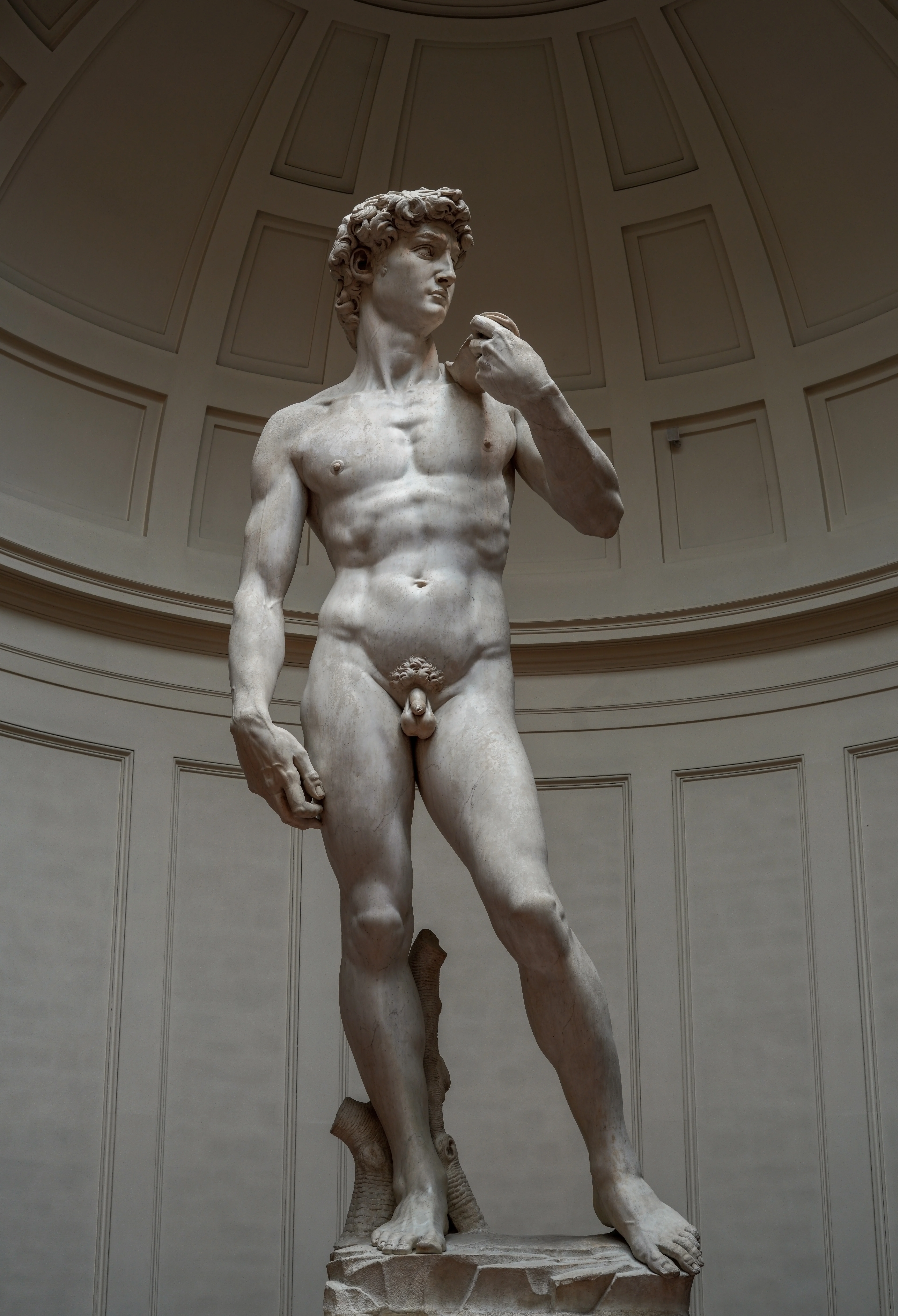
Image from Wikipedia
Image from Wikipedia
David by Michelangelo: The Heroic Renaissance Icon Between Calm, Tension, and Political Symbolism
A Masterpiece of the High Renaissance that Sets Standards to This Day
The David by Michelangelo is much more than a statue: it is a key work of European art history, a monumental sculpture of the High Renaissance, and a globally admired symbol of artistic perfection. Created between 1501 and 1504 in Florence from a single block of marble, the figure combines technical brilliance with psychological presence and a form language that has influenced generations of sculptors. The original has been housed in the Galleria dell’Accademia in Florence since 1873; the statue measures 5.16 meters and weighs 5660 kilograms. ([britannica.com](https://www.britannica.com/topic/David-sculpture?utm_source=openai))
Michelangelo portrays David not in the moment of victory, but in the concentrated tension before the fight against Goliath. This is where the greatness of the work lies: the sculpture condenses expectation, determination, and inner strength into a composition that appears both idealized and human. As a symbol of the Republic of Florence, David was placed in 1504 in the Piazza della Signoria, where it was interpreted as a political and cultural statement against external threats. ([britannica.com](https://www.britannica.com/topic/David-sculpture?utm_source=openai))
Creation: From a Problematic Block of Marble to Art History
The creation of David is one of the most fascinating production stories of the Renaissance. The marble block had already been worked on by other sculptors and then abandoned before Michelangelo received the commission in 1501 to carve an oversized figure from it. This challenging starting point highlights the achievement: from damaged material, Michelangelo developed a sculpture of extraordinary coherence and presence. ([britannica.com](https://www.britannica.com/topic/David-sculpture?utm_source=openai))
Work began in September 1501, and by 1504 the piece was completed. Contemporary and later evaluations highlighted the Florentine authorities' decision to display the statue not on the dome roof but in a central public space. The current positioning in the museum preserves the original, while copies in Florence recall its historical placement. ([britannica.com](https://www.britannica.com/story/how-a-rejected-block-of-marble-became-the-worlds-most-famous-statue?utm_source=openai))
Michelangelo as a Sculptor: Virtuosity, Anatomy, and Monumentality
Michelangelo is regarded as one of the most influential figures of the Italian Renaissance, renowned for his sculpture, painting, and architecture. Britannica describes him as an artist who gained early recognition with works such as the Pietà and David and expanded his stature with the ceiling frescoes of the Sistine Chapel. This versatility explains why David should not be viewed in isolation, but as part of a body of work that reflects the artist’s claim to maximum formal and intellectual control. ([britannica.com](https://www.britannica.com/biography/Michelangelo?utm_source=openai))
Technically, the statue impresses with its compositional balance and masterful command of the human body. The figure appears tense but not rigid; Michelangelo employs nuanced weight distribution and a controlled body axis to make energy visible in stillness. Britannica emphasizes that David particularly showcases Michelangelo's virtuosity, as a 4-meter tall figure was carved from the damaged block, whose influence radiated into the Baroque period. ([britannica.com](https://www.britannica.com/art/Western-sculpture/Michelangelo-and-the-High-Renaissance?utm_source=openai))
Iconography and Interpretation: The Moment Before Decision
David appears in Michelangelo's work not as a triumphant hero bearing the spoils of victory, but as a youthful, concentrated figure at the moment of highest mental focus. The traditional iconography is condensed in favor of a psychological moment: no visible signs of battle, no demonstrative pose, just taut attention. This reduction enhances the impact of the sculpture and opens it up to political, religious, and humanistic interpretations. ([britannica.com](https://www.britannica.com/story/how-a-rejected-block-of-marble-became-the-worlds-most-famous-statue?utm_source=openai))
This interpretation made David particularly significant for Florence. In the early modern era, the city understood itself as a politically threatened republic, and the figure of David served as an image of protection, vigilance, and the inferior but victorious strength. The location in front of the Palazzo Vecchio connected the work with the civic identity of the city and elevated it beyond a purely religious context. ([britannica.com](https://www.britannica.com/topic/David-sculpture?utm_source=openai))
Historical Impact: From Florentine Symbol to World Icon
David quickly became a reference point in art history. Contemporaries recognized the extraordinary quality of the work, and later a canon developed around Michelangelo, making him one of the most documented artists of his era. The transfer of the statue to the museum in 1873 underscores the transformation from a public symbol of power to a protected national and international cultural heritage. ([britannica.com](https://www.britannica.com/topic/David-sculpture?utm_source=openai))
The aftermath extends far beyond Florence. Britannica notes that David had a lasting influence on sculpture and particularly impacted later Baroque artists. The contrapposto as an expression of dynamic stillness is often discussed in European art history in connection with Michelangelo's work; David remains an exemplary reference point for the depiction of body, tension, and presence. ([britannica.com](https://www.britannica.com/art/contrapposto?utm_source=openai))
Reception in Art History and Cultural Critique
The art historical reception of David revolves around three major themes: technical mastery, political symbolism, and human greatness at the moment of decision. Cultural and art historical sources emphasize the statue as the epitome of Renaissance aesthetics and as a work that redefines the concept of monumental sculpture. The international fame of the work is also reflected in its almost ubiquitous presence in depictions of Michelangelo. ([britannica.com](https://www.britannica.com/art/Western-sculpture/Michelangelo-and-the-High-Renaissance?utm_source=openai))
Modern perspectives highlight the tension between ideal and reality. The body appears powerful yet unusually concentrated and almost introverted; Michelangelo does not create a mere heroic body, but an idea of self-control. This ambiguity keeps David alive to this day, as it not only displays beauty but also psychological depth and historical resonance. ([britannica.com](https://www.britannica.com/story/how-a-rejected-block-of-marble-became-the-worlds-most-famous-statue?utm_source=openai))
Cultural Influence: Why David Continues to Fascinate
The cultural influence of David lies in its ability to address multiple levels simultaneously. As a work of art, it represents the perfection of the Renaissance; as a political symbol, it embodies republican vigilance; as a museum object, it remains a global icon. Few sculptures combine formal rigor, emotional concentration, and historical radiance as convincingly. ([britannica.com](https://www.britannica.com/topic/David-sculpture?utm_source=openai))
For art lovers, David is a must-see when engaging with Michelangelo, for travelers, it is a highlight in Florence, and for cultural historians, it serves as a reference work of European sculpture. Its fame rests not on mere size, but on the precision of its idea: the decisive moment is transformed into marble, without excess pathos, but with maximum inner tension. This is what makes the sculpture immortal. ([britannica.com](https://www.britannica.com/story/how-a-rejected-block-of-marble-became-the-worlds-most-famous-statue?utm_source=openai))
Conclusion: An Eternal Moment in Marble
Michelangelo's David remains captivating because it encapsulates beauty, power, vulnerability, and determination in a single figure. It is a masterpiece that not only wants to be viewed but read: as art, as history, and as a political image of its time. Anyone visiting Florence should experience this David live, as no photo or reproduction can fully capture the impact of its grandeur, tranquility, and inner tension. ([britannica.com](https://www.britannica.com/topic/David-sculpture?utm_source=openai))
Official Channels of David (Michelangelo):
- Instagram: No official profile found
- Facebook: No official profile found
- YouTube: No official profile found
- Spotify: No official profile found
- TikTok: No official profile found