
Harald Jähner
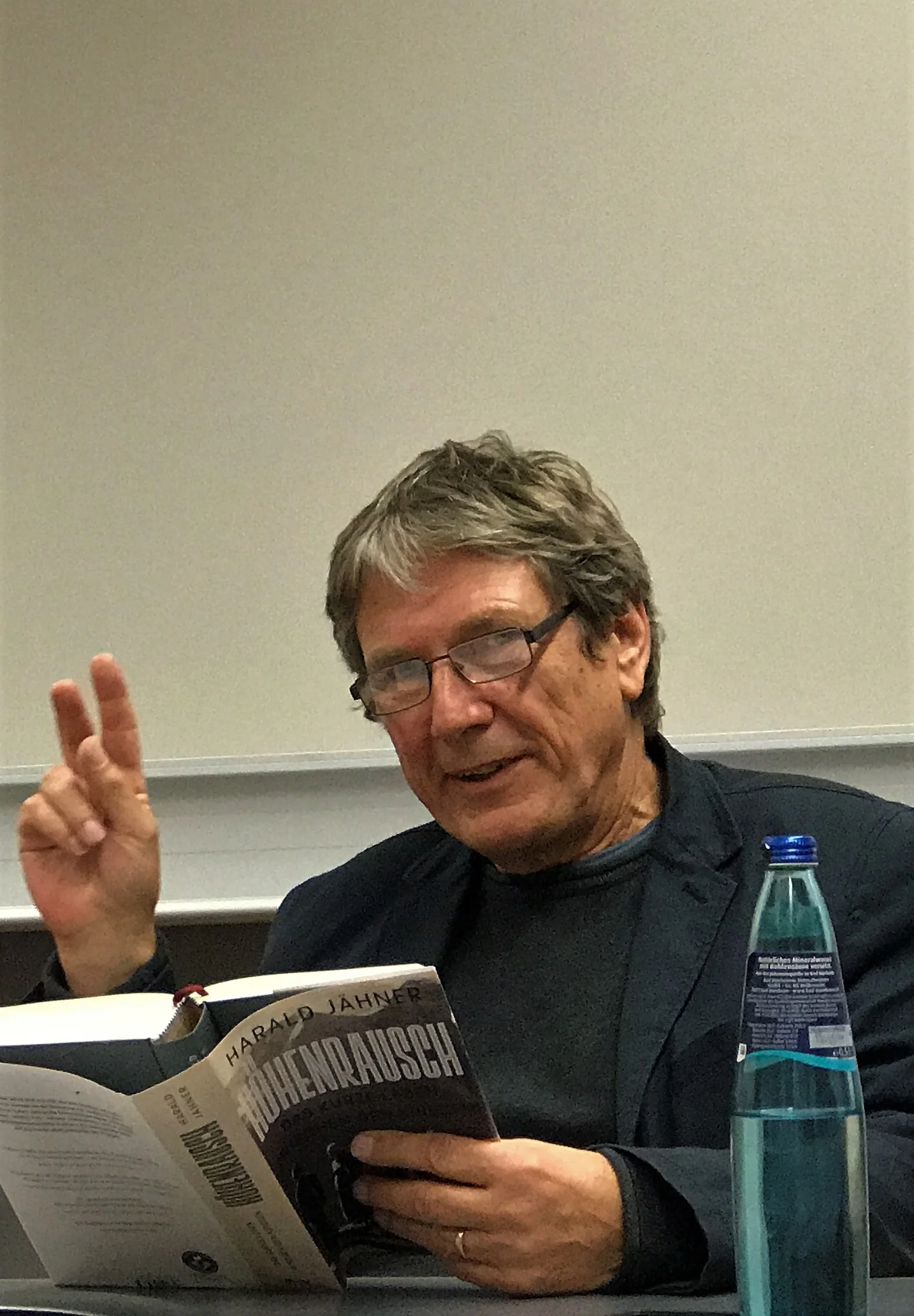
Image from Wikipedia
Image from Wikipedia
Harald Jähner – a precise chronicler of German post-war history
An author who makes history tangible as a narrated present
Harald Jähner, born on March 26, 1953, in Duisburg, is one of the most distinctive voices in German nonfiction. As a journalist, cultural editor, and author, he specializes in cultural-historical storytelling, describing the Federal Republic not in a dry academic manner, but with analytical clarity and narrative tension. His books combine historical research, cultural journalism, and a strong sensitivity to everyday and mental history. ([en.wikipedia.org](https://en.wikipedia.org/wiki/Harald_J%C3%A4hner))
Biography: From literary and art history to cultural journalism
Jähner studied literature, history, and art history in Freiburg and earned his doctorate in Berlin. His path first led him to freelance journalism, later taking on key cultural and editorial positions that sharpened his perspective on societal developments. From 1989 to 1997, he headed the communications department of the House of World Cultures; concurrently, he worked as a freelance literary critic for the Frankfurter Allgemeine Zeitung. ([en.wikipedia.org](https://en.wikipedia.org/wiki/Harald_J%C3%A4hner))
Later, he moved to the Berliner Zeitung, where he was responsible for the cultural section from 2003 to 2015. This position is central to his profile: Jähner learned here to shape cultural debates, aesthetic trends, and political upheaval into sharp, readable forms. Since 2011, he has been an honorary professor of cultural journalism at the University of the Arts Berlin, further emphasizing his professional authority. ([en.wikipedia.org](https://en.wikipedia.org/wiki/Harald_J%C3%A4hner))
Career: Late breakthrough as a narrative nonfiction author
Although Jähner has been publishing for decades, his major breakthrough as an author came with the book Wolfszeit. Deutschland und die Deutschen 1945–1955. The title was released in 2019 by Rowohlt Berlin, received the Leipzig Book Fair Prize, and spent months on the Spiegel bestseller list. The English version Aftermath also garnered international attention and was nominated for the Baillie-Gifford Prize. ([rowohlt.de](https://www.rowohlt.de/autor/harald-jaehner-16436))
This success redefined Jähner's position in German nonfiction: he not only wrote for a cultural section audience but also became a staple in the broader readership market. The press recognized his ability to compose historical material in a way that creates literary momentum. The Frankfurter Allgemeine Zeitung later described him as a "sharp-witted and life-wise analyst of contemporary events," while the Neue Zürcher Zeitung highlighted the exceptional strength of his storytelling. ([faz.net](https://www.faz.net/aktuell/feuilleton/buecher/sachbuch/harald-jaehners-buch-wunderland-accg-110724209.html/?utm_source=openai))
Work and bibliography: Contemporary history as a grand panorama
Jähner's journalistic work extends far beyond his late bestseller success. His academic work Erzählter, montierter, soufflierter Text. Zur Konstruktion des Romans „Berlin Alexanderplatz“ von Alfred Döblin was published in 1984, followed by an editorial collaboration with Krista Tebbe on Alfred Döblin in 1987. These early titles show that his later nonfiction prose is built on solid literary and cultural scientific foundations. ([en.wikipedia.org](https://en.wikipedia.org/wiki/Harald_Jähner))
With Wolfszeit, Jähner set a standard for narrative post-war history in 2019. Höhenrausch. Das kurze Leben zwischen den Kriegen was published in 2022 and also became a bestseller, translated into several languages and praised by the press for its grand storytelling. Rowohlt has announced Wunderland for 2025/2026, a volume about the young Federal Republic amid economic miracles, consumer society, and cultural change. ([rowohlt.de](https://www.rowohlt.de/autor/harald-jaehner-16436))
Current projects and publications: A view on the economic miracle
Among his latest visible projects is Wunderland, listed by Rowohlt as “coming soon” with precise outlines already provided in event texts. The book addresses the years 1955 to 1967 as a phase of profound social and cultural reconstruction, in which consumption, television, youth culture, and American influences reshaped West German society. Rowohlt is also listing readings and events from October 2025 to January 2026, with additional events planned for spring and summer 2026. ([rowohlt.de](https://www.rowohlt.de/autor/harald-jaehner-16436))
This keeps Jähner a contemporary author who transforms historical writing into present public discourse. His themes are not concluded but are connected: What lifestyles emerged in the early Federal Republic, how did media and consumption change mentality, and how did political expectations impact everyday culture? This perspective fuels his ongoing relevance. ([rowohlt.de](https://www.rowohlt.de/veranstaltung/lesung-harald-jaehner-stuttgart-16818-260519))
Style: Precise analysis, narrative approach, cultural-historical depth
Jähner's style thrives on the tension between historical accuracy and literary readability. He does not write mere lists of facts but organizes material into scenes, thought movements, and societal atmospheres. His approach resembles a careful montage: press, pop culture, political upheavals, and everyday details interweave, creating a historical panorama with strong visual power. ([en.wikipedia.org](https://en.wikipedia.org/wiki/Harald_Jähner))
Especially remarkable is his ability to anchor large epochs in specific cultural observations. In the Rowohlt and event texts for Wunderland, hedgehog cheese platters, Neckermann catalogs, guest workers, Elvis Presley, Freddy Quinn, Kennedy, Brandt, and the Beatles do not appear as mere decoration, but as evidence of upheaval. This makes his books equally relevant for historians, journalists, and culture-interested readers. ([rowohlt.de](https://www.rowohlt.de/veranstaltung/lesung-harald-jaehner-stuttgart-16818-260519))
Critical reception and cultural influence
The reception of Jähner's work is marked by high appreciation. Wolfszeit won the Leipzig Book Fair Prize in 2019; Höhenrausch became a bestseller and was translated into several languages; the English version of Wolfszeit gained international attention. The press repeatedly emphasizes his status as a storyteller who makes historical material accessible not by oversimplification, but with precise societal observation. ([rowohlt.de](https://www.rowohlt.de/autor/harald-jaehner-16436))
His cultural influence is evident in the way he makes German post-war history newly readable. Jähner places everyday life, consumption, media change, and political self-understanding at the center and links these dimensions into a new narrative of the Federal Republic. Thus, he is not only a nonfiction author but also a formative mediator of historical memory in the German-speaking cultural space. ([rowohlt.de](https://www.rowohlt.de/autor/harald-jaehner-16436))
Why Harald Jähner remains so fascinating today
Harald Jähner is fascinating because he does not merely manage history but provokes thought. His books combine scholarly diligence with stylistic elegance and a clear sensitivity for the upheavals of the 20th century. Anyone wanting to understand how a new society arose from the ruins of the post-war period will find in him an author with an eye for structure, mood, and the quiet shifts of everyday life. ([rowohlt.de](https://www.rowohlt.de/autor/harald-jaehner-16436))
It is precisely the combination of journalistic experience, academic teaching, and award-winning nonfiction prose that makes his work so relevant. Jähner belongs to that group of authors whose books not only inform but also open perspectives. Those who attend his readings experience cultural-historical storytelling at a high level and an author who brings German history to life with analytical calm and narrative power. ([rowohlt.de](https://www.rowohlt.de/autor/harald-jaehner-16436))
Official channels of Harald Jähner:
- Instagram: no official profile found
- Facebook: no official profile found
- YouTube: no official profile found
- Spotify: no official profile found
- TikTok: no official profile found
Sources:
- Rowohlt Verlag – Author page of Harald Jähner
- Rowohlt Verlag – Event about Harald Jähner / Wunderland
- Wikipedia – Harald Jähner
- University of the Arts Berlin – Prof. Dr. Harald Jähner
- Frankfurter Allgemeine Zeitung – Harald Jähner's book "Wunderland"
- buchreport – "Wolfszeit" climbs to rank 3 thanks to "Lanz" effect
Upcoming Events
23. LeseLust: Opening
Join us as Harald Jähner presents his work "Wonderland". Free entry at Kunsthaus Ansbach!
Harald Jähner reads - Wonderland Fürth 2026
An evening full of contemporary history in Fürth: Harald Jähner reads from Wonderland and opens the view onto the economic miracle. 21.05.2026, 19:00, €12. #Literature