
Henry Kissinger
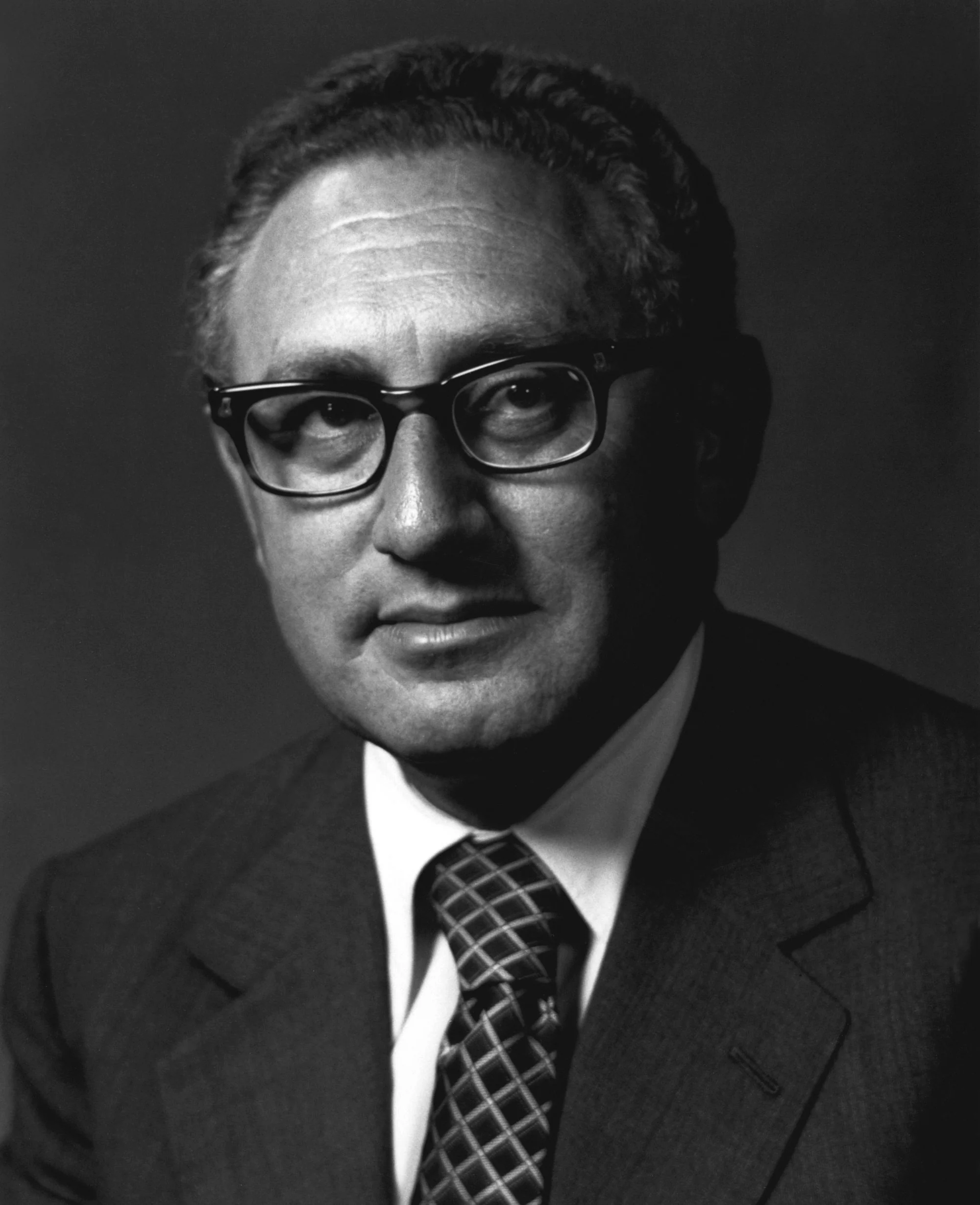
Image from Wikipedia
Image from Wikipedia
Henry Kissinger – Statecraft Between Realpolitik and World Order
A Life That Shaped International Politics
Henry Alfred Kissinger, born in 1923 in Fürth, Bavaria, and passed away in 2023 at the age of 100 in Connecticut, is one of the most influential foreign policy strategists of the 20th century. As a Jewish refugee from Nazi Germany, a Harvard scholar, National Security Advisor, and later U.S. Secretary of State under Richard Nixon and Gerald Ford, he significantly shaped the architecture of the post-war order. His music career did not materialize – yet his stage presence was in conference rooms, during state visits, and at the negotiating table, where he composed the agenda, arrangement, and timing of diplomacy with cool precision. Between détente, the opening to China, SALT negotiations, and Middle East shuttle diplomacy, he developed an artistic evolution of realpolitik, whose resonance is still felt in global institutions today.
Early Years and Influences: Emigration, Army, Harvard
As a teenager, Kissinger fled to the U.S. with his family in 1938 and became a U.S. citizen in 1943. He served in the U.S. Army and in the military government in post-war Germany – experiences that sharpened his perspective on power, security, and order. After the war, he studied at Harvard, where he earned his PhD in 1954 and quickly gained recognition as a thought leader in strategic studies. His influential work on nuclear strategy defined the vocabulary of deterrence, escalation control, and flexible response. This artistic evolution of strategy – from theory to application – established his authority in think tanks, government advising, and academia.
Academic Brilliance and Rise in Washington
Between 1955 and 1968, Kissinger advised both Republican and Democratic administrations, shaping debates on the composition and orchestration of American power. His work for Governor Nelson Rockefeller brought him into top-tier politics. In 1969, President Nixon appointed him National Security Advisor. With analytical sharpness, meticulous dossier work, and choreographed negotiation tactics, he combined expertise and experience – a portfolio that additionally made him Secretary of State in 1973, allowing him to hold both key positions concurrently.
At the Center of Power: National Security Advisor and Secretary of State
Between 1969 and 1977, Kissinger structured decision-making processes, defined priorities, and relied on discreet, tightly controlled channels. His stage presence was evident in secret consultations, precise meeting notes, and a relentless travel schedule that defined shuttle diplomacy. The thematic underpinning of his realpolitik was the motif of power balance: stability arises when major actors recognize, limit, and balance their interests. Whether one admired or dismissed this score – it dominated U.S. foreign policy during a period of tectonic shifts.
Détente, SALT, and Engagement with China
Kissinger's influence on détente with the Soviet Union was paradigm-shifting. The strategic arms limitation talks (SALT I) and the ABM Treaty marked a de-escalation in the nuclear arms race. Concurrently, the spectacular rapprochement with the People's Republic of China was orchestrated through secret preparations and symbolic summits. This dual strategy – détente with Moscow, rapprochement with Beijing – was an arrangement that changed the global tonal landscape. The U.S. positioned itself between two rivals, creating maneuvering space for further movements in the geopolitical concert.
Vietnam War and Nobel Prize: Diplomacy at the Limit
In the Vietnam conflict, Kissinger combined toughness with negotiation – an ambiguity that still sparks debate today. After a military escalation, protracted talks in Paris led to a ceasefire agreement in 1973. For these efforts, he was awarded the Nobel Peace Prize, shared with Lê Đức Thọ, who declined the award. The political and moral appraisal of this chapter remains controversial; nonetheless, it exemplifies Kissinger's ability to create rhythmic openings in entrenched conflicts to enable withdrawals, feedbacks, and new arrangements.
Shuttle Diplomacy in the Middle East: Precision in Crisis Mode
After the Yom Kippur War in 1973, Kissinger tirelessly traversed capitals, negotiating partial agreements that eased tensions between Israel and its Arab neighbors. This episodic dramatic approach – step by step, line by line – focused on interim results rather than grand final acts and became a textbook example of pragmatic crisis diplomacy. In this phase, his stage presence reached a peak: he moderated distrust, maintained tempo, and guided the actors without visibly wielding a baton.
After Office: Books, Consulting, Think Tanks
From 1977, Kissinger transitioned into the role of public intellectual, advisor, and author. His extensive bibliography – from memoirs to diplomacy theory and analyses on China – became a long-term project that blends practice with theory. Honors such as the Presidential Medal of Freedom and the Medal of Liberty recognized his work. Until his death, he remained a presence in debates, speaking on technological disruptions such as artificial intelligence and reflecting on the future of world order. Documentaries and interviews painted a picture oscillating between admiration and sharp critique.
Critical Reception: Controversies, Responsibility, Legacy
Kissinger polarized like few other statesmen of his time. Critics accuse him of expanding the war into Cambodia, supporting authoritarian regimes in Latin America, and making controversial decisions in Southeast Asia. Supporters point to arms control, détente, and the inclusion of China in the international order. These contrasts form the canon of his reception: moral judgments collide with power-political calculations; normative expectations clash with the realities of international relations. The debate itself has become part of the political cultural history of the U.S. and continues to shape generations of students, diplomats, and historians.
Style and Method: The Craft of Diplomacy
Kissinger's expertise lay in the craft of diplomacy: precise preparation, multi-channel communication, psychological profiling of opponents, and a negotiation tactic that employed pauses, hints, and controlled leaks. His artistic development as a statesman was evident in the arrangement of interests, the balance of pressure and incentives, and the drama of the "step-by-step" approach. He understood international politics as a complex composition where sound and counter-sound – threats and promises, symbol and substance – intertwine.
Cultural Influence and Pop Culture
Kissinger was not only a power politician but also a pop culture phenomenon: talk shows, cover stories, a reputation as an unusual celebrity in Washington. His quotes circulate to this day – sometimes ironically, sometimes admiringly – and his books remain reference texts for strategists. Documentaries, interviews, and exhibitions engage with his impact history. Whether as a role model of the cold realist or as a cautionary example of the limits of power politics: he remains a resonant figure in historical memory.
Bibliography Instead of Discography: Works, Themes, Impact
As a non-musician, Kissinger has no discography. The relevance of his bibliography is all the more significant: spanning from "Nuclear Weapons and Foreign Policy" to the memoir trilogy to "On China" and "World Order," a corpus emerges that is both theory, contemporary witness, and manual. These titles formed curricula, shaped debates in editorial offices and ministries, and provided generations of students with analytical frameworks. The critical reception ranges from glowing reviews to sharp counter-readings – an indicator of the enduring appeal as well as the friction of his thinking.
Conclusion: Why Henry Kissinger Continues to Fascinate
Kissinger's life work fascinates because it encapsulates experience, expertise, authority, and credibility in one person – and simultaneously lays bare the contradictions of the 20th century. He brought order to a dissonant concert of great powers without resolving the dissonances. Anyone looking to understand diplomatic stage presence, artistic development in the thought of power, and the long breath of international negotiations cannot bypass this name. He can no longer be experienced live – yet his books, interviews, and cinematic portraits invite exploration of the repertoire of realpolitik anew and critically.
Official Channels of Henry Kissinger:
- Instagram: No official profile found
- Facebook: No official profile found
- YouTube: No official profile found
- Spotify: No official profile found
- TikTok: No official profile found
Sources:
- Henry A. Kissinger – Official Website
- U.S. Department of State – Office of the Historian: Henry A. Kissinger
- Encyclopaedia Britannica – Henry Kissinger (Biography, Works, Controversies)
- Biography.com – Henry Kissinger: Biography, Career & Legacy
- PBS American Experience – Kissinger (Documentary, 2025)
- History.com – Henry Kissinger: Biography, Career & Legacy
- Wikipedia – Henry Kissinger (Image and Text Source)
- Apple Books – Henry Kissinger: Short Biography Compact (2024)
