
Jan Weiler

Image from Wikipedia
Image from Wikipedia
Jan Weiler – the Chronicler of Everyday Life between Humor, Family, and Keen Observation
An author who turns the ordinary into literature
Jan Weiler, born in Düsseldorf in 1967, is one of the defining German storytellers of the present day. He became known in 2003 with Maria, ihm schmeckt’s nicht!, a book that immediately showcased his eye for cultural friction, familial dynamics, and sharp humor. From journalist, he transformed into a writer with a distinctive style, blending everyday language, comedy, and precise observations of life into a unique form of literary entertainment. ([janweiler.de](https://www.janweiler.de/presse/biographie?utm_source=openai))
Biography: From Journalism to Literary Brand
Weiler completed the German School of Journalism in Munich and initially worked in journalism, among others at SZ-Magazin, where he later took over the editorial management. This background shapes his prose to this day: His texts appear strong in observation, accurate in dialogue, and close to the language of real life. The fact that he also appeared as a presenter on Bavarian Television for several months and later developed his own stage format through reading tours demonstrates the breadth of his presence in the cultural sphere, akin to a music career – even though his true terrain remains literature. ([janweiler.de](https://www.janweiler.de/presse/biographie?utm_source=openai))
From an early age, Weiler combined writing, media work, and live presence. Since 2005, he has undertaken extensive reading tours across Germany; at the same time, he has been represented by the literary and film agency Marcel Hartges. This professional grounding explains why his books have been successful not only in print but also as audiobooks, stage programs, and film adaptations. ([janweiler.de](https://www.janweiler.de/presse/biographie?utm_source=openai))
The Breakthrough with Maria, ihm schmeckt’s nicht!
Weiler achieved his literary breakthrough with the novel Maria, ihm schmeckt’s nicht!, which draws its impact from German-Italian family conflicts, cultural misunderstandings, and lovingly sharpened observations of everyday life. The book became one of the most successful debuts of recent decades and marked the moment when Weiler transitioned from journalist to bestselling author. The later film adaptation further underscores the popular appeal of this material, adeptly striking a tone between comedy, family saga, and social satire. ([penguin.de](https://www.penguin.de/buecher/jan-weiler-der-markisenmann/buch/9783453273771?utm_source=openai))
With Antonio im Wunderland, Weiler continued the literary world of this debut and sharpened his profile as an author who finds narrative tension in familial relationships, origins, and everyday culture. The strength of his books lies less in the plot than in the precise composition of short scenes, the rhythmic management of dialogue, and the ability to develop the comedic from the emotionally true. This is precisely where his hallmark as a storyteller lies. ([penguin.de](https://www.penguin.de/buecher/jan-weiler-der-markisenmann/buch/9783453273771?utm_source=openai))
Development of Work: From Family Novels to the Pubertier Books
With Das Pubertier and the later titles surrounding this character universe, Weiler created one of the most successful German family series of recent years. The books address life between teenagers and exhausted parents without slipping into flat punchlines; instead, they blend situational comedy with social observation and a calm view of modern parental reality. The publisher describes the series as humorous entertainment with broad resonance, and the ongoing popularity is also reflected in audiobooks, readings, and film adaptations. ([penguin.de](https://www.penguin.de/buecher/jan-weiler-das-pubertier/ebook/9783641310493?utm_source=openai))
Der Markisenmann expands this spectrum with a novel about father-daughter relationships, guilt, responsibility, and growing up. The book was published in 2022 and found a large audience; reviews and publisher notes clearly situate it within the realm of modern, accessible contemporary literature. Weiler achieves a finely balanced mixture of lightness and emotional depth here, a hallmark of his writing for years. ([penguin.de](https://www.penguin.de/buecher/jan-weiler-der-markisenmann/buch/9783453273771?utm_source=openai))
Current Projects: Munk, Älternzeit, and the New Reading Tour
In 2023, Älternzeit was published, another title from the author's broad family cosmos. The publisher presents the book as a humorous observation of the phase in which children become older and parents must renegotiate new roles. This continuation of his popular storytelling confirms Weiler's strength in literarily condensing social normality with a sharp gaze and warm tone. ([penguin.de](https://www.penguin.de/Buch/Aelternzeit/Jan-Weiler/Heyne/e596775.rhd?utm_source=openai))
In 2024, Munk followed, a novel about a man who must reorganize his life after a heart attack. On the author's website, Weiler describes the book as very personally crafted and simultaneously points to readings, media appearances, and the book premiere. He also announced Das Beste! Mein Leben zwischen Pubertieren for 2025, a revised and expanded collection of his most popular texts from the Pubertier era, set to be released in September 2025. ([janweiler.de](https://www.janweiler.de/?utm_source=openai))
Weiler also remains present in theater, film, and stage environments. His website documents screenplay work for Die Ältern, Das Pubertier – Der Film, Die Pubertier-Serie, Eingeschlossene Gesellschaft, and Maria, ihm schmeckt’s nicht!. This shows an author whose material extends far beyond the book, unfolding additional cultural reach through the interplay of literature, cinema, and live performance. ([janweiler.de](https://www.janweiler.de/konsum/kino-und-tv/die-aeltern?utm_source=openai))
Catalog of Works instead of Discography: Books, Audiobooks, and Stage Adaptations
Since Jan Weiler is neither a musician nor a classic artist but a journalist and writer, there is no traditional discography in the musical sense. However, his catalog includes novels, columns, radio plays, screenplays, and audiobook versions, which in their media diversity almost resemble a literary version of a discography. His official website even features its own "Discography" page that documents the audible publications and radio plays. ([janweiler.de](https://www.janweiler.de/presse/diskographie?utm_source=openai))
Key titles include Maria, ihm schmeckt’s nicht!, Antonio im Wunderland, Mein Leben als Mensch, Das Pubertier, Der Markisenmann, Älternzeit, Munk, and Das Beste! Mein Leben zwischen Pubertieren. These works form a clear developmental line, from the ethnographically colored family novel through the columnar and serial to the more mature contemporary novel. ([penguin.de](https://www.penguin.de/Buch/Aelternzeit/Jan-Weiler/Heyne/e596775.rhd?utm_source=openai))
Style: Humor, Precision, and Human Warmth
Weiler's style thrives on precise observations, cleanly timed punchlines, and a language that never comes off as preachy. He masters the arrangement of short scenes, the timing of comedic tension, and the shift between irony and empathy. Particularly in the family stories, his expertise as a storyteller unfolds: he takes conflicts seriously without stripping them of their lightness. ([penguin.de](https://www.penguin.de/buecher/jan-weiler-das-pubertier/ebook/9783641310493?utm_source=openai))
The press regularly highlights precisely these qualities. SWR describes him as one of the most successful German authors, while other media characterize his readings as entertaining, spot-on, and strong in delivery. The impact of his texts arises not only on paper, but also in the live moment where language, facial expressions, and rhythm come together. ([swr.de](https://www.swr.de/swrkultur/leben-und-gesellschaft/jan-weiler-bestsellerautor-swr-kultur-gespraech-2024-08-31-100.html?utm_source=openai))
Cultural Influence and Reception
Jan Weiler has had a lasting impact on the spectrum of German-language entertainment literature. His books have become bestsellers, been adapted into films, converted into series, and read in schools; thus, they transcend mere readership and become part of the pop cultural everyday life. Notably, Das Pubertier and Der Markisenmann illustrate how well he hits the nerve of a broad audience without losing literary ambition. ([merkur.de](https://www.merkur.de/lokales/weilheim/weilheim-ort29677/dichterlesung-gymnasium-weilheim-star-autor-jan-weiler-entschuldigt-sich-bei-den-schuelern-94235399.html?utm_source=openai))
Weiler's cultural authority stems from his dual role as a journalist and storyteller. He knows the craft of observation from the newsroom, brings it into the novel, and extends it to the stage. The fact that his texts work in audiobook form, on reading tours, and in film attests to the stability of his characters, themes, and tones across different media. ([janweiler.de](https://www.janweiler.de/presse/biographie?utm_source=openai))
Conclusion: An author with a sense of pace, timing, and the present
Jan Weiler remains compelling because he elevates the seemingly small with literary precision. His stories about families, fathers, children, origins, and the friction of everyday life possess wit, heart, and recognizability. Those who experience him live immediately sense the strength of his stage presence and narrative musicality – an evening with Jan Weiler is always worthwhile. ([merkur.de](https://www.merkur.de/lokales/weilheim/weilheim-ort29677/dichterlesung-gymnasium-weilheim-star-autor-jan-weiler-entschuldigt-sich-bei-den-schuelern-94235399.html?utm_source=openai))
Official Channels of Jan Weiler:
- Instagram: No official profile found
- Facebook: No official profile found
- YouTube: No official profile found
- Spotify: No official profile found
- TikTok: No official profile found
Sources:
- Jan Weiler – Official Website
- Jan Weiler – Biography
- Jan Weiler – Discography
- Jan Weiler – Books
- Jan Weiler – Das Pubertier – The Film
- Jan Weiler – Die Ältern
- Penguin Random House / Heyne – Älternzeit
- Penguin Random House / Heyne – Der Markisenmann
- Penguin Random House / Heyne – Das Beste! Mein Leben zwischen Pubertieren
- SWR Kultur – Jan Weiler in Conversation
- Merkur – Star Author Jan Weiler Enthralls 300 Listeners
- Wikipedia: Jan Weiler
Upcoming Events
JAN WEILER – The Best! My Life Between Puberties
Jan Weiler brings his best puberty texts to the stage at Stadttheater Bielefeld. An evening full of clever punchlines, recognition, and laughter. #Comedy
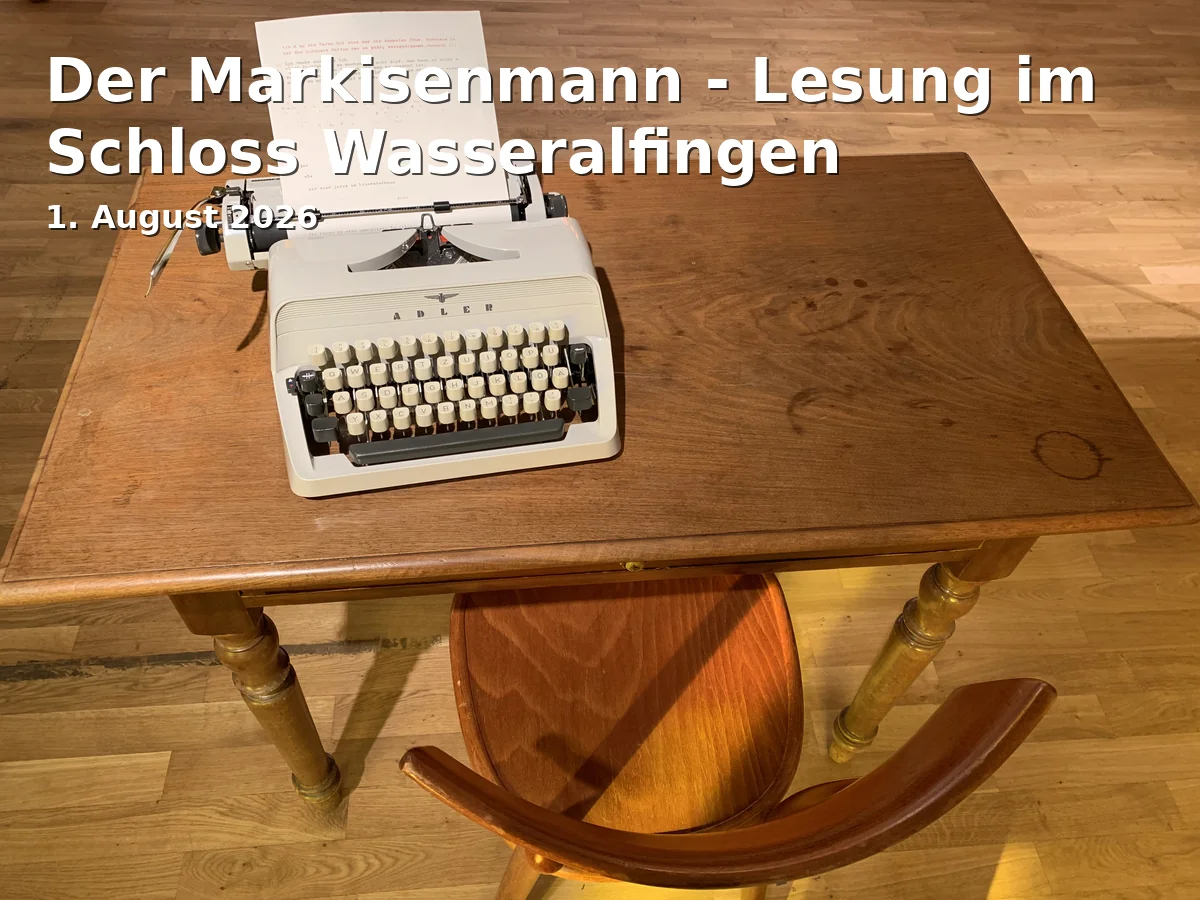
The Awning Man - Reading at Wasseralfingen Castle
Enjoy Jan Weiler's novel as a staged reading at Wasseralfingen Castle. A must for literature fans in Aalen!
The Man of the Awning (as part of Summer at the Castle)
A summer evening full of literature and emotion: The Man of the Awning at Schloss Wasseralfingen. Staged reading, historical backdrop, great proximity. #Theater