
Josef Mysliveček
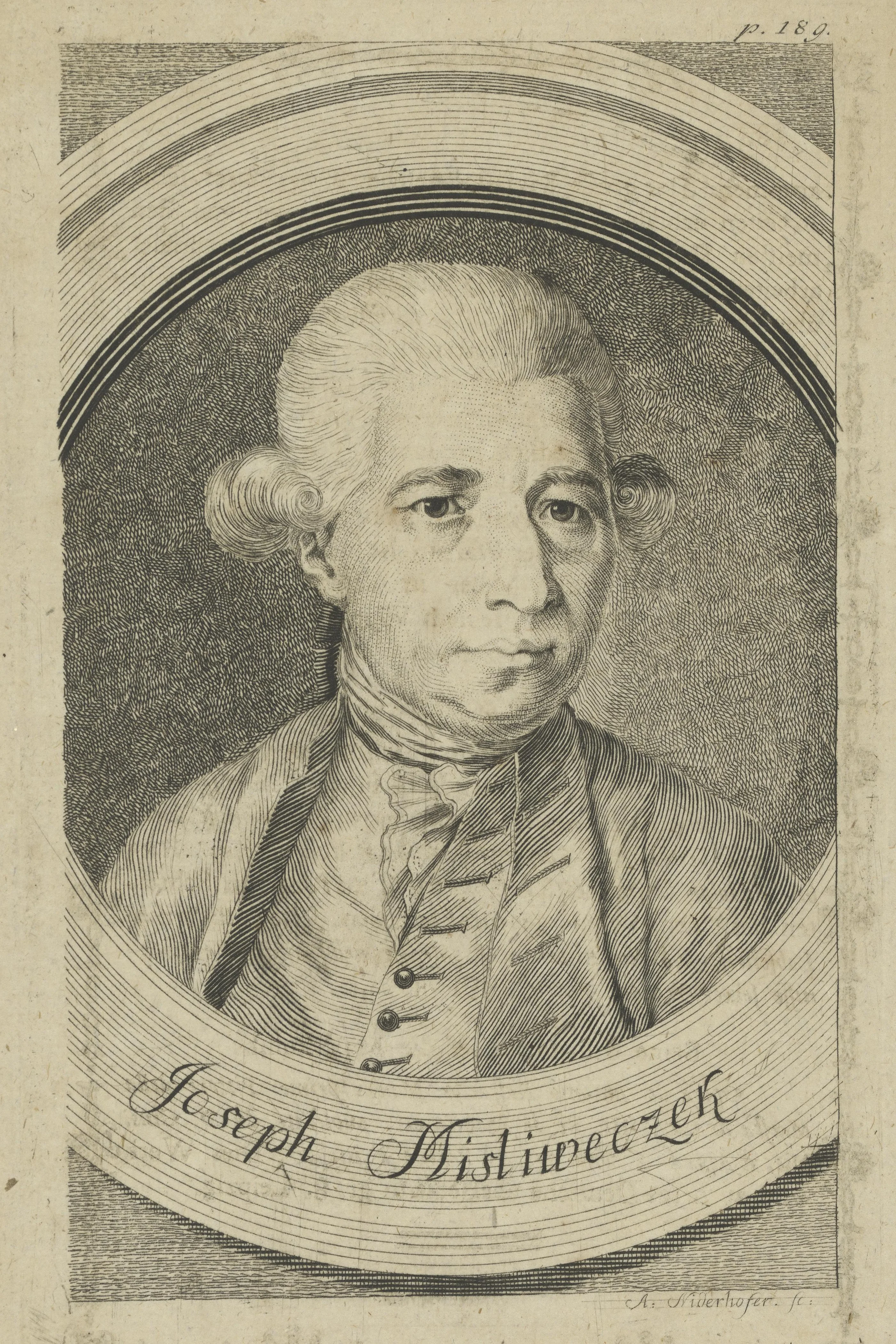
Image from Wikipedia
Image from Wikipedia
Josef Mysliveček – The Bohemian Master of Italian Opera seria
A composer between Prague, Italy, and Mozart: Josef Mysliveček rediscovered
Josef Mysliveček is among the most fascinating composers of the 18th century: born in 1737 in Prague and died in 1781 in Rome, he transformed from the son of a miller's family to one of the most sought-after opera composers on the Italian stage. His life path connects Bohemian roots, an Italian career, and a music that developed a distinctive dramatic style between late Baroque and early Classicism. It is precisely this mix of international success, nearly forgotten impact, and today's rediscovery that makes him so exciting for music lovers.
Biography: From the Prague environment to Italy
Mysliveček grew up in an environment that initially had nothing to do with the opera houses of Europe. As the son of a Prague miller, he was not destined for a career in music, but he chose against family tradition and for the arts. At the age of 26, he left Prague and went to Italy, where his music career took off significantly and his name quickly circulated in opera circles. There he became known as “Il Boemo,” or the Bohemian, who enriched Italian opera with Bohemian temperament and international elegance. ([deutsch.radio.cz](https://deutsch.radio.cz/jahr-der-tschechischen-musik-josef-myslivecek-ein-italien-verehrter-boehme-8831987?utm_source=openai))
In Italy, Mysliveček found the ideal environment for his compositional development. He worked in an opera culture characterized by virtuoso singers, representative theaters, and grand court occasions. Notably, he was active not only in Rome, Bologna, or Naples, but also made his mark in the most important musical centers of the peninsula. This presence made him one of the most productive and successful representatives of opera seria of his time. ([de.wikipedia.org](https://de.wikipedia.org/wiki/Der_B%C3%B6hme))
The breakthrough in the Italian opera world
The decisive fame came to him through the opera stage. Radio Prague describes his success as a dazzling career in Italy; particularly the opera Il Bellerofonte earned him recognition throughout Italy. His operas were performed in prestigious houses and were often associated with court festivities and representative occasions. Albatrosmedia highlights that his works were even performed for royal celebrations, and he collaborated with famous singers such as Caterina Gabrielli, Anton Raaff, and Luigi Marchesi. ([deutsch.radio.cz](https://deutsch.radio.cz/jahr-der-tschechischen-musik-josef-myslivecek-ein-italien-verehrter-boehme-8831987?utm_source=openai))
His success was based not only on craftsmanship but also on a sense of musical effect. Mysliveček wrote for the voice, for dramatic intensification, and for the virtuosity of the opera personnel of his time. This made him a composer whose works held high appeal in the opera landscape of the 1770s. At the same time, it reflected his ability to not only adopt Italian stylistics but also to shape it with his own hand. ([albatrosmedia.cz](https://www.albatrosmedia.cz/tituly/64694298/josef-myslivecek/))
Josef Mysliveček and Wolfgang Amadeus Mozart
A central chapter of his biography is the relationship with Wolfgang Amadeus Mozart. Mysliveček and Mozart met in Bologna in 1770, and their acquaintance developed into a close friendship over several travels to Italy. Sources emphasize that Mysliveček impressed the young Mozart, and his style had an inspiring effect on the later Viennese classicist. This positions Mysliveček not as a peripheral figure but as a true impetus within European music history. ([de.wikipedia.org](https://de.wikipedia.org/wiki/Der_B%C3%B6hme))
This connection is also significant in music history because it makes the exchange between generations visible. Mysliveček existed in a world where opera composition, singer careers, and international networks were closely intertwined. Mozart's encounter with him documents how strongly the Italian opera tradition influenced the development of Classicism. Mysliveček thus serves as a bridge between older opera seria and the stylistic clarity that would characterize Classicism. ([english.radio.cz](https://english.radio.cz/josef-vaclav-myslivecek-il-divino-boemo-8764753?utm_source=openai))
Discography and work profile: Operas, arias, and instrumental music
The documented reception of his oeuvre shows a wide spectrum of operas, vocal works, and instrumental music. The website of the project Il Boemo lists numerous recordings, including Adamo ed Eva, Simona Šaturová - Decade: Mozart & Mysliveček, Magdalena Kožená - Le belle immagini: Mozart – Gluck – Mysliveček, as well as the Violin Concertos with Collegium 1704 and Václav Luks. These recordings demonstrate that Mysliveček's music is regaining strong presence today, especially through historically informed interpretations. ([ilboemo.cz](https://www.ilboemo.cz/about-josef-myslivecek))
Particularly, the operas remain the heart of his discography. Oper PLUS and other music sources refer to works such as Tamerlan, Olimpiade, Armida, Demetrio, and La clemenza di Tito, showcasing his closeness to Italian opera seria. These pieces exemplify a compositional style that combines singable melodies, clear dramatic arcs, and an effective treatment of vocal lines. In historical performance practices, these operas are gaining increasing profile. ([operaplus.cz](https://operaplus.cz/encyklopedie/josef-myslivecek/))
Instrumental works are also preserved and recorded, such as violin concertos and symphonies. This shows that Mysliveček is not only to be read as an opera composer but also as a versatile composer with a keen sense for form, sound balance, and thematic work. Looking at these works expands the picture of an artist whose music bridges stage and concert hall. ([ilboemo.cz](https://www.ilboemo.cz/about-josef-myslivecek))
Musical style: Early Classicism with Italian elegance
Mysliveček's music bears the hallmark of a transitional era. It combines the expressive rhetoric of late Baroque with the formal clarity of early Classicism and is strongly tailored to the taste of the Italian opera audience. The melodic lines are lyrical, the dramaturgy precise, and the arrangement of voices is constructed for virtuosity and effect. This is precisely where his historical significance lies: He shaped a style that appears elegant, theatrical, and yet structured. ([deutsch.radio.cz](https://deutsch.radio.cz/jahr-der-tschechischen-musik-josef-myslivecek-ein-italien-verehrter-boehme-8831987?utm_source=openai))
Historically, his rank can also be recognized by the sustainable revival of his works. Modern research, including the monograph by Daniel E. Freeman, is explicitly mentioned in the sources as a fundamental scholarly study. This underscores that today Mysliveček is no longer perceived merely as Mozart's friend but as an independent composer with a clearly defined work profile and high stylistic quality. ([ilboemo.cz](https://www.ilboemo.cz/about-josef-myslivecek))
Cultural influence and today's rediscovery
After his death, Mysliveček long fell into the shadow of the great names of the Viennese Classicism. Nevertheless, his cultural footprint remained, evident in later literary, theatrical, and cinematic references. The 2022 film Der Böhme by Petr Václav brought his life to a wider audience and demonstrated how strongly his biography still fascinates. The musical implementation with Collegium 1704 and renowned soloists further enhanced this rediscovery. ([de.wikipedia.org](https://de.wikipedia.org/wiki/Der_B%C3%B6hme))
In concert and recording practice, Mysliveček is also experiencing a significant renaissance. New editions, recordings, and concert programs testify to a growing interest in his operatic art and instrumental works. As a result, he is increasingly returning to the prominent position that historically belongs to him: as one of the leading Bohemian-Italian composers of the 18th century and as an important pioneer of classical opera culture. ([ilboemo.cz](https://www.ilboemo.cz/about-josef-myslivecek))
Voices of the fans
No official profile found.
Conclusion: A composer everyone should hear again
Josef Mysliveček captivates with a rare blend of historical significance, dramatic energy, and musical nobility. His career tells of rise, international fame, and an artistic language that remained unmistakably relevant in the Italian opera of the 18th century. Anyone interested in Mozart, opera seria, and the emergence of Classicism will discover in Mysliveček a name of true stature. His music deserves the grand stage – live, passionate, and with the attention that a forgotten master finally deserves.
Official channels of Josef Mysliveček:
- Instagram: No official profile found
- Facebook: No official profile found
- YouTube: No official profile found
- Spotify: No official profile found
- TikTok: No official profile found
Sources:
- Wikipedia – Josef Mysliveček
- Radio Prague International – Year of Czech Music: Josef Mysliveček – a Bohemian revered in Italy
- Il Boemo – About Josef Mysliveček
- Opera PLUS – Josef Mysliveček
- Albatrosmedia – Josef Mysliveček
- Wikipedia – Der Böhme (Il Boemo)
- Klassika.info – Josef Mysliveček (1737-1781)