
Max Goldt
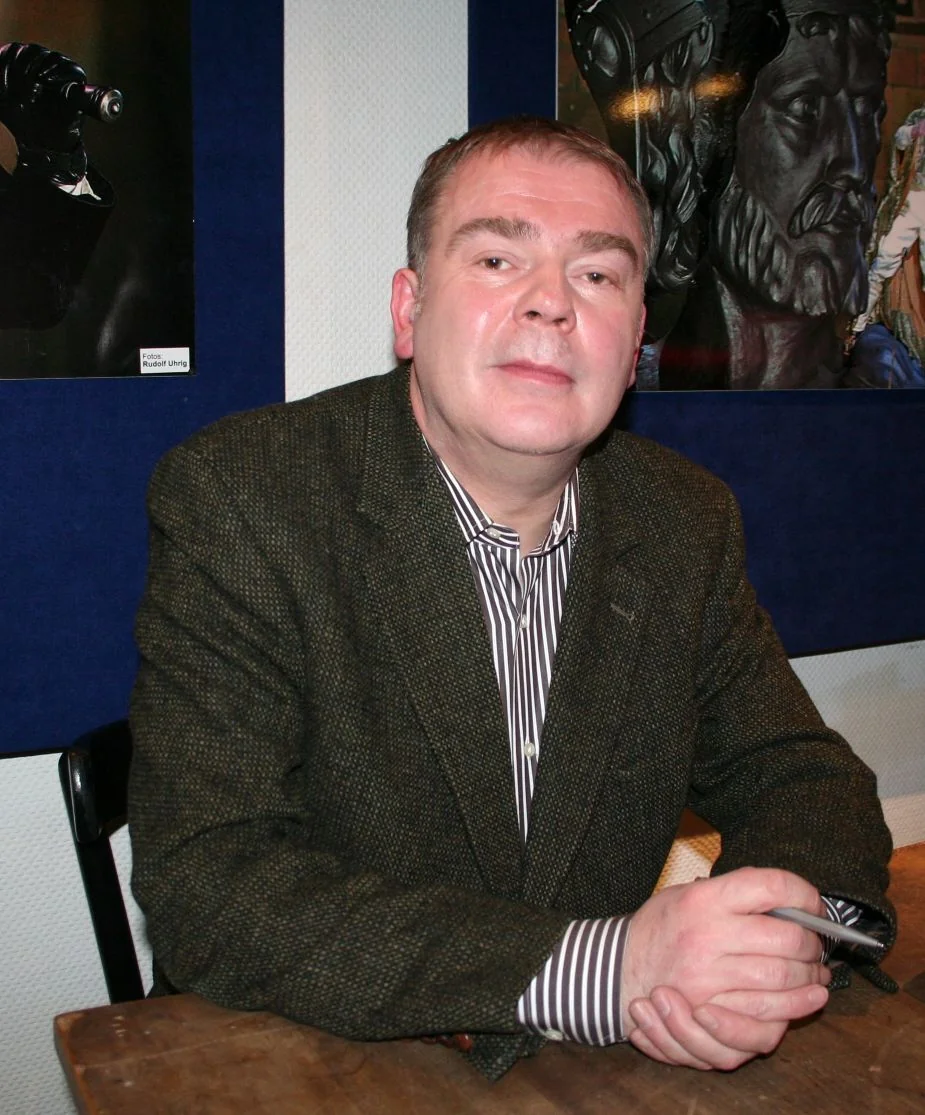
Image from Wikipedia
Image from Wikipedia
Max Goldt – the Sound of Irony, the Art of Precision
An Author, Musician, and Stylist between NDW, Satire, and Language Art
Max Goldt, born in 1958 in Weende and actually named Matthias Ernst, is one of those rare German artists whose work does not confine itself to a single discipline. He is a writer, columnist, musician, comic scriptwriter, and audio play author – and it is precisely this versatility that makes his artistic biography so remarkable. While many know him primarily as a writer, his music career dates back to the early years of the Neue Deutsche Welle and still represents an independent, unconventional part of his oeuvre. ([de.wikipedia.org](https://de.wikipedia.org/wiki/Max_Goldt))
From West Berlin of the 1970s to His Own Artistic Language
Goldt's journey into art did not follow a straight path, but rather stemmed from a spirit of exploration. After graduating from high school in Göttingen, he moved to West Berlin in 1977, initially starting a training program in photography, which he soon abandoned to pursue music. During this phase, he also worked part-time as a tour guide; the famous song “Wissenswertes über Erlangen” is still read as an echo of this time. The fact that Goldt later wanted to earn his living not with music, but solely with literature marks not a break, but rather a shift in his artistic focus. ([de.wikipedia.org](https://de.wikipedia.org/wiki/Max_Goldt))
Already in 1980, he performed as a musician under the pseudonym Max Gold, as the GEMA pointed out a name conflict, which led him to change his artist name to Max Goldt. This small administrative episode fits well with his career: In Goldt's case, biographical accuracy is always mixed with ironic distance, and even formal constraints become part of an artistic identity. His early work oscillated between experimental sound art, spoken-word, satirical sharpness, and pop musical form. ([de.wikipedia.org](https://de.wikipedia.org/wiki/Max_Goldt))
Foyer des Arts: Neue Deutsche Welle with Sharp Wit and Cool Elegance
In 1981, Goldt founded the duo Foyer des Arts with Gerd Pasemann, which is attributed to the Neue Deutsche Welle, but never simply followed the trend. The band combined melancholic, resigned, comical, and surreal elements into a musically contrasting project that stood out precisely because of its quirkiness. Tapete Records describes how John Peel appreciated the band, played several pieces on the radio, and eventually invited the duo to a Peel Session – a rare honor for a German-speaking group. ([tapeterecords.de](https://www.tapeterecords.de/artists/foyer-des-arts))
The special position of Foyer des Arts is particularly evident in the blend of clever lyrics, pointed production, and an attitude that never treated pop as mere superficiality. The project was simultaneously playful and intellectual, laconic and poetic. This was precisely its appeal: The songs were not mere NDW imitations, but miniatures with a satirical undertone where verbal wit and musical form intertwined. ([tapeterecords.de](https://www.tapeterecords.de/artists/foyer-des-arts))
Solo Works, Nuuk, and the Idea of a Musical Exhibition
In addition to Foyer des Arts, Goldt also released solo works and collaborated with Stephan Winkler as the duo Nuuk. The Wikipedia discography lists, among others, “Die majestätische Ruhe des Anorganischen,” “Nachts in schwarzer Seilbahn nach Waldpotsdam” by Nuuk, “Bundesratufer,” and later collections of early music. These releases showcase an artist who understood music not as a byproduct but as an independent laboratory for sound, language, and form. ([de.wikipedia.org](https://de.wikipedia.org/wiki/Max_Goldt))
A particularly important reference point is the 6-CD anthology “Draußen die herrliche Sonne. Musik 1980-2000,” which was released in 2019 and published in 2020 as an extract on double LP and CD. Goldt himself described it as an exhibition of works featuring pieces from 1980 to 2000 and emphasized that he only wanted to record what he still finds good or at least interesting today. This selection is more than just an archive: it is an artistic self-location that combines retrospection and the formation of a canon. ([tapeterecords.de](https://www.tapeterecords.de/artists/max-goldt/))
Musical Style: Between Preparation, Electronics, and Spoken Word
Goldt's musical development is closely linked to experimentation and technology. In the early phase, he worked with what he called the “Rubbermind” technique, where an acoustic guitar and a dulcimer were prepared with mallets, cardboard, metal sheets, and wrapping paper. After a herniated disc in 1984, he temporarily switched to synthesizers like the Yamaha DX7 and also used a Roland tape echo. This creates a picture of music production where physical limitations, inventiveness, and sonic curiosity directly converge. ([de.wikipedia.org](https://de.wikipedia.org/wiki/Max_Goldt))
The influences are also broad: Goldt has stated that for several years he listened daily to Stravinsky's “Les Noces,” later turned to jazz, and showed sympathy for electronic music. It is precisely this openness that explains why his works remain so hard to classify. They are neither pure pop music nor mere sound experiments but rather moved early on between avant-garde, audio piece, song form, and language composition. ([de.wikipedia.org](https://de.wikipedia.org/wiki/Max_Goldt))
Discography, Reception, and Cultural Influence
The critical reception continues to recognize Goldt as an exceptional voice. On the literary side, his breakthrough is closely linked to the Titanic column, but his musical work also received attention, especially through later re-releases and exhibitions. The Tapete Records texts emphasize his position as a “fixed star” of the avant-garde and good taste; this formulation comes from a music press voice that succinctly captures Goldt's unique position in the German pop and art context. ([tapeterecords.de](https://www.tapeterecords.de/artists/max-goldt/))
His discography includes, according to sources, the early works of Foyer des Arts, solo releases, the Nuuk LP/CD, and the later anthology. Particularly important is not only the number of releases but also the range: from satirical songs to experimental instrumentals to spoken-word forms. Goldt's work shows how closely literature and music are interconnected in his creativity – not as two separate careers, but as two expressions of a shared artistic stance. ([de.wikipedia.org](https://de.wikipedia.org/wiki/Max_Goldt))
His awards further underscore the authority of his œuvre. In 2008, he received the Kleist Prize, as well as the Kassel Literary Prize, the Richard Schönfeld Prize, the Hugo Ball Prize, the Göttingen Elk, and in 2022 the Jacob Grimm Prize for the German Language. The jury's justification for the Kleist Prize praised him for having “distorted German everyday life to a recognizable degree”; Daniel Kehlmann also honored Goldt as one of the wittiest and most linguistically precise authors of our time. ([de.wikipedia.org](https://de.wikipedia.org/wiki/Max_Goldt))
Current Projects: Literary Presence, Musical Memory
In current sources, Goldt is shown in 2025/26 primarily as a presenting author and performer: The website of Katz & Goldt announces numerous reading dates with new and old text material. At the same time, his musical past remains alive through reissues, collections, and archival releases. However, the search in reliable sources has not brought forth any current music releases for new albums or fresh music publications from 2024 and 2025; the continued literary activity is mainly visible. ([katzundgoldt.de](https://www.katzundgoldt.de/))
For the present, this does not mean absence but rather a shift in public perception. Goldt remains an artist whose musical history continues to shine, even if the reading now takes center stage. It is precisely this dual role that makes him exciting: He is the rare case of a musician whose sound work and language art illuminate each other. ([de.wikipedia.org](https://de.wikipedia.org/wiki/Max_Goldt))
Conclusion: Why Max Goldt Continues to Fascinate Today
Max Goldt is fascinating because he has never allowed himself to be reduced to a single role. His music career combines NDW, experimentation, spoken word, and ironic pop observation into a work that has remained clever, playful, and culturally independent. Those who want to understand German music history beyond the usual keywords will find in him a figure that unites language, sound, and attitude in a rare way. Anyone who has the opportunity to experience him live should take it — not only because of the texts but because of this special blend of intellect, timing, and stage presence. ([tapeterecords.de](https://www.tapeterecords.de/artists/max-goldt/))
Official Channels of Max Goldt:
- Instagram: no official profile found
- Facebook: no official profile found
- YouTube: no official profile found
- Spotify: no official profile found
- TikTok: no official profile found
Sources:
- Wikipedia – Max Goldt
- Tapete Records – Max Goldt
- Tapete Records – Foyer des Arts
- FAZ – Max Goldt's New Book, 16.09.2025
- Katz & Goldt – Official Website
- Wikipedia: Image and text source
Upcoming Events
Max Goldt reads – Aber? in Munich
An evening for clever laughs: Max Goldt reads in Munich from Aber? and strikes with fine satire right to the heart. April 15, 2026, from 29 €. #Comedy #Munich
Max Goldt reads from Aber? in Regensburg
An evening for literature lovers in Regensburg: Max Goldt reads from Aber? in the Alte Mälzerei. Satire, linguistic art, and clever observations from 8 PM. #Reading #Regensburg #MaxGoldt