
Sona Jobarteh
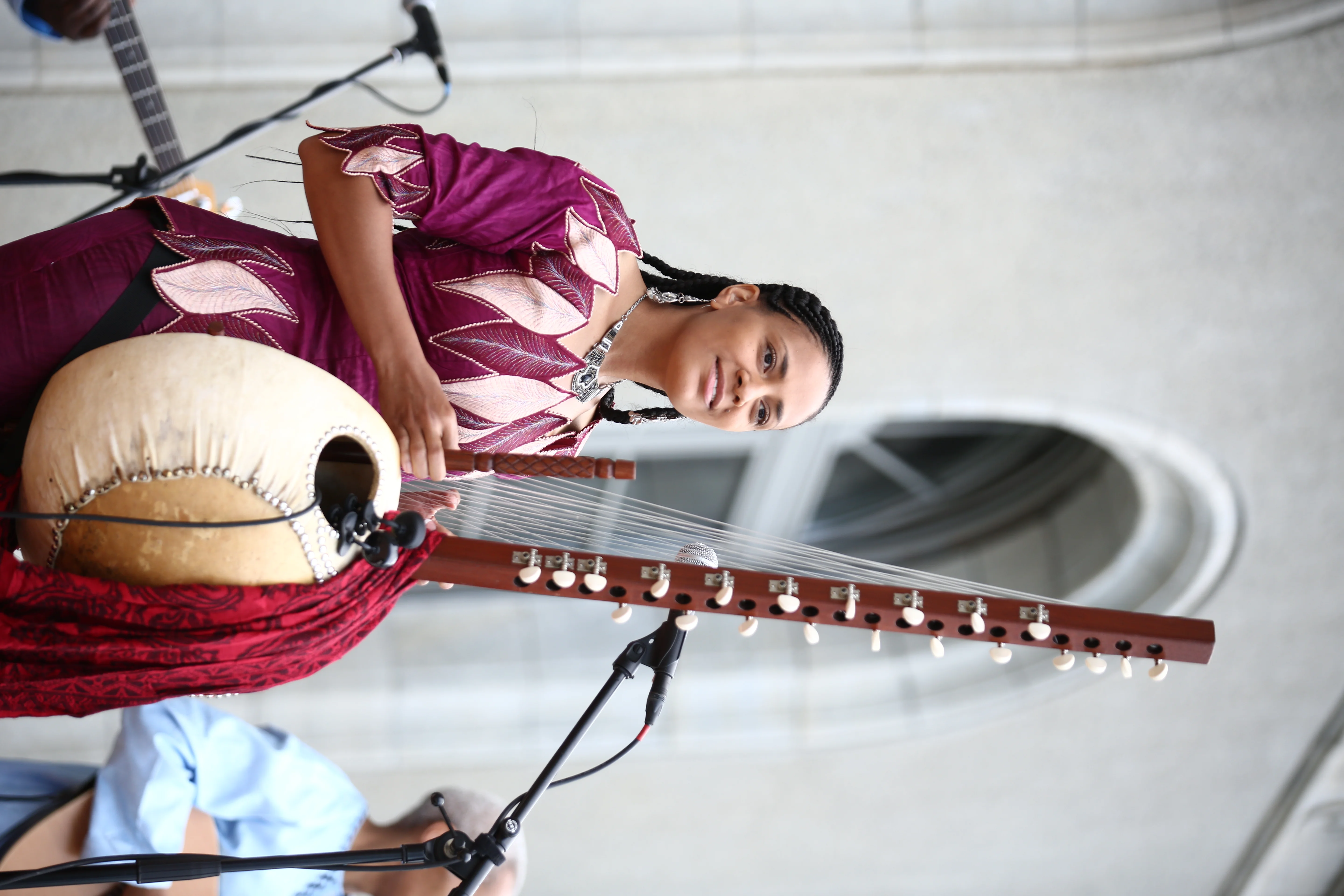
Image from Wikipedia
Image from Wikipedia
Sona Jobarteh – The groundbreaking Kora virtuoso bridging Griot tradition, West African modernity, and musical emancipation
An artist who does not preserve tradition, but reinterprets it
Sona Jobarteh is one of the most distinctive voices in contemporary African music. As a musician, composer, and actress, she merges the centuries-old Griot tradition of West Africa with an internationally influenced education and a clear, independent artistic profile. Born in 1983 in London with roots in a renowned Griot family from Gambia, she developed an early music career that intertwines cultural heritage, virtuosity, and intellectual depth.
Jobarteh is particularly known as one of the few women who play the Kora at a professional level within the Griot tradition. This 21-string instrument is central to her work, yet her approach goes far beyond: she thinks in terms of composition, arrangement, and sound architecture, working with West African rhythms, classical forms, and a stage presence that captivates both audience and critics alike. Therefore, her career is not only a matter of talent but also a cultural statement.
Roots in a musical dynasty
The biography of Sona Jobarteh is closely linked to one of the most significant musical lineages in West Africa. She is the granddaughter of the Griot Amadou Bansang Jobarteh and cousin of the Kora master Toumani Diabaté; her brother Tunde Jegede is also musically active. This heritage shapes her understanding of music as a carrier of history, identity, and social responsibility. In Griot culture, knowledge is passed down through generations, and this continuity forms the foundation of her artistic self-understanding.
At the same time, Jobarteh breaks away from the expectations of this tradition. While the Kora has historically been passed from father to son, she positions herself as a remarkable female figure with international appeal. Her career indicates an important shift in music history: tradition for her does not appear as a rigid inheritance but as a vibrant space for development.
Education, discipline, and an early access to the stage
Jobarteh's musical development began remarkably early. She learned to play the Kora at the age of three and made her public debut at the age of four at London’s Jazz Café. This early stage experience not only shaped her technical skills but also her confident presence, which later became one of her trademarks. Her artistic socialization thus combines familial tradition with extremely early professional experience.
Additionally, she has a solid academic education that distinctly sets her work apart from purely traditional or solely popular approaches. At the Royal College of Music, she studied cello, piano, and harpsichord, composition at the Purcell School, and African studies at the School of Oriental and African Studies. This combination of Western classical music, composition techniques, and a cultural studies perspective explains why her works often feel both archaically rooted and formally highly reflective.
The path to international recognition
Her professional breakthrough occurred through several avenues: concerts, collaborations, film compositions, and international festival appearances. As a member of the Tunde Jegede Ensemble, she toured across the UK, Ireland, and parts of the Caribbean. She later collaborated with the Irish Chamber Orchestra, Evelyn Glennie, as well as ensembles such as the Royal Philharmonic Orchestra, Britten Sinfonia, Milton Keynes City Orchestra, and Viva Chamber Orchestra. These contexts sharpened her approach to orchestration and opened her music to a broader audience.
The official biography on her website emphasizes that her live presence has been in high demand in recent years, and she performed on prestigious stages and festivals such as the Hollywood Bowl, WOMAD in Australia and New Zealand, and in New York in 2019. Such milestones underscore her international authority as a performer, whose music transcends cultural and geographical boundaries. It is the combination of technical control and emotional directness that makes her concerts so compelling.
Discography spanning debut, film music, and current maturation
Sona Jobarteh's discography includes notably her debut Fasiya and Badinyaa Kumoo from 2022. On her official website, Fasiya is described as a landmark album that gained widespread attention for its distinct sound. The production combines melodic accessibility, strong West African rhythms, and her status as a composer, producer, and multi-instrumentalist. Particularly remarkable is the versatility in her playing; on the album, she utilizes not only the Kora but also bass, Ngoni, flute, guitar, and percussion.
Another central element of her discography is the film score for Motherland by Owen Alik Shahadah. This work is described on her official website as an innovative attempt to reimagine a classical African sound world for cinema. Jobarteh used the Kora there, among other things, as a bass instrument, played guitar in a language reminiscent of an African lute, and even developed a new instrument, the “Nkoni,” which sonically bridges the Kora and Donso Ngoni. This work demonstrates her precise manipulation of timbre, texture, and cultural reference.
Musical signature: Kora as the voice of a new African modernity
Jobarteh's style thrives on a rare balance between virtuosity and clarity. The Kora in her hands is not a folkloric prop but a vital medium for complex musical ideas. Her melodies often feel open and immediate, yet beneath lies a fine sensitivity to harmonic movement, tension building, and sound layering. In her music, traditional forms meet modern production aesthetics without one displacing the other.
Her voice is also central to the impact of her compositions. The official biography describes her as a singer with a distinctive tone and catchy melody. Especially in connection with the Kora, a sound language emerges that feels both intimate and expansive: close to heritage yet free enough to open new spaces. This artistic development positions her as a significant figure in the dialogue between African tradition and global contemporary music.
Collaborations, orchestras, and artistic networking
A key part of Jobarteh's authority arises from her collaborative openness. She worked with Mícheál Ó Súilleabháin and Dónal Lunny on River of Sound with the Irish Chamber Orchestra and Evelyn Glennie. Additionally, she has been a member of the band Ocacia since 1999. Such projects demonstrate that her career has never been limited to a single genre but unfolds in musical border spaces.
Collaboration with orchestras and renowned soloists further strengthens her position as a composer with an intercultural perspective. In these contexts, it becomes clear that she is not only a virtuoso but also a translator between musical systems. Her compositions are neither purely academic nor purely popular but form a productive interface where West African tradition and international concert practice enrich one another.
Education, activism, and the Gambia Academy
A central chapter of her career is the founding of the Gambia Academy in 2015. According to her official website, it is the first institution in Gambia to familiarize young Africans with culture, tradition, and history alongside their academic education. Jobarteh connects her artistic work with an educational political claim that extends her role far beyond the music scene.
The Academy stands for a clear vision: education should not marginalize African identity but place it at the center. The website emphasizes that the institution works holistically, also considering the medical, social, and familial needs of the students. This approach turns Jobarteh into a cultural actor who understands music, pedagogy, and social responsibility as interconnected fields.
Critical reception and cultural influence
The press consistently highlights the connection between Jobarteh's artistic independence and cultural relevance. Her composition Innovation Through Preservation is mentioned on her official website, premiered in 2019 at the Purcell Room and described by The Observer as a connection of West African and Western classical sounds "to exuberant and poetic effect." Such reactions mark her as an artist who does not musealize her origins but transforms them into a new form.
This tension between preservation and innovation is also visible in Fasiya. The official album description and press reviews from outlets like Afropop Worldwide and Sound Sense Online speak of warmth, grace, and sonic renewal. Jobarteh has thus created a place in contemporary music that is rare and unmistakable: she is not just a Kora player but an architect of contemporary African sound culture.
Current projects, performances, and ongoing presence
In recent years, Jobarteh has remained internationally visible. Performances and concert formats are documented for 2025, including a concert in the context of Salif Keïta / Sona Jobarteh at the Philharmonie de Paris and an appearance in the context of the Berliner Philharmonie. Additionally, official and organizer pages reference ongoing live activity, confirming her status as a sought-after performer.
Furthermore, the Gambia Academy continues to be a central project of her public work. The text on the official website emphasizes that the institution is growing, with funding and infrastructure being expanded, and a campus as a permanent center for cultural and academic excellence is to be established. Jobarteh's current artistic identity thus cannot be reduced to new releases; it also encompasses institutional work, education, and cultural infrastructure.
Conclusion: An artist of substance, stance, and extraordinary stage magic
Sona Jobarteh is exciting because she combines musical excellence with cultural clarity. Her art unites Kora tradition, Western education, compositional skill, and social responsibility into a remarkably convincing whole. Listening to her music is not just an experience of virtuosity but a vibrant narrative about origin, identity, renewal, and female self-determination in music.
Especially live, this artist unfolds her full radiance: focused, expressive, and carried by an aura that extends far beyond the concert. Experiencing Sona Jobarteh on stage is to encounter a musician who does not reproduce tradition but transforms it. It is precisely this aspect that gives her special significance for the African and international music world.
Official channels of Sona Jobarteh:
- Instagram: no official profile found
- Facebook: no official profile found
- YouTube: no official profile found
- Spotify: no official profile found
- TikTok: no official profile found
Sources:
- Sona Jobarteh – Biography (official website)
- Sona Jobarteh – Fasiya (official website)
- Sona Jobarteh – Motherland: The Score (official website)
- Sona Jobarteh – Gambia Academy (official website)
- Sona Jobarteh – Videos (official website)
- Wikipedia: Sona Jobarteh
- ARTE Concert – Sona Jobarteh: Jazz à Porquerolles 2025
- Philharmonie de Paris – Salif Keïta / Sona Jobarteh
- Berliner Philharmoniker – Concert on 29.05.2025 with Sona Jobarteh
- Civic Music Association – Sona Jobarteh: March 2025
- Global Arts Live – Sona Jobarteh Band, March 22, 2025