
Bismarckstraße 3, Bayreuth
Bismarckstraße 3, 95444 Bayreuth, Germany
Löhehaus | Bayreuth & Events
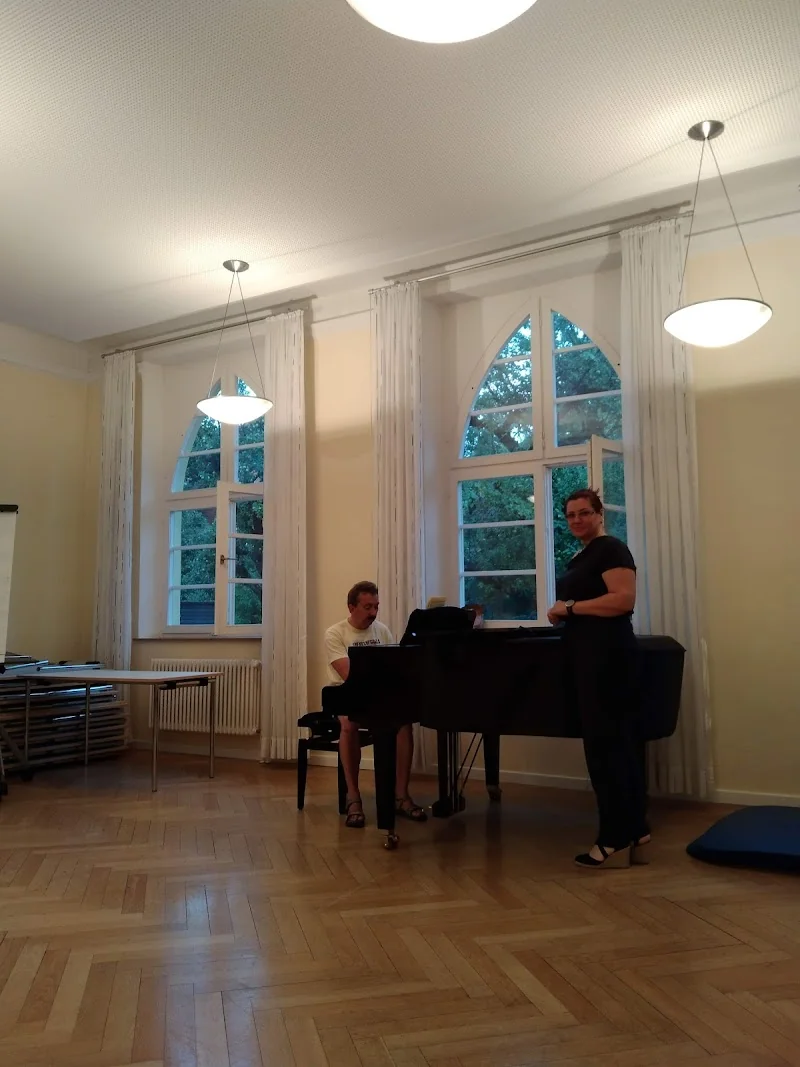
The Löhehaus at Bismarckstraße 3, 95444 Bayreuth, is a traditional place of education, culture, and encounter. Located in the central old town and owned by the Evangelical Lutheran Community of Bayreuth, the house today serves as a versatile event venue for courses, lectures, rehearsals, and community meetings. After a comprehensive renovation completed in December 2012, the building presents itself as a carefully modernized individual monument with a newly designed barrier-free access situation. This connects historical substance with contemporary use. The room ensemble includes a large hall that can be divided by a historical partition, additional meeting and seminar rooms on the ground floor, and a teaching kitchen that enables practical course formats. The Evangelical Family Education Center plus Multi-Generational House (FBS) regularly uses the Löhehaus for its program; in addition, church groups, choirs, and civil society initiatives meet here. Those looking for a suitable address for further education, exchange, and culture in the heart of Bayreuth will find a welcoming atmosphere, short distances, and flexible room solutions that can be adapted to the respective format in the Löhehaus.
Current Events and Courses at Löhehaus Bayreuth
The program at Löhehaus is largely managed and published by the Evangelical Family Education Center plus Multi-Generational House. The range of offerings extends from cooking and nutrition topics to readings, parent evenings, and lectures, as well as movement and relaxation formats. A characteristic example from the recent past is an evening under the motto of seasonal cuisine, where warming recipes were prepared together in winter – a format that ideally utilizes the strengths of the house, as culinary course concepts can be realized without external infrastructure thanks to the existing teaching kitchen. At the same time, health and movement-oriented activities regularly take place in the Löhehaus, such as Qigong courses, which were listed on church event portals for the beginning of the year. These events show how varied the usage can be: sometimes as a quiet, focused practice framework for small groups, sometimes as a lively meeting point with lectures and exchanges.
Civic initiatives, associations, and church groups also utilize the spaces. Membership meetings and group gatherings are announced in the event calendar, underscoring the Löhehaus as an established place for volunteer engagement. The Evangelical Family Education Center also refers to recurring offerings with parent-child connections, creative formats such as sewing or pottery courses, and educational series with external speakers. In total, there is a continuous flow of activities: According to the Family Education Center, hundreds of participants use the offerings at the locations each week, including in the Löhehaus, where courses, rehearsals, and open meetings take place. Those wishing to inform themselves or register can find the current announcements in the digital program of the Family Education Center; individual dates are clearly marked with the note “Event location: Löhehaus, Bismarckstraße 3,” making it easy for visitors to identify.
In addition to courses and further education, the Löhehaus also serves as a place for musical rehearsals. The documents of the Family Education Center explicitly mention the use of the house by choirs and groups of the city church. For such rehearsals or vocal projects, the characteristics of the divisible hall are an advantage: acoustically, the room size can be adjusted, and parallel working phases – such as sectional rehearsals – are easier to organize due to the divisible layout. Occasionally, thematic evenings, readings, or panel discussions are also featured. This diversity makes the Löhehaus a place that is not just an address on paper but is continuously filled with life – from the cooking apron to the music stand, from the parent course to the membership meeting.
Directions and Parking at Löhehaus (Bismarckstraße 3)
Thanks to its location in the Bayreuth old town, the Löhehaus is easily accessible on foot, by bicycle, as well as by bus and car. The municipal bus service is operated by the Bayreuth city works; the central hub is the Central Bus Station (ZOH) in the city center. From there, Bismarckstraße is conveniently reachable on foot, and depending on the bus lines, nearby city center stops – such as Sternplatz, Opera House, or Wahnfried – are also suitable drop-off points if one wants to keep the route to the Löhehaus as short as possible. Current line and stop information, including schedules and network plans, are provided digitally by the city works; for last-minute changes, it is advisable to check the respective notices or apps.
For those arriving by car, numerous parking options are available in Bayreuth's city center. In addition to above-ground parking spaces, there are several central parking garages that significantly facilitate access to the old town. Frequently used facilities include the Badstraße parking garage (P7) near the museum and library, the Rotmain Center parking garage, the Stadthalle parking garage, and other garages and parking spaces listed in city overviews and digital parking maps. Rates and opening hours vary by operator; as construction adjustments and renovations are taking place in the city center, it is worthwhile to take a quick look at the current notices from the city and operators before arriving. Those dropping off passengers can occasionally find short-term stopping options in the surrounding streets – however, parking regulations must be strictly observed. In general, due to the central location of the Löhehaus, the combination of “parking garage + short walk” is often the least stressful solution, especially when events start in the early evening.
Travelers arriving by train reach Bayreuth via the main train station. There is a close connection between the station and the old town via the bus service, with the ZOH in the city center serving as a transfer point. From there, the path towards Bismarckstraße leads through the developed urban fabric with short distances to cultural institutions, churches, and administrative offices. Those arriving by bicycle benefit from the good accessibility of the old town; depending on the day of the week and time of day, bicycle parking options in side streets are more practical than directly on the main axis. Due to the proximity to central axes and sights, the Löhehaus is intuitively findable not only for residents of Bayreuth but also for guests.
Rooms, Equipment, and Flexible Use
The spatial centerpiece of the Löhehaus is a large hall that can be divided into two independent areas by a historical partition. This architectural feature allows formats to be scaled very differently: from the concentrated working atmosphere of smaller groups to events that require larger seating arrangements. In addition to the hall, there is a seminar room on the ground floor, which is particularly suitable for workshops, meetings, courses in small groups, or advisory offerings. Characteristic of the Löhehaus profile is also a teaching kitchen. It is not just an additional feature but an integral part of the educational offerings of the Evangelical Family Education Center: cooking and nutrition courses can take place directly in the house without additional logistics; at the same time, the kitchen provides a low-threshold framework for communal activities where cooking is used as a medium for learning and togetherness.
The furnishings are adapted to the needs. For lectures and readings, row seating is common, while workshops and parent evenings often use table islands or U-shapes. Choirs and music groups utilize the open floor space for rehearsals; with a divided hall, two acoustically separated working areas are created. Through the combination of the hall, seminar room on the ground floor, and teaching kitchen, the Löhehaus covers a wide range – from educational formats to cultural rehearsals to meetings. The spatial proximity of the units supports the interplay of theory, practice, and encounter: a lecture can take place in the hall while a coaching session is running in the seminar room and a course is being prepared in the kitchen.
Important for all users is the barrier-free access that was created during the renovation. This measure not only improves accessibility for people with mobility impairments but also facilitates the transport of materials for courses and events. In publicly accessible representations of the renovation, the Löhehaus is listed as an individual monument; the enhancement was carried out in accordance with monument preservation requirements. For practical use, this means: historical atmosphere and details remain tangible, while processes are designed to be more modern, safer, and inclusive. Those working with technology – such as sound or presentation technology – usually bring their own or clarify the need in advance with the organizers. Due to the flexible, non-museum-like use, the Löhehaus is open to various formats without claiming to be a pure concert or theater hall.
History, Sponsorship, and Major Renovation 2011/2012
The Löhehaus is named after the Lutheran theologian Wilhelm Löhe (1808–1872). It stands as an individual monument at Bismarckstraße 3 and is owned by the Evangelical Lutheran Community of Bayreuth. In its recent history, the house was extensively enhanced: the major renovation began in 2011 and was completed in December 2012. A central result of the work is the barrier-free access situation that meets today’s usage requirements while respecting the historical substance. In professional publications, the historical partition wall is highlighted, which allows the large hall to be separated into a smaller hall – a feature that is both architecturally interesting and offers practical advantages for operation.
The Evangelical Family Education Center plus Multi-Generational House has been using the Löhehaus for many years for part of its offering structure. In retrospectives of the institution, well-known course formats in the Löhehaus are mentioned, including a traditional teaching kitchen work that has established the defining spectrum of cooking and nutrition courses. At the same time, institutional representations contain references to the usage spectrum: groups and circles of the city church – such as choirs – utilize the spaces; in total, hundreds of people visit the family and education-oriented offerings weekly. Before the renovation, the church community also used a community library on the ground floor; its dissolution was organizationally accompanied during the renovation phase. The historical integration of the house into church and urban life is also reflected in its address location: Bismarckstraße is one of the central urban axes that connect the cultural fabric of Bayreuth – with museums, churches, educational, and administrative institutions – through short distances.
In public perception, the name “Löhehaus” is sometimes associated with other cities. For example, there is the district center Kult9 in the Löhehaus of Open Disability Work in Munich, and in Selb, a “Children's Daycare Löhehaus” is part of the church infrastructure. For Bayreuth, it is important to note: the Löhehaus here is primarily a place for courses, rehearsals, and encounters under the roof of the Evangelical Lutheran Community and the Evangelical Family Education Center plus Multi-Generational House. This clarification helps avoid search queries and navigation errors – especially when users search for the term “Löhehaus” without a location addition.
Tickets, Registration, and Usage Practice
Since the Löhehaus is not a pure concert or theater house, participation in events usually does not occur through a classic ticket shop with a seating plan, but through registrations or notices in the respective event announcements. For courses, workshops, and lectures of the Evangelical Family Education Center plus Multi-Generational House, registration directly with the institution is emphasized; here, timeframes, target groups, fees, and any material costs are indicated. Event announcements explicitly mention the location “Löhehaus, Bismarckstraße 3, 95444 Bayreuth,” which facilitates orientation. For other formats – such as membership meetings or internal gatherings – the inviting groups or associations handle communication. This keeps the Löhehaus open and multifunctional without committing to a single distribution channel.
Those requesting rooms in the Löhehaus for community-related activities, rehearsals, or education-related formats usually contact the Evangelical Lutheran Community or the Evangelical Family Education Center if it concerns their course operations. The modalities – from availability to setup and teardown – are individually coordinated. Since the seating is variable and the hall has a divisible structure, it is advisable to clarify the required arrangement (rows, circle of chairs, tables) and possible additional needs early on. For events involving kitchen use, hygiene and material questions should be discussed in advance; the teaching kitchen is a special asset of the house but is structured for orderly course operations.
It is also advisable to check the city’s information on arrival (public transport, parking), especially during events at peak traffic times. For visitors who are not familiar with the area, it is recommended to check in the event profile whether the door opening, access routes, or a meeting point are explained in the announcement. Positive feedback from user reviews often highlights the friendly support and pleasant atmosphere – aspects that shape the Löhehaus as a place of welcoming culture and promote the willingness to participate in further formats.
Seating Arrangement, Seating, and Typical Formats
A common need for information concerns the “seating plan” – especially when one is used to fixed seat numbers from large concert halls or theaters. The Löhehaus does not have a permanently published, numbered seating plan; instead, the seating is tailored to the respective format. For lectures, row seating predominates, while courses typically use table groups or U-shapes, and for rehearsals, open areas with circles of chairs are common. Thanks to the historical partition wall, the large hall can be divided into a smaller hall; this creates parallel usable spaces or more compact acoustic zones. This flexibility is not only organizationally sensible but also promotes the didactics of many courses, in which transitions between input, practice, and reflection are planned.
The teaching kitchen is predestined for practical nutrition and cooking formats. Events of this kind typically feature a combination of demonstration, joint preparation, and subsequent exchange – often supplemented with seasonal themes. For movement and relaxation offerings such as Qigong or similar formats, the hall serves as an open space; mats or small devices are brought as needed. For readings and discussion evenings, platforms, lecterns, or standing and seating areas ensure clear sightlines; in smaller setups, the seminar room on the ground floor functions as a quiet place for intensive discussions. For all variants, the processes are designed in the spirit of educational and community operations – low-threshold, participation-oriented, and focused on encounter.
Sources:
- Bavarian Chamber of Architects – Major Renovation Löhehaus, Bayreuth (Project page, address, monument protection, barrier-free access, completion December 2012)
- Evangelical Family Education Center plus Multi-Generational House Bayreuth – About Us (Use of the Löhehaus, teaching kitchen, weekly use, renovation years)
- FBS Bayreuth – Course Example “Warming Winter Cuisine” (Date, Location: Löhehaus, Bismarckstraße 3)
- Evangelical-Termine.de – Qigong Gymnastics in the Löhehaus (Movement format in the Löhehaus)
- 11880 – Löhehaus Bayreuth (Address, phone, location note old town)
- meinestadt.de – Löhehaus, Seminar Room EG (Location mention, room reference)
- City Works Bayreuth – Bus Lines & Stops (Network plans, stop overview for public transport)
- VHS Bayreuth – Directions, Parking Options & Bus Lines (City center stops like Sternplatz, Opera House, Wahnfried)
- Bayreuth Tourism – Parking in the City Center (Basic information, parking garages and spaces)
- next-parken.de – Parking in Bayreuth (Overview including Badstraße parking garage P7, Rotmain Center, Stadthalle, Dammallee)
- “Do You Speak German” – Overview of Volunteer German Courses (Location mention Löhehaus, Bismarckstraße 3)
- J.A.Z. Bayreuth – Event Notice with Location Löhehaus (Membership Meeting, Address Mention)
Show moreShow less
Löhehaus | Bayreuth & Events
The Löhehaus at Bismarckstraße 3, 95444 Bayreuth, is a traditional place of education, culture, and encounter. Located in the central old town and owned by the Evangelical Lutheran Community of Bayreuth, the house today serves as a versatile event venue for courses, lectures, rehearsals, and community meetings. After a comprehensive renovation completed in December 2012, the building presents itself as a carefully modernized individual monument with a newly designed barrier-free access situation. This connects historical substance with contemporary use. The room ensemble includes a large hall that can be divided by a historical partition, additional meeting and seminar rooms on the ground floor, and a teaching kitchen that enables practical course formats. The Evangelical Family Education Center plus Multi-Generational House (FBS) regularly uses the Löhehaus for its program; in addition, church groups, choirs, and civil society initiatives meet here. Those looking for a suitable address for further education, exchange, and culture in the heart of Bayreuth will find a welcoming atmosphere, short distances, and flexible room solutions that can be adapted to the respective format in the Löhehaus.
Current Events and Courses at Löhehaus Bayreuth
The program at Löhehaus is largely managed and published by the Evangelical Family Education Center plus Multi-Generational House. The range of offerings extends from cooking and nutrition topics to readings, parent evenings, and lectures, as well as movement and relaxation formats. A characteristic example from the recent past is an evening under the motto of seasonal cuisine, where warming recipes were prepared together in winter – a format that ideally utilizes the strengths of the house, as culinary course concepts can be realized without external infrastructure thanks to the existing teaching kitchen. At the same time, health and movement-oriented activities regularly take place in the Löhehaus, such as Qigong courses, which were listed on church event portals for the beginning of the year. These events show how varied the usage can be: sometimes as a quiet, focused practice framework for small groups, sometimes as a lively meeting point with lectures and exchanges.
Civic initiatives, associations, and church groups also utilize the spaces. Membership meetings and group gatherings are announced in the event calendar, underscoring the Löhehaus as an established place for volunteer engagement. The Evangelical Family Education Center also refers to recurring offerings with parent-child connections, creative formats such as sewing or pottery courses, and educational series with external speakers. In total, there is a continuous flow of activities: According to the Family Education Center, hundreds of participants use the offerings at the locations each week, including in the Löhehaus, where courses, rehearsals, and open meetings take place. Those wishing to inform themselves or register can find the current announcements in the digital program of the Family Education Center; individual dates are clearly marked with the note “Event location: Löhehaus, Bismarckstraße 3,” making it easy for visitors to identify.
In addition to courses and further education, the Löhehaus also serves as a place for musical rehearsals. The documents of the Family Education Center explicitly mention the use of the house by choirs and groups of the city church. For such rehearsals or vocal projects, the characteristics of the divisible hall are an advantage: acoustically, the room size can be adjusted, and parallel working phases – such as sectional rehearsals – are easier to organize due to the divisible layout. Occasionally, thematic evenings, readings, or panel discussions are also featured. This diversity makes the Löhehaus a place that is not just an address on paper but is continuously filled with life – from the cooking apron to the music stand, from the parent course to the membership meeting.
Directions and Parking at Löhehaus (Bismarckstraße 3)
Thanks to its location in the Bayreuth old town, the Löhehaus is easily accessible on foot, by bicycle, as well as by bus and car. The municipal bus service is operated by the Bayreuth city works; the central hub is the Central Bus Station (ZOH) in the city center. From there, Bismarckstraße is conveniently reachable on foot, and depending on the bus lines, nearby city center stops – such as Sternplatz, Opera House, or Wahnfried – are also suitable drop-off points if one wants to keep the route to the Löhehaus as short as possible. Current line and stop information, including schedules and network plans, are provided digitally by the city works; for last-minute changes, it is advisable to check the respective notices or apps.
For those arriving by car, numerous parking options are available in Bayreuth's city center. In addition to above-ground parking spaces, there are several central parking garages that significantly facilitate access to the old town. Frequently used facilities include the Badstraße parking garage (P7) near the museum and library, the Rotmain Center parking garage, the Stadthalle parking garage, and other garages and parking spaces listed in city overviews and digital parking maps. Rates and opening hours vary by operator; as construction adjustments and renovations are taking place in the city center, it is worthwhile to take a quick look at the current notices from the city and operators before arriving. Those dropping off passengers can occasionally find short-term stopping options in the surrounding streets – however, parking regulations must be strictly observed. In general, due to the central location of the Löhehaus, the combination of “parking garage + short walk” is often the least stressful solution, especially when events start in the early evening.
Travelers arriving by train reach Bayreuth via the main train station. There is a close connection between the station and the old town via the bus service, with the ZOH in the city center serving as a transfer point. From there, the path towards Bismarckstraße leads through the developed urban fabric with short distances to cultural institutions, churches, and administrative offices. Those arriving by bicycle benefit from the good accessibility of the old town; depending on the day of the week and time of day, bicycle parking options in side streets are more practical than directly on the main axis. Due to the proximity to central axes and sights, the Löhehaus is intuitively findable not only for residents of Bayreuth but also for guests.
Rooms, Equipment, and Flexible Use
The spatial centerpiece of the Löhehaus is a large hall that can be divided into two independent areas by a historical partition. This architectural feature allows formats to be scaled very differently: from the concentrated working atmosphere of smaller groups to events that require larger seating arrangements. In addition to the hall, there is a seminar room on the ground floor, which is particularly suitable for workshops, meetings, courses in small groups, or advisory offerings. Characteristic of the Löhehaus profile is also a teaching kitchen. It is not just an additional feature but an integral part of the educational offerings of the Evangelical Family Education Center: cooking and nutrition courses can take place directly in the house without additional logistics; at the same time, the kitchen provides a low-threshold framework for communal activities where cooking is used as a medium for learning and togetherness.
The furnishings are adapted to the needs. For lectures and readings, row seating is common, while workshops and parent evenings often use table islands or U-shapes. Choirs and music groups utilize the open floor space for rehearsals; with a divided hall, two acoustically separated working areas are created. Through the combination of the hall, seminar room on the ground floor, and teaching kitchen, the Löhehaus covers a wide range – from educational formats to cultural rehearsals to meetings. The spatial proximity of the units supports the interplay of theory, practice, and encounter: a lecture can take place in the hall while a coaching session is running in the seminar room and a course is being prepared in the kitchen.
Important for all users is the barrier-free access that was created during the renovation. This measure not only improves accessibility for people with mobility impairments but also facilitates the transport of materials for courses and events. In publicly accessible representations of the renovation, the Löhehaus is listed as an individual monument; the enhancement was carried out in accordance with monument preservation requirements. For practical use, this means: historical atmosphere and details remain tangible, while processes are designed to be more modern, safer, and inclusive. Those working with technology – such as sound or presentation technology – usually bring their own or clarify the need in advance with the organizers. Due to the flexible, non-museum-like use, the Löhehaus is open to various formats without claiming to be a pure concert or theater hall.
History, Sponsorship, and Major Renovation 2011/2012
The Löhehaus is named after the Lutheran theologian Wilhelm Löhe (1808–1872). It stands as an individual monument at Bismarckstraße 3 and is owned by the Evangelical Lutheran Community of Bayreuth. In its recent history, the house was extensively enhanced: the major renovation began in 2011 and was completed in December 2012. A central result of the work is the barrier-free access situation that meets today’s usage requirements while respecting the historical substance. In professional publications, the historical partition wall is highlighted, which allows the large hall to be separated into a smaller hall – a feature that is both architecturally interesting and offers practical advantages for operation.
The Evangelical Family Education Center plus Multi-Generational House has been using the Löhehaus for many years for part of its offering structure. In retrospectives of the institution, well-known course formats in the Löhehaus are mentioned, including a traditional teaching kitchen work that has established the defining spectrum of cooking and nutrition courses. At the same time, institutional representations contain references to the usage spectrum: groups and circles of the city church – such as choirs – utilize the spaces; in total, hundreds of people visit the family and education-oriented offerings weekly. Before the renovation, the church community also used a community library on the ground floor; its dissolution was organizationally accompanied during the renovation phase. The historical integration of the house into church and urban life is also reflected in its address location: Bismarckstraße is one of the central urban axes that connect the cultural fabric of Bayreuth – with museums, churches, educational, and administrative institutions – through short distances.
In public perception, the name “Löhehaus” is sometimes associated with other cities. For example, there is the district center Kult9 in the Löhehaus of Open Disability Work in Munich, and in Selb, a “Children's Daycare Löhehaus” is part of the church infrastructure. For Bayreuth, it is important to note: the Löhehaus here is primarily a place for courses, rehearsals, and encounters under the roof of the Evangelical Lutheran Community and the Evangelical Family Education Center plus Multi-Generational House. This clarification helps avoid search queries and navigation errors – especially when users search for the term “Löhehaus” without a location addition.
Tickets, Registration, and Usage Practice
Since the Löhehaus is not a pure concert or theater house, participation in events usually does not occur through a classic ticket shop with a seating plan, but through registrations or notices in the respective event announcements. For courses, workshops, and lectures of the Evangelical Family Education Center plus Multi-Generational House, registration directly with the institution is emphasized; here, timeframes, target groups, fees, and any material costs are indicated. Event announcements explicitly mention the location “Löhehaus, Bismarckstraße 3, 95444 Bayreuth,” which facilitates orientation. For other formats – such as membership meetings or internal gatherings – the inviting groups or associations handle communication. This keeps the Löhehaus open and multifunctional without committing to a single distribution channel.
Those requesting rooms in the Löhehaus for community-related activities, rehearsals, or education-related formats usually contact the Evangelical Lutheran Community or the Evangelical Family Education Center if it concerns their course operations. The modalities – from availability to setup and teardown – are individually coordinated. Since the seating is variable and the hall has a divisible structure, it is advisable to clarify the required arrangement (rows, circle of chairs, tables) and possible additional needs early on. For events involving kitchen use, hygiene and material questions should be discussed in advance; the teaching kitchen is a special asset of the house but is structured for orderly course operations.
It is also advisable to check the city’s information on arrival (public transport, parking), especially during events at peak traffic times. For visitors who are not familiar with the area, it is recommended to check in the event profile whether the door opening, access routes, or a meeting point are explained in the announcement. Positive feedback from user reviews often highlights the friendly support and pleasant atmosphere – aspects that shape the Löhehaus as a place of welcoming culture and promote the willingness to participate in further formats.
Seating Arrangement, Seating, and Typical Formats
A common need for information concerns the “seating plan” – especially when one is used to fixed seat numbers from large concert halls or theaters. The Löhehaus does not have a permanently published, numbered seating plan; instead, the seating is tailored to the respective format. For lectures, row seating predominates, while courses typically use table groups or U-shapes, and for rehearsals, open areas with circles of chairs are common. Thanks to the historical partition wall, the large hall can be divided into a smaller hall; this creates parallel usable spaces or more compact acoustic zones. This flexibility is not only organizationally sensible but also promotes the didactics of many courses, in which transitions between input, practice, and reflection are planned.
The teaching kitchen is predestined for practical nutrition and cooking formats. Events of this kind typically feature a combination of demonstration, joint preparation, and subsequent exchange – often supplemented with seasonal themes. For movement and relaxation offerings such as Qigong or similar formats, the hall serves as an open space; mats or small devices are brought as needed. For readings and discussion evenings, platforms, lecterns, or standing and seating areas ensure clear sightlines; in smaller setups, the seminar room on the ground floor functions as a quiet place for intensive discussions. For all variants, the processes are designed in the spirit of educational and community operations – low-threshold, participation-oriented, and focused on encounter.
Sources:
- Bavarian Chamber of Architects – Major Renovation Löhehaus, Bayreuth (Project page, address, monument protection, barrier-free access, completion December 2012)
- Evangelical Family Education Center plus Multi-Generational House Bayreuth – About Us (Use of the Löhehaus, teaching kitchen, weekly use, renovation years)
- FBS Bayreuth – Course Example “Warming Winter Cuisine” (Date, Location: Löhehaus, Bismarckstraße 3)
- Evangelical-Termine.de – Qigong Gymnastics in the Löhehaus (Movement format in the Löhehaus)
- 11880 – Löhehaus Bayreuth (Address, phone, location note old town)
- meinestadt.de – Löhehaus, Seminar Room EG (Location mention, room reference)
- City Works Bayreuth – Bus Lines & Stops (Network plans, stop overview for public transport)
- VHS Bayreuth – Directions, Parking Options & Bus Lines (City center stops like Sternplatz, Opera House, Wahnfried)
- Bayreuth Tourism – Parking in the City Center (Basic information, parking garages and spaces)
- next-parken.de – Parking in Bayreuth (Overview including Badstraße parking garage P7, Rotmain Center, Stadthalle, Dammallee)
- “Do You Speak German” – Overview of Volunteer German Courses (Location mention Löhehaus, Bismarckstraße 3)
- J.A.Z. Bayreuth – Event Notice with Location Löhehaus (Membership Meeting, Address Mention)
Löhehaus | Bayreuth & Events
The Löhehaus at Bismarckstraße 3, 95444 Bayreuth, is a traditional place of education, culture, and encounter. Located in the central old town and owned by the Evangelical Lutheran Community of Bayreuth, the house today serves as a versatile event venue for courses, lectures, rehearsals, and community meetings. After a comprehensive renovation completed in December 2012, the building presents itself as a carefully modernized individual monument with a newly designed barrier-free access situation. This connects historical substance with contemporary use. The room ensemble includes a large hall that can be divided by a historical partition, additional meeting and seminar rooms on the ground floor, and a teaching kitchen that enables practical course formats. The Evangelical Family Education Center plus Multi-Generational House (FBS) regularly uses the Löhehaus for its program; in addition, church groups, choirs, and civil society initiatives meet here. Those looking for a suitable address for further education, exchange, and culture in the heart of Bayreuth will find a welcoming atmosphere, short distances, and flexible room solutions that can be adapted to the respective format in the Löhehaus.
Current Events and Courses at Löhehaus Bayreuth
The program at Löhehaus is largely managed and published by the Evangelical Family Education Center plus Multi-Generational House. The range of offerings extends from cooking and nutrition topics to readings, parent evenings, and lectures, as well as movement and relaxation formats. A characteristic example from the recent past is an evening under the motto of seasonal cuisine, where warming recipes were prepared together in winter – a format that ideally utilizes the strengths of the house, as culinary course concepts can be realized without external infrastructure thanks to the existing teaching kitchen. At the same time, health and movement-oriented activities regularly take place in the Löhehaus, such as Qigong courses, which were listed on church event portals for the beginning of the year. These events show how varied the usage can be: sometimes as a quiet, focused practice framework for small groups, sometimes as a lively meeting point with lectures and exchanges.
Civic initiatives, associations, and church groups also utilize the spaces. Membership meetings and group gatherings are announced in the event calendar, underscoring the Löhehaus as an established place for volunteer engagement. The Evangelical Family Education Center also refers to recurring offerings with parent-child connections, creative formats such as sewing or pottery courses, and educational series with external speakers. In total, there is a continuous flow of activities: According to the Family Education Center, hundreds of participants use the offerings at the locations each week, including in the Löhehaus, where courses, rehearsals, and open meetings take place. Those wishing to inform themselves or register can find the current announcements in the digital program of the Family Education Center; individual dates are clearly marked with the note “Event location: Löhehaus, Bismarckstraße 3,” making it easy for visitors to identify.
In addition to courses and further education, the Löhehaus also serves as a place for musical rehearsals. The documents of the Family Education Center explicitly mention the use of the house by choirs and groups of the city church. For such rehearsals or vocal projects, the characteristics of the divisible hall are an advantage: acoustically, the room size can be adjusted, and parallel working phases – such as sectional rehearsals – are easier to organize due to the divisible layout. Occasionally, thematic evenings, readings, or panel discussions are also featured. This diversity makes the Löhehaus a place that is not just an address on paper but is continuously filled with life – from the cooking apron to the music stand, from the parent course to the membership meeting.
Directions and Parking at Löhehaus (Bismarckstraße 3)
Thanks to its location in the Bayreuth old town, the Löhehaus is easily accessible on foot, by bicycle, as well as by bus and car. The municipal bus service is operated by the Bayreuth city works; the central hub is the Central Bus Station (ZOH) in the city center. From there, Bismarckstraße is conveniently reachable on foot, and depending on the bus lines, nearby city center stops – such as Sternplatz, Opera House, or Wahnfried – are also suitable drop-off points if one wants to keep the route to the Löhehaus as short as possible. Current line and stop information, including schedules and network plans, are provided digitally by the city works; for last-minute changes, it is advisable to check the respective notices or apps.
For those arriving by car, numerous parking options are available in Bayreuth's city center. In addition to above-ground parking spaces, there are several central parking garages that significantly facilitate access to the old town. Frequently used facilities include the Badstraße parking garage (P7) near the museum and library, the Rotmain Center parking garage, the Stadthalle parking garage, and other garages and parking spaces listed in city overviews and digital parking maps. Rates and opening hours vary by operator; as construction adjustments and renovations are taking place in the city center, it is worthwhile to take a quick look at the current notices from the city and operators before arriving. Those dropping off passengers can occasionally find short-term stopping options in the surrounding streets – however, parking regulations must be strictly observed. In general, due to the central location of the Löhehaus, the combination of “parking garage + short walk” is often the least stressful solution, especially when events start in the early evening.
Travelers arriving by train reach Bayreuth via the main train station. There is a close connection between the station and the old town via the bus service, with the ZOH in the city center serving as a transfer point. From there, the path towards Bismarckstraße leads through the developed urban fabric with short distances to cultural institutions, churches, and administrative offices. Those arriving by bicycle benefit from the good accessibility of the old town; depending on the day of the week and time of day, bicycle parking options in side streets are more practical than directly on the main axis. Due to the proximity to central axes and sights, the Löhehaus is intuitively findable not only for residents of Bayreuth but also for guests.
Rooms, Equipment, and Flexible Use
The spatial centerpiece of the Löhehaus is a large hall that can be divided into two independent areas by a historical partition. This architectural feature allows formats to be scaled very differently: from the concentrated working atmosphere of smaller groups to events that require larger seating arrangements. In addition to the hall, there is a seminar room on the ground floor, which is particularly suitable for workshops, meetings, courses in small groups, or advisory offerings. Characteristic of the Löhehaus profile is also a teaching kitchen. It is not just an additional feature but an integral part of the educational offerings of the Evangelical Family Education Center: cooking and nutrition courses can take place directly in the house without additional logistics; at the same time, the kitchen provides a low-threshold framework for communal activities where cooking is used as a medium for learning and togetherness.
The furnishings are adapted to the needs. For lectures and readings, row seating is common, while workshops and parent evenings often use table islands or U-shapes. Choirs and music groups utilize the open floor space for rehearsals; with a divided hall, two acoustically separated working areas are created. Through the combination of the hall, seminar room on the ground floor, and teaching kitchen, the Löhehaus covers a wide range – from educational formats to cultural rehearsals to meetings. The spatial proximity of the units supports the interplay of theory, practice, and encounter: a lecture can take place in the hall while a coaching session is running in the seminar room and a course is being prepared in the kitchen.
Important for all users is the barrier-free access that was created during the renovation. This measure not only improves accessibility for people with mobility impairments but also facilitates the transport of materials for courses and events. In publicly accessible representations of the renovation, the Löhehaus is listed as an individual monument; the enhancement was carried out in accordance with monument preservation requirements. For practical use, this means: historical atmosphere and details remain tangible, while processes are designed to be more modern, safer, and inclusive. Those working with technology – such as sound or presentation technology – usually bring their own or clarify the need in advance with the organizers. Due to the flexible, non-museum-like use, the Löhehaus is open to various formats without claiming to be a pure concert or theater hall.
History, Sponsorship, and Major Renovation 2011/2012
The Löhehaus is named after the Lutheran theologian Wilhelm Löhe (1808–1872). It stands as an individual monument at Bismarckstraße 3 and is owned by the Evangelical Lutheran Community of Bayreuth. In its recent history, the house was extensively enhanced: the major renovation began in 2011 and was completed in December 2012. A central result of the work is the barrier-free access situation that meets today’s usage requirements while respecting the historical substance. In professional publications, the historical partition wall is highlighted, which allows the large hall to be separated into a smaller hall – a feature that is both architecturally interesting and offers practical advantages for operation.
The Evangelical Family Education Center plus Multi-Generational House has been using the Löhehaus for many years for part of its offering structure. In retrospectives of the institution, well-known course formats in the Löhehaus are mentioned, including a traditional teaching kitchen work that has established the defining spectrum of cooking and nutrition courses. At the same time, institutional representations contain references to the usage spectrum: groups and circles of the city church – such as choirs – utilize the spaces; in total, hundreds of people visit the family and education-oriented offerings weekly. Before the renovation, the church community also used a community library on the ground floor; its dissolution was organizationally accompanied during the renovation phase. The historical integration of the house into church and urban life is also reflected in its address location: Bismarckstraße is one of the central urban axes that connect the cultural fabric of Bayreuth – with museums, churches, educational, and administrative institutions – through short distances.
In public perception, the name “Löhehaus” is sometimes associated with other cities. For example, there is the district center Kult9 in the Löhehaus of Open Disability Work in Munich, and in Selb, a “Children's Daycare Löhehaus” is part of the church infrastructure. For Bayreuth, it is important to note: the Löhehaus here is primarily a place for courses, rehearsals, and encounters under the roof of the Evangelical Lutheran Community and the Evangelical Family Education Center plus Multi-Generational House. This clarification helps avoid search queries and navigation errors – especially when users search for the term “Löhehaus” without a location addition.
Tickets, Registration, and Usage Practice
Since the Löhehaus is not a pure concert or theater house, participation in events usually does not occur through a classic ticket shop with a seating plan, but through registrations or notices in the respective event announcements. For courses, workshops, and lectures of the Evangelical Family Education Center plus Multi-Generational House, registration directly with the institution is emphasized; here, timeframes, target groups, fees, and any material costs are indicated. Event announcements explicitly mention the location “Löhehaus, Bismarckstraße 3, 95444 Bayreuth,” which facilitates orientation. For other formats – such as membership meetings or internal gatherings – the inviting groups or associations handle communication. This keeps the Löhehaus open and multifunctional without committing to a single distribution channel.
Those requesting rooms in the Löhehaus for community-related activities, rehearsals, or education-related formats usually contact the Evangelical Lutheran Community or the Evangelical Family Education Center if it concerns their course operations. The modalities – from availability to setup and teardown – are individually coordinated. Since the seating is variable and the hall has a divisible structure, it is advisable to clarify the required arrangement (rows, circle of chairs, tables) and possible additional needs early on. For events involving kitchen use, hygiene and material questions should be discussed in advance; the teaching kitchen is a special asset of the house but is structured for orderly course operations.
It is also advisable to check the city’s information on arrival (public transport, parking), especially during events at peak traffic times. For visitors who are not familiar with the area, it is recommended to check in the event profile whether the door opening, access routes, or a meeting point are explained in the announcement. Positive feedback from user reviews often highlights the friendly support and pleasant atmosphere – aspects that shape the Löhehaus as a place of welcoming culture and promote the willingness to participate in further formats.
Seating Arrangement, Seating, and Typical Formats
A common need for information concerns the “seating plan” – especially when one is used to fixed seat numbers from large concert halls or theaters. The Löhehaus does not have a permanently published, numbered seating plan; instead, the seating is tailored to the respective format. For lectures, row seating predominates, while courses typically use table groups or U-shapes, and for rehearsals, open areas with circles of chairs are common. Thanks to the historical partition wall, the large hall can be divided into a smaller hall; this creates parallel usable spaces or more compact acoustic zones. This flexibility is not only organizationally sensible but also promotes the didactics of many courses, in which transitions between input, practice, and reflection are planned.
The teaching kitchen is predestined for practical nutrition and cooking formats. Events of this kind typically feature a combination of demonstration, joint preparation, and subsequent exchange – often supplemented with seasonal themes. For movement and relaxation offerings such as Qigong or similar formats, the hall serves as an open space; mats or small devices are brought as needed. For readings and discussion evenings, platforms, lecterns, or standing and seating areas ensure clear sightlines; in smaller setups, the seminar room on the ground floor functions as a quiet place for intensive discussions. For all variants, the processes are designed in the spirit of educational and community operations – low-threshold, participation-oriented, and focused on encounter.
Sources:
- Bavarian Chamber of Architects – Major Renovation Löhehaus, Bayreuth (Project page, address, monument protection, barrier-free access, completion December 2012)
- Evangelical Family Education Center plus Multi-Generational House Bayreuth – About Us (Use of the Löhehaus, teaching kitchen, weekly use, renovation years)
- FBS Bayreuth – Course Example “Warming Winter Cuisine” (Date, Location: Löhehaus, Bismarckstraße 3)
- Evangelical-Termine.de – Qigong Gymnastics in the Löhehaus (Movement format in the Löhehaus)
- 11880 – Löhehaus Bayreuth (Address, phone, location note old town)
- meinestadt.de – Löhehaus, Seminar Room EG (Location mention, room reference)
- City Works Bayreuth – Bus Lines & Stops (Network plans, stop overview for public transport)
- VHS Bayreuth – Directions, Parking Options & Bus Lines (City center stops like Sternplatz, Opera House, Wahnfried)
- Bayreuth Tourism – Parking in the City Center (Basic information, parking garages and spaces)
- next-parken.de – Parking in Bayreuth (Overview including Badstraße parking garage P7, Rotmain Center, Stadthalle, Dammallee)
- “Do You Speak German” – Overview of Volunteer German Courses (Location mention Löhehaus, Bismarckstraße 3)
- J.A.Z. Bayreuth – Event Notice with Location Löhehaus (Membership Meeting, Address Mention)
Upcoming Events
Introduction to Solid Foods
Gentle introduction to solid foods at Löhehaus: practical, BLW & purees, questions welcome. April 24, 2026, 10 AM–12 PM, €15. More safety at the family table – register now. #BayreuthFamilies
Home Remedies for Babies and Toddlers
Empowering parents, gently helping children: Practical workshop on home remedies in the teaching kitchen Bayreuth. April 25, 2026, 4–6 PM, 17 € including materials. Apply safely, return home relaxed. #FamilyTime
Frequently Asked Questions
Reviews
Richard Stiller
2. August 2023
Very friendly and helpful staff. Pleasant atmosphere. Highly recommended.
Xy Ungelöst
28. March 2025
Everything was great 👍🏼 would gladly come again 👍🏼
Valery Damaratski
8. October 2023
A wonderful place for holding various events, especially parties.
Fiorenza Olga
1. June 2019
Justus Living, 71 Street
Karl Massberger
24. March 2024
Cooking Greek food with Christos is a dream.