
Hauptstraße 7, Bischofsgrün
Hauptstraße 7, 95493 Bischofsgrün, Germany
Matthäuskirche Bischofsgrün | Events & Services
The Matthäuskirche of the Evangelical-Lutheran congregation in Bischofsgrün is much more than a distinctive building in the town center. It is a spiritual center, a meeting place for services, and a place of tranquility in a landscape situated between Schneeberg and Ochsenkopf. The congregation describes itself as a community in Franconia "at the very top," and this feeling also shapes the visit: up in the Fichtelgebirge, yet right in the midst of the everyday life of the town. With its 500 seats, the neo-Gothic church is large enough for festive services, quiet visits, and special occasions in the church year. At the same time, it is open during the day, free of charge, and thus deliberately accessible for guests, locals, and hikers seeking a quiet stop in the center of Bischofsgrün. Those looking for events, services, or a historically significant place with real atmosphere will find here not a loud event hall, but a church with a deep-rooted significance, clear identity, and a strong connection to the region. ([bischofsgruen-evangelisch.de](https://bischofsgruen-evangelisch.de/))
Events, Services, and Tickets
Those searching for tickets for the Matthäuskirche Bischofsgrün quickly encounter an important peculiarity: This location does not function like a classic concert or event hall, but as a living community church. For a regular visit, no ticket is required, as the church is open during the day and admission is free. This makes it attractive for many people who do not just want to tick off sights while traveling, but wish to experience a quiet, authentic place. At the same time, the search term "events" is absolutely fitting here, as community life regularly takes place in the church. The official church community refers to its schedule and community life, and the deanery entry mentions the main service on Sundays at 9:30 AM, as well as an additional main service once a month at 5:00 PM. This makes the Matthäuskirche a reliable anchor point in the weekly rhythm of the community. ([bischofsgruen-evangelisch.de](https://bischofsgruen-evangelisch.de/))
For SEO searches around "program," "services," and "tickets," it is important to categorize the terms ecclesiastically correctly. This is not about seat reservations, show tickets, or dynamic program campaigns, but about liturgy, community events, and special service times. This is precisely what makes the site strong in searches: Users looking for an event in Bischofsgrün often want to know exactly when the church is open, whether they can enter spontaneously, and if special dates are taking place. The answer is clear: Yes, the church is open during the day, yes, there are regular services, and no, no tickets are needed for a regular visit. Those interested in festive dates in the church year should also keep an eye on the official community website and local event calendars, as ecclesiastical special dates and community actions are most reliably published there. ([pages.bischofsgruen.de](https://pages.bischofsgruen.de/de/bischofsgruen/streaming/detail/POI/p_21461/evang-matthaeuskirche))
Opening Hours, Admission, and Visit
A major advantage of the Matthäuskirche is its openness: The tourist information page of the community explicitly states that the church is open at any time during the day. This is a strong plus for travelers, walkers, and people on a short discovery tour, as a visit is not tied to rigid time slots. The combination of free access and central location makes the church a place that can also be spontaneously included in a local tour. Those traveling with family will also find good conditions, as the tourist classification names the church as suitable for all weather and family-friendly. This is not just a small practical note, but very useful in everyday life: Even in rain, snow, or during a short break between excursions, the Matthäuskirche offers a quiet, sheltered space. ([pages.bischofsgruen.de](https://pages.bischofsgruen.de/de/bischofsgruen/streaming/detail/POI/p_21461/evang-matthaeuskirche))
The address is located in the town center of Bischofsgrün on the main street, and this central location is one of the reasons why the church is so easily accessible for many visitors. Convenient for planning is also the note that no admission is charged. This allows one to consciously perceive the church as a quiet cultural and spiritual place without having to organize a ticket purchase beforehand. For many guests, this is an important signal: The Matthäuskirche does not want to deter but to invite. It is therefore suitable not only for targeted visits but also for a short, respectful stop during a hike, after a café visit, or as a quiet conclusion to a day in the Fichtelgebirge. Those planning to include the church as part of a day trip benefit from its central location, making it easy to connect with other destinations in the town. ([pages.bischofsgruen.de](https://pages.bischofsgruen.de/de/bischofsgruen/streaming/detail/POI/p_21461/evang-matthaeuskirche))
Directions and Parking in the Town Center
For directions, it is important to note that the Matthäuskirche is located in the town center of Bischofsgrün. The tourist information explicitly describes the location this way and thus names the church as a very central reference point in the town. This facilitates both arrival by car and visits on foot. However, those coming by car should not expect a large, dedicated church parking area, as the publicly documented parking instructions refer to nearby municipal parking options rather than an exclusive church parking lot. Particularly helpful is the community tour suggestion for the healing climate hiking trail No. 6: It names the Evangelical Church in the town center as the starting point and refers to the Rangenweg parking lot and the RV parking area Rangenweg, about 250 meters northwest of the starting point. This provides a well-documented and nearby parking option for visitors who do not wish to park directly in the center. ([pages.bischofsgruen.de](https://pages.bischofsgruen.de/de/bischofsgruen/streaming/detail/POI/p_21461/evang-matthaeuskirche))
Additionally, the community of Bischofsgrün mentions free parking for up to 20 cars at the Kurhaus. This is also interesting for visitors, as the Kurhaus is located in the town center and can thus be practically combined with a visit to the Matthäuskirche. Therefore, those planning to include the church as part of a walk or town visit can keep the distances short and park centrally. For the SEO logic around "parking" and "directions," this combination of town center, Rangenweg parking lot, and Kurhaus parking is valuable, as it provides real, practical orientation without promising anything that is not substantiated on-site. This is also practical for bus travelers and day visitors, as the central location facilitates integration into tours or small town visits. The tourist infrastructure of Bischofsgrün is geared towards visitors, and the church lies right in the middle of this network of paths, meeting points, and public offerings. ([pages.bischofsgruen.de](https://pages.bischofsgruen.de/de/bischofsgruen/wlan/detail/POI/p_25362/parkplatz-am-kurhaus?utm_source=openai))
History of the Matthäuskirche in Bischofsgrün
The history of the Matthäuskirche is closely linked to the upheavals of the town. The official community page reminds us that there was early church life in Bischofsgrün and that the current church is not simply an isolated new building but part of a long development. Important milestones mentioned by the community include the first record of a church from 1496, the introduction of the first Protestant service in 1536, and the first church book from 1558. After that, fires and new constructions followed, as was typical for many places in historical Franconia. The predecessor church, the Aegidienkirche, burned down in 1612 after a large fire destroyed several houses in the town alongside the rectory and church. Even then, it became clear that the community understood its church not just as a building but as a central identity-forming element of the village. For the same reason, much historical memory is still visible in the church space today. ([bischofsgruen-evangelisch.de](https://bischofsgruen-evangelisch.de/unsere-matthaeus-kirche?utm_source=openai))
The prehistory of the current Matthäuskirche leads to the first Matthäuskirche, which was built from 1699 to 1702 and consecrated in 1702. The community emphasizes that at that time, not only was construction undertaken, but community also became visible, as the town gradually found a stronger economic and social basis again. The decisive step towards the current building was marked by the town fire of 1887. Two years later, the foundation stone for the new church was laid, and in 1891, the current building was consecrated. Thus, the Matthäuskirche stands in a line of reconstruction, renewal, and community will. The church was not rebuilt by chance, but as a conscious sign after a significant loss. The fact that the community continues to tell this story today makes the visit special: One enters not only a beautiful church space but a house that has been rebuilt multiple times and whose current form has grown out of a very concrete local experience. ([bischofsgruen-evangelisch.de](https://bischofsgruen-evangelisch.de/unsere-matthaeus-kirche?utm_source=openai))
500 Seats, Neo-Gothic Style, and Spatial Effect
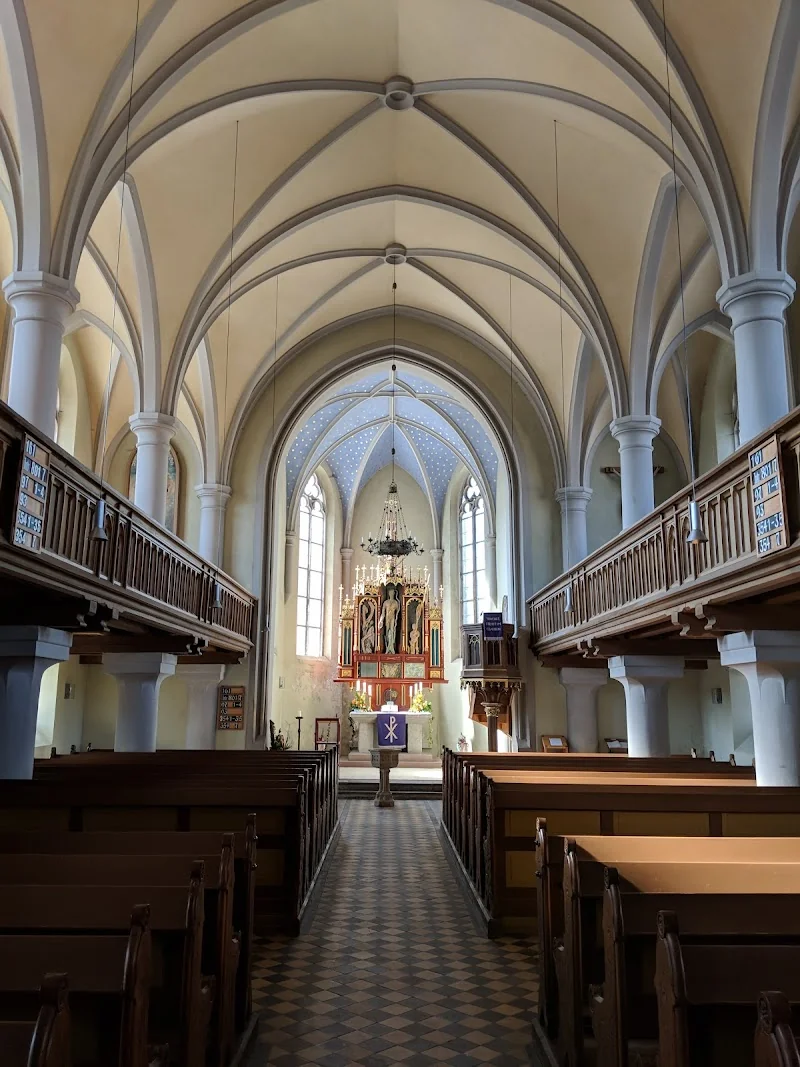
The Matthäuskirche is described by the church community as a neo-Gothic church with 500 seats. This number is particularly relevant for seekers, as it provides a direct impression of size and usability. With 500 seats, the church is large enough for well-attended services, festive devotions, introductory services, or special events in the church year. At the same time, despite this capacity, it is not an anonymous large space, but a place with a clear sacred aura. The term "neo-Gothic" is more than a stylistic term: it signals an architecture that connects to historical forms without being a museum. This mixture of tradition and vibrant use shapes the space. The community describes the Matthäuskirche as the center of community life, which underscores its role as a real, regularly used church. Therefore, those looking for "seats," "capacity," or a suitable place for large church celebrations receive a clear picture: The Matthäuskirche is spacious, rich in tradition, and designed for communal use. ([bischofsgruen-evangelisch.de](https://bischofsgruen-evangelisch.de/))
The interior has also evolved historically. During the renovation in the 1950s, some neo-Gothic elements were removed to make the space simpler; later, in 1992, parts were brought closer to the original condition again. The community explicitly mentions that the starry sky in the altar area was reconstructed, the floor renewed, and the baptismal font returned to its old place. This shows that the church is not frozen in time but continues to develop with each generation. For visitors, this is palpable: One perceives a clear, calm, and at the same time historically aware spatial effect. Particularly in the interplay with light, wood, and architectural details, the atmosphere is created that is described in reviews as warm, dignified, and bright. This makes the Matthäuskirche interesting for people who want to experience a church not only externally but also atmospherically. ([bischofsgruen-evangelisch.de](https://bischofsgruen-evangelisch.de/unsere-matthaeus-kirche?utm_source=openai))
Altar, Crib, and Special Details in the Church Space
Among the most striking features of the Matthäuskirche is the altar with its linden wood figures. The community describes it as a consciously designed image of faith that tells the salvation history in a way that places the resurrected at the center. This emphasis is theologically and spatially important, as it makes the church space visible not only as a historical place but as an expression of a specific Christian understanding. The altar was created after long planning and was restored and reconstructed after a phase of negotiations with an altar part from Abtswind. The figures were completed in 1992. For visitors, this is exciting because the altar is not simply decorative but makes a clear statement: This is not about mere adornment, but about the representation of death, loss, hope, and resurrection in a form that can be understood even without art historical knowledge. This makes the church space particularly readable. ([bischofsgruen-evangelisch.de](https://bischofsgruen-evangelisch.de/unsere-matthaeus-kirche?utm_source=openai))
Additionally, there is the crib, built in 1998 by a member of the church council. Especially during the Advent and Christmas season, this is an important part of the church atmosphere, as the crib makes the church even more accessible for families, locals, and guests. The community also refers to older pieces from the predecessor churches, such as the crucifix on the gallery and the historical baptismal font, which keep the long continuity of the place visible. Thus, the Matthäuskirche becomes a space where multiple layers of time stand side by side: medieval memories, neo-Gothic new construction, transformations of the 20th century, and a conscious return to historical elements. Those who observe the church space attentively will discover not only a beautiful altar but a whole narrative of loss, reconstruction, and lived community. This is precisely the special quality of this church: It is not only beautiful but also meaningful. ([bischofsgruen-evangelisch.de](https://bischofsgruen-evangelisch.de/unsere-matthaeus-kirche?utm_source=openai))
Parish Office, Community Life, and the Location Between Schneeberg and Ochsenkopf
The Matthäuskirche is accompanied by an active community life that is not limited to Sunday services. The official homepage of the church community emphasizes that one can find information about community life there and that the community consists not only of Bischofsgrün itself but also of Wülfersreuth and Grassemann. This makes it clear that the church carries a larger pastoral spatial mandate. The parish office is located at Hauptstraße 5 in Bischofsgrün; current opening hours are indicated as Tuesday, Wednesday, and Friday. The contact person is Pastor Dr. Peter Zeh, who can be reached through the parish office. For visitors with practical questions or those looking for church dates, this is useful, as the way to the right point of contact is clearly defined. Thus, a beautiful church also becomes a well-organized community location. ([bischofsgruen-evangelisch.de](https://bischofsgruen-evangelisch.de/wir/pfarramt))
The location between Schneeberg and Ochsenkopf strongly shapes the character of the town. The community consciously describes this region as part of its self-understanding, and this is felt during the visit: The Matthäuskirche does not stand apart from a landscape but is situated in a region that thrives on movement, nature, and short distances. The town is a healing climate spa, and the church thus appears as a quiet center in a place that is used both touristically and in everyday life. The church community connects spiritual life, children's and family work, and regular parish operations with this scenic location. For visitors, this means: A church visit, a quiet visit, or a glance into the church space can be easily combined with a walk, a town tour, or a short break. The Matthäuskirche is thus not only a cultural point but a true center of the town, where community, history, and landscape intertwine. ([bischofsgruen-evangelisch.de](https://bischofsgruen-evangelisch.de/))
Sources:
- Evangelical-Lutheran Congregation Bischofsgrün - Homepage
- Evangelical-Lutheran Congregation Bischofsgrün - Our Matthäus Church
- Bischofsgrün Tourism - Evangelical Matthäuskirche
- Evangelical-Lutheran Deanery Bayreuth - Congregation Bischofsgrün
- Community Bischofsgrün - Healing Climate Hiking Trail No. 6 PDF
- Bischofsgrün Tourism - Parking at the Kurhaus
Show moreShow less
Matthäuskirche Bischofsgrün | Events & Services
The Matthäuskirche of the Evangelical-Lutheran congregation in Bischofsgrün is much more than a distinctive building in the town center. It is a spiritual center, a meeting place for services, and a place of tranquility in a landscape situated between Schneeberg and Ochsenkopf. The congregation describes itself as a community in Franconia "at the very top," and this feeling also shapes the visit: up in the Fichtelgebirge, yet right in the midst of the everyday life of the town. With its 500 seats, the neo-Gothic church is large enough for festive services, quiet visits, and special occasions in the church year. At the same time, it is open during the day, free of charge, and thus deliberately accessible for guests, locals, and hikers seeking a quiet stop in the center of Bischofsgrün. Those looking for events, services, or a historically significant place with real atmosphere will find here not a loud event hall, but a church with a deep-rooted significance, clear identity, and a strong connection to the region. ([bischofsgruen-evangelisch.de](https://bischofsgruen-evangelisch.de/))
Events, Services, and Tickets
Those searching for tickets for the Matthäuskirche Bischofsgrün quickly encounter an important peculiarity: This location does not function like a classic concert or event hall, but as a living community church. For a regular visit, no ticket is required, as the church is open during the day and admission is free. This makes it attractive for many people who do not just want to tick off sights while traveling, but wish to experience a quiet, authentic place. At the same time, the search term "events" is absolutely fitting here, as community life regularly takes place in the church. The official church community refers to its schedule and community life, and the deanery entry mentions the main service on Sundays at 9:30 AM, as well as an additional main service once a month at 5:00 PM. This makes the Matthäuskirche a reliable anchor point in the weekly rhythm of the community. ([bischofsgruen-evangelisch.de](https://bischofsgruen-evangelisch.de/))
For SEO searches around "program," "services," and "tickets," it is important to categorize the terms ecclesiastically correctly. This is not about seat reservations, show tickets, or dynamic program campaigns, but about liturgy, community events, and special service times. This is precisely what makes the site strong in searches: Users looking for an event in Bischofsgrün often want to know exactly when the church is open, whether they can enter spontaneously, and if special dates are taking place. The answer is clear: Yes, the church is open during the day, yes, there are regular services, and no, no tickets are needed for a regular visit. Those interested in festive dates in the church year should also keep an eye on the official community website and local event calendars, as ecclesiastical special dates and community actions are most reliably published there. ([pages.bischofsgruen.de](https://pages.bischofsgruen.de/de/bischofsgruen/streaming/detail/POI/p_21461/evang-matthaeuskirche))
Opening Hours, Admission, and Visit
A major advantage of the Matthäuskirche is its openness: The tourist information page of the community explicitly states that the church is open at any time during the day. This is a strong plus for travelers, walkers, and people on a short discovery tour, as a visit is not tied to rigid time slots. The combination of free access and central location makes the church a place that can also be spontaneously included in a local tour. Those traveling with family will also find good conditions, as the tourist classification names the church as suitable for all weather and family-friendly. This is not just a small practical note, but very useful in everyday life: Even in rain, snow, or during a short break between excursions, the Matthäuskirche offers a quiet, sheltered space. ([pages.bischofsgruen.de](https://pages.bischofsgruen.de/de/bischofsgruen/streaming/detail/POI/p_21461/evang-matthaeuskirche))
The address is located in the town center of Bischofsgrün on the main street, and this central location is one of the reasons why the church is so easily accessible for many visitors. Convenient for planning is also the note that no admission is charged. This allows one to consciously perceive the church as a quiet cultural and spiritual place without having to organize a ticket purchase beforehand. For many guests, this is an important signal: The Matthäuskirche does not want to deter but to invite. It is therefore suitable not only for targeted visits but also for a short, respectful stop during a hike, after a café visit, or as a quiet conclusion to a day in the Fichtelgebirge. Those planning to include the church as part of a day trip benefit from its central location, making it easy to connect with other destinations in the town. ([pages.bischofsgruen.de](https://pages.bischofsgruen.de/de/bischofsgruen/streaming/detail/POI/p_21461/evang-matthaeuskirche))
Directions and Parking in the Town Center
For directions, it is important to note that the Matthäuskirche is located in the town center of Bischofsgrün. The tourist information explicitly describes the location this way and thus names the church as a very central reference point in the town. This facilitates both arrival by car and visits on foot. However, those coming by car should not expect a large, dedicated church parking area, as the publicly documented parking instructions refer to nearby municipal parking options rather than an exclusive church parking lot. Particularly helpful is the community tour suggestion for the healing climate hiking trail No. 6: It names the Evangelical Church in the town center as the starting point and refers to the Rangenweg parking lot and the RV parking area Rangenweg, about 250 meters northwest of the starting point. This provides a well-documented and nearby parking option for visitors who do not wish to park directly in the center. ([pages.bischofsgruen.de](https://pages.bischofsgruen.de/de/bischofsgruen/streaming/detail/POI/p_21461/evang-matthaeuskirche))
Additionally, the community of Bischofsgrün mentions free parking for up to 20 cars at the Kurhaus. This is also interesting for visitors, as the Kurhaus is located in the town center and can thus be practically combined with a visit to the Matthäuskirche. Therefore, those planning to include the church as part of a walk or town visit can keep the distances short and park centrally. For the SEO logic around "parking" and "directions," this combination of town center, Rangenweg parking lot, and Kurhaus parking is valuable, as it provides real, practical orientation without promising anything that is not substantiated on-site. This is also practical for bus travelers and day visitors, as the central location facilitates integration into tours or small town visits. The tourist infrastructure of Bischofsgrün is geared towards visitors, and the church lies right in the middle of this network of paths, meeting points, and public offerings. ([pages.bischofsgruen.de](https://pages.bischofsgruen.de/de/bischofsgruen/wlan/detail/POI/p_25362/parkplatz-am-kurhaus?utm_source=openai))
History of the Matthäuskirche in Bischofsgrün
The history of the Matthäuskirche is closely linked to the upheavals of the town. The official community page reminds us that there was early church life in Bischofsgrün and that the current church is not simply an isolated new building but part of a long development. Important milestones mentioned by the community include the first record of a church from 1496, the introduction of the first Protestant service in 1536, and the first church book from 1558. After that, fires and new constructions followed, as was typical for many places in historical Franconia. The predecessor church, the Aegidienkirche, burned down in 1612 after a large fire destroyed several houses in the town alongside the rectory and church. Even then, it became clear that the community understood its church not just as a building but as a central identity-forming element of the village. For the same reason, much historical memory is still visible in the church space today. ([bischofsgruen-evangelisch.de](https://bischofsgruen-evangelisch.de/unsere-matthaeus-kirche?utm_source=openai))
The prehistory of the current Matthäuskirche leads to the first Matthäuskirche, which was built from 1699 to 1702 and consecrated in 1702. The community emphasizes that at that time, not only was construction undertaken, but community also became visible, as the town gradually found a stronger economic and social basis again. The decisive step towards the current building was marked by the town fire of 1887. Two years later, the foundation stone for the new church was laid, and in 1891, the current building was consecrated. Thus, the Matthäuskirche stands in a line of reconstruction, renewal, and community will. The church was not rebuilt by chance, but as a conscious sign after a significant loss. The fact that the community continues to tell this story today makes the visit special: One enters not only a beautiful church space but a house that has been rebuilt multiple times and whose current form has grown out of a very concrete local experience. ([bischofsgruen-evangelisch.de](https://bischofsgruen-evangelisch.de/unsere-matthaeus-kirche?utm_source=openai))
500 Seats, Neo-Gothic Style, and Spatial Effect
The Matthäuskirche is described by the church community as a neo-Gothic church with 500 seats. This number is particularly relevant for seekers, as it provides a direct impression of size and usability. With 500 seats, the church is large enough for well-attended services, festive devotions, introductory services, or special events in the church year. At the same time, despite this capacity, it is not an anonymous large space, but a place with a clear sacred aura. The term "neo-Gothic" is more than a stylistic term: it signals an architecture that connects to historical forms without being a museum. This mixture of tradition and vibrant use shapes the space. The community describes the Matthäuskirche as the center of community life, which underscores its role as a real, regularly used church. Therefore, those looking for "seats," "capacity," or a suitable place for large church celebrations receive a clear picture: The Matthäuskirche is spacious, rich in tradition, and designed for communal use. ([bischofsgruen-evangelisch.de](https://bischofsgruen-evangelisch.de/))
The interior has also evolved historically. During the renovation in the 1950s, some neo-Gothic elements were removed to make the space simpler; later, in 1992, parts were brought closer to the original condition again. The community explicitly mentions that the starry sky in the altar area was reconstructed, the floor renewed, and the baptismal font returned to its old place. This shows that the church is not frozen in time but continues to develop with each generation. For visitors, this is palpable: One perceives a clear, calm, and at the same time historically aware spatial effect. Particularly in the interplay with light, wood, and architectural details, the atmosphere is created that is described in reviews as warm, dignified, and bright. This makes the Matthäuskirche interesting for people who want to experience a church not only externally but also atmospherically. ([bischofsgruen-evangelisch.de](https://bischofsgruen-evangelisch.de/unsere-matthaeus-kirche?utm_source=openai))
Altar, Crib, and Special Details in the Church Space
Among the most striking features of the Matthäuskirche is the altar with its linden wood figures. The community describes it as a consciously designed image of faith that tells the salvation history in a way that places the resurrected at the center. This emphasis is theologically and spatially important, as it makes the church space visible not only as a historical place but as an expression of a specific Christian understanding. The altar was created after long planning and was restored and reconstructed after a phase of negotiations with an altar part from Abtswind. The figures were completed in 1992. For visitors, this is exciting because the altar is not simply decorative but makes a clear statement: This is not about mere adornment, but about the representation of death, loss, hope, and resurrection in a form that can be understood even without art historical knowledge. This makes the church space particularly readable. ([bischofsgruen-evangelisch.de](https://bischofsgruen-evangelisch.de/unsere-matthaeus-kirche?utm_source=openai))
Additionally, there is the crib, built in 1998 by a member of the church council. Especially during the Advent and Christmas season, this is an important part of the church atmosphere, as the crib makes the church even more accessible for families, locals, and guests. The community also refers to older pieces from the predecessor churches, such as the crucifix on the gallery and the historical baptismal font, which keep the long continuity of the place visible. Thus, the Matthäuskirche becomes a space where multiple layers of time stand side by side: medieval memories, neo-Gothic new construction, transformations of the 20th century, and a conscious return to historical elements. Those who observe the church space attentively will discover not only a beautiful altar but a whole narrative of loss, reconstruction, and lived community. This is precisely the special quality of this church: It is not only beautiful but also meaningful. ([bischofsgruen-evangelisch.de](https://bischofsgruen-evangelisch.de/unsere-matthaeus-kirche?utm_source=openai))
Parish Office, Community Life, and the Location Between Schneeberg and Ochsenkopf
The Matthäuskirche is accompanied by an active community life that is not limited to Sunday services. The official homepage of the church community emphasizes that one can find information about community life there and that the community consists not only of Bischofsgrün itself but also of Wülfersreuth and Grassemann. This makes it clear that the church carries a larger pastoral spatial mandate. The parish office is located at Hauptstraße 5 in Bischofsgrün; current opening hours are indicated as Tuesday, Wednesday, and Friday. The contact person is Pastor Dr. Peter Zeh, who can be reached through the parish office. For visitors with practical questions or those looking for church dates, this is useful, as the way to the right point of contact is clearly defined. Thus, a beautiful church also becomes a well-organized community location. ([bischofsgruen-evangelisch.de](https://bischofsgruen-evangelisch.de/wir/pfarramt))
The location between Schneeberg and Ochsenkopf strongly shapes the character of the town. The community consciously describes this region as part of its self-understanding, and this is felt during the visit: The Matthäuskirche does not stand apart from a landscape but is situated in a region that thrives on movement, nature, and short distances. The town is a healing climate spa, and the church thus appears as a quiet center in a place that is used both touristically and in everyday life. The church community connects spiritual life, children's and family work, and regular parish operations with this scenic location. For visitors, this means: A church visit, a quiet visit, or a glance into the church space can be easily combined with a walk, a town tour, or a short break. The Matthäuskirche is thus not only a cultural point but a true center of the town, where community, history, and landscape intertwine. ([bischofsgruen-evangelisch.de](https://bischofsgruen-evangelisch.de/))
Sources:
- Evangelical-Lutheran Congregation Bischofsgrün - Homepage
- Evangelical-Lutheran Congregation Bischofsgrün - Our Matthäus Church
- Bischofsgrün Tourism - Evangelical Matthäuskirche
- Evangelical-Lutheran Deanery Bayreuth - Congregation Bischofsgrün
- Community Bischofsgrün - Healing Climate Hiking Trail No. 6 PDF
- Bischofsgrün Tourism - Parking at the Kurhaus
Matthäuskirche Bischofsgrün | Events & Services
The Matthäuskirche of the Evangelical-Lutheran congregation in Bischofsgrün is much more than a distinctive building in the town center. It is a spiritual center, a meeting place for services, and a place of tranquility in a landscape situated between Schneeberg and Ochsenkopf. The congregation describes itself as a community in Franconia "at the very top," and this feeling also shapes the visit: up in the Fichtelgebirge, yet right in the midst of the everyday life of the town. With its 500 seats, the neo-Gothic church is large enough for festive services, quiet visits, and special occasions in the church year. At the same time, it is open during the day, free of charge, and thus deliberately accessible for guests, locals, and hikers seeking a quiet stop in the center of Bischofsgrün. Those looking for events, services, or a historically significant place with real atmosphere will find here not a loud event hall, but a church with a deep-rooted significance, clear identity, and a strong connection to the region. ([bischofsgruen-evangelisch.de](https://bischofsgruen-evangelisch.de/))
Events, Services, and Tickets
Those searching for tickets for the Matthäuskirche Bischofsgrün quickly encounter an important peculiarity: This location does not function like a classic concert or event hall, but as a living community church. For a regular visit, no ticket is required, as the church is open during the day and admission is free. This makes it attractive for many people who do not just want to tick off sights while traveling, but wish to experience a quiet, authentic place. At the same time, the search term "events" is absolutely fitting here, as community life regularly takes place in the church. The official church community refers to its schedule and community life, and the deanery entry mentions the main service on Sundays at 9:30 AM, as well as an additional main service once a month at 5:00 PM. This makes the Matthäuskirche a reliable anchor point in the weekly rhythm of the community. ([bischofsgruen-evangelisch.de](https://bischofsgruen-evangelisch.de/))
For SEO searches around "program," "services," and "tickets," it is important to categorize the terms ecclesiastically correctly. This is not about seat reservations, show tickets, or dynamic program campaigns, but about liturgy, community events, and special service times. This is precisely what makes the site strong in searches: Users looking for an event in Bischofsgrün often want to know exactly when the church is open, whether they can enter spontaneously, and if special dates are taking place. The answer is clear: Yes, the church is open during the day, yes, there are regular services, and no, no tickets are needed for a regular visit. Those interested in festive dates in the church year should also keep an eye on the official community website and local event calendars, as ecclesiastical special dates and community actions are most reliably published there. ([pages.bischofsgruen.de](https://pages.bischofsgruen.de/de/bischofsgruen/streaming/detail/POI/p_21461/evang-matthaeuskirche))
Opening Hours, Admission, and Visit
A major advantage of the Matthäuskirche is its openness: The tourist information page of the community explicitly states that the church is open at any time during the day. This is a strong plus for travelers, walkers, and people on a short discovery tour, as a visit is not tied to rigid time slots. The combination of free access and central location makes the church a place that can also be spontaneously included in a local tour. Those traveling with family will also find good conditions, as the tourist classification names the church as suitable for all weather and family-friendly. This is not just a small practical note, but very useful in everyday life: Even in rain, snow, or during a short break between excursions, the Matthäuskirche offers a quiet, sheltered space. ([pages.bischofsgruen.de](https://pages.bischofsgruen.de/de/bischofsgruen/streaming/detail/POI/p_21461/evang-matthaeuskirche))
The address is located in the town center of Bischofsgrün on the main street, and this central location is one of the reasons why the church is so easily accessible for many visitors. Convenient for planning is also the note that no admission is charged. This allows one to consciously perceive the church as a quiet cultural and spiritual place without having to organize a ticket purchase beforehand. For many guests, this is an important signal: The Matthäuskirche does not want to deter but to invite. It is therefore suitable not only for targeted visits but also for a short, respectful stop during a hike, after a café visit, or as a quiet conclusion to a day in the Fichtelgebirge. Those planning to include the church as part of a day trip benefit from its central location, making it easy to connect with other destinations in the town. ([pages.bischofsgruen.de](https://pages.bischofsgruen.de/de/bischofsgruen/streaming/detail/POI/p_21461/evang-matthaeuskirche))
Directions and Parking in the Town Center
For directions, it is important to note that the Matthäuskirche is located in the town center of Bischofsgrün. The tourist information explicitly describes the location this way and thus names the church as a very central reference point in the town. This facilitates both arrival by car and visits on foot. However, those coming by car should not expect a large, dedicated church parking area, as the publicly documented parking instructions refer to nearby municipal parking options rather than an exclusive church parking lot. Particularly helpful is the community tour suggestion for the healing climate hiking trail No. 6: It names the Evangelical Church in the town center as the starting point and refers to the Rangenweg parking lot and the RV parking area Rangenweg, about 250 meters northwest of the starting point. This provides a well-documented and nearby parking option for visitors who do not wish to park directly in the center. ([pages.bischofsgruen.de](https://pages.bischofsgruen.de/de/bischofsgruen/streaming/detail/POI/p_21461/evang-matthaeuskirche))
Additionally, the community of Bischofsgrün mentions free parking for up to 20 cars at the Kurhaus. This is also interesting for visitors, as the Kurhaus is located in the town center and can thus be practically combined with a visit to the Matthäuskirche. Therefore, those planning to include the church as part of a walk or town visit can keep the distances short and park centrally. For the SEO logic around "parking" and "directions," this combination of town center, Rangenweg parking lot, and Kurhaus parking is valuable, as it provides real, practical orientation without promising anything that is not substantiated on-site. This is also practical for bus travelers and day visitors, as the central location facilitates integration into tours or small town visits. The tourist infrastructure of Bischofsgrün is geared towards visitors, and the church lies right in the middle of this network of paths, meeting points, and public offerings. ([pages.bischofsgruen.de](https://pages.bischofsgruen.de/de/bischofsgruen/wlan/detail/POI/p_25362/parkplatz-am-kurhaus?utm_source=openai))
History of the Matthäuskirche in Bischofsgrün
The history of the Matthäuskirche is closely linked to the upheavals of the town. The official community page reminds us that there was early church life in Bischofsgrün and that the current church is not simply an isolated new building but part of a long development. Important milestones mentioned by the community include the first record of a church from 1496, the introduction of the first Protestant service in 1536, and the first church book from 1558. After that, fires and new constructions followed, as was typical for many places in historical Franconia. The predecessor church, the Aegidienkirche, burned down in 1612 after a large fire destroyed several houses in the town alongside the rectory and church. Even then, it became clear that the community understood its church not just as a building but as a central identity-forming element of the village. For the same reason, much historical memory is still visible in the church space today. ([bischofsgruen-evangelisch.de](https://bischofsgruen-evangelisch.de/unsere-matthaeus-kirche?utm_source=openai))
The prehistory of the current Matthäuskirche leads to the first Matthäuskirche, which was built from 1699 to 1702 and consecrated in 1702. The community emphasizes that at that time, not only was construction undertaken, but community also became visible, as the town gradually found a stronger economic and social basis again. The decisive step towards the current building was marked by the town fire of 1887. Two years later, the foundation stone for the new church was laid, and in 1891, the current building was consecrated. Thus, the Matthäuskirche stands in a line of reconstruction, renewal, and community will. The church was not rebuilt by chance, but as a conscious sign after a significant loss. The fact that the community continues to tell this story today makes the visit special: One enters not only a beautiful church space but a house that has been rebuilt multiple times and whose current form has grown out of a very concrete local experience. ([bischofsgruen-evangelisch.de](https://bischofsgruen-evangelisch.de/unsere-matthaeus-kirche?utm_source=openai))
500 Seats, Neo-Gothic Style, and Spatial Effect
The Matthäuskirche is described by the church community as a neo-Gothic church with 500 seats. This number is particularly relevant for seekers, as it provides a direct impression of size and usability. With 500 seats, the church is large enough for well-attended services, festive devotions, introductory services, or special events in the church year. At the same time, despite this capacity, it is not an anonymous large space, but a place with a clear sacred aura. The term "neo-Gothic" is more than a stylistic term: it signals an architecture that connects to historical forms without being a museum. This mixture of tradition and vibrant use shapes the space. The community describes the Matthäuskirche as the center of community life, which underscores its role as a real, regularly used church. Therefore, those looking for "seats," "capacity," or a suitable place for large church celebrations receive a clear picture: The Matthäuskirche is spacious, rich in tradition, and designed for communal use. ([bischofsgruen-evangelisch.de](https://bischofsgruen-evangelisch.de/))
The interior has also evolved historically. During the renovation in the 1950s, some neo-Gothic elements were removed to make the space simpler; later, in 1992, parts were brought closer to the original condition again. The community explicitly mentions that the starry sky in the altar area was reconstructed, the floor renewed, and the baptismal font returned to its old place. This shows that the church is not frozen in time but continues to develop with each generation. For visitors, this is palpable: One perceives a clear, calm, and at the same time historically aware spatial effect. Particularly in the interplay with light, wood, and architectural details, the atmosphere is created that is described in reviews as warm, dignified, and bright. This makes the Matthäuskirche interesting for people who want to experience a church not only externally but also atmospherically. ([bischofsgruen-evangelisch.de](https://bischofsgruen-evangelisch.de/unsere-matthaeus-kirche?utm_source=openai))
Altar, Crib, and Special Details in the Church Space
Among the most striking features of the Matthäuskirche is the altar with its linden wood figures. The community describes it as a consciously designed image of faith that tells the salvation history in a way that places the resurrected at the center. This emphasis is theologically and spatially important, as it makes the church space visible not only as a historical place but as an expression of a specific Christian understanding. The altar was created after long planning and was restored and reconstructed after a phase of negotiations with an altar part from Abtswind. The figures were completed in 1992. For visitors, this is exciting because the altar is not simply decorative but makes a clear statement: This is not about mere adornment, but about the representation of death, loss, hope, and resurrection in a form that can be understood even without art historical knowledge. This makes the church space particularly readable. ([bischofsgruen-evangelisch.de](https://bischofsgruen-evangelisch.de/unsere-matthaeus-kirche?utm_source=openai))
Additionally, there is the crib, built in 1998 by a member of the church council. Especially during the Advent and Christmas season, this is an important part of the church atmosphere, as the crib makes the church even more accessible for families, locals, and guests. The community also refers to older pieces from the predecessor churches, such as the crucifix on the gallery and the historical baptismal font, which keep the long continuity of the place visible. Thus, the Matthäuskirche becomes a space where multiple layers of time stand side by side: medieval memories, neo-Gothic new construction, transformations of the 20th century, and a conscious return to historical elements. Those who observe the church space attentively will discover not only a beautiful altar but a whole narrative of loss, reconstruction, and lived community. This is precisely the special quality of this church: It is not only beautiful but also meaningful. ([bischofsgruen-evangelisch.de](https://bischofsgruen-evangelisch.de/unsere-matthaeus-kirche?utm_source=openai))
Parish Office, Community Life, and the Location Between Schneeberg and Ochsenkopf
The Matthäuskirche is accompanied by an active community life that is not limited to Sunday services. The official homepage of the church community emphasizes that one can find information about community life there and that the community consists not only of Bischofsgrün itself but also of Wülfersreuth and Grassemann. This makes it clear that the church carries a larger pastoral spatial mandate. The parish office is located at Hauptstraße 5 in Bischofsgrün; current opening hours are indicated as Tuesday, Wednesday, and Friday. The contact person is Pastor Dr. Peter Zeh, who can be reached through the parish office. For visitors with practical questions or those looking for church dates, this is useful, as the way to the right point of contact is clearly defined. Thus, a beautiful church also becomes a well-organized community location. ([bischofsgruen-evangelisch.de](https://bischofsgruen-evangelisch.de/wir/pfarramt))
The location between Schneeberg and Ochsenkopf strongly shapes the character of the town. The community consciously describes this region as part of its self-understanding, and this is felt during the visit: The Matthäuskirche does not stand apart from a landscape but is situated in a region that thrives on movement, nature, and short distances. The town is a healing climate spa, and the church thus appears as a quiet center in a place that is used both touristically and in everyday life. The church community connects spiritual life, children's and family work, and regular parish operations with this scenic location. For visitors, this means: A church visit, a quiet visit, or a glance into the church space can be easily combined with a walk, a town tour, or a short break. The Matthäuskirche is thus not only a cultural point but a true center of the town, where community, history, and landscape intertwine. ([bischofsgruen-evangelisch.de](https://bischofsgruen-evangelisch.de/))
Sources:
- Evangelical-Lutheran Congregation Bischofsgrün - Homepage
- Evangelical-Lutheran Congregation Bischofsgrün - Our Matthäus Church
- Bischofsgrün Tourism - Evangelical Matthäuskirche
- Evangelical-Lutheran Deanery Bayreuth - Congregation Bischofsgrün
- Community Bischofsgrün - Healing Climate Hiking Trail No. 6 PDF
- Bischofsgrün Tourism - Parking at the Kurhaus
Frequently Asked Questions
Reviews
Norbert Friedemann
28. September 2020
A church in a beautiful location
Boris Alexander Keller
28. December 2024
A dignified church, large with a warm atmosphere and light! With beautiful nativity scenes at Christmastime!
Heidi Zeitler
10. January 2019
A place where you have it all. Peace, but also adventure. Community, but also solitude if you want. You should take the time to experience it more often!
Uwe H.
11. June 2025
Beautiful church on the market square of Bischofsgrün
Jacqueline-Emma Buchwald
12. June 2024