
Carlton Holmes
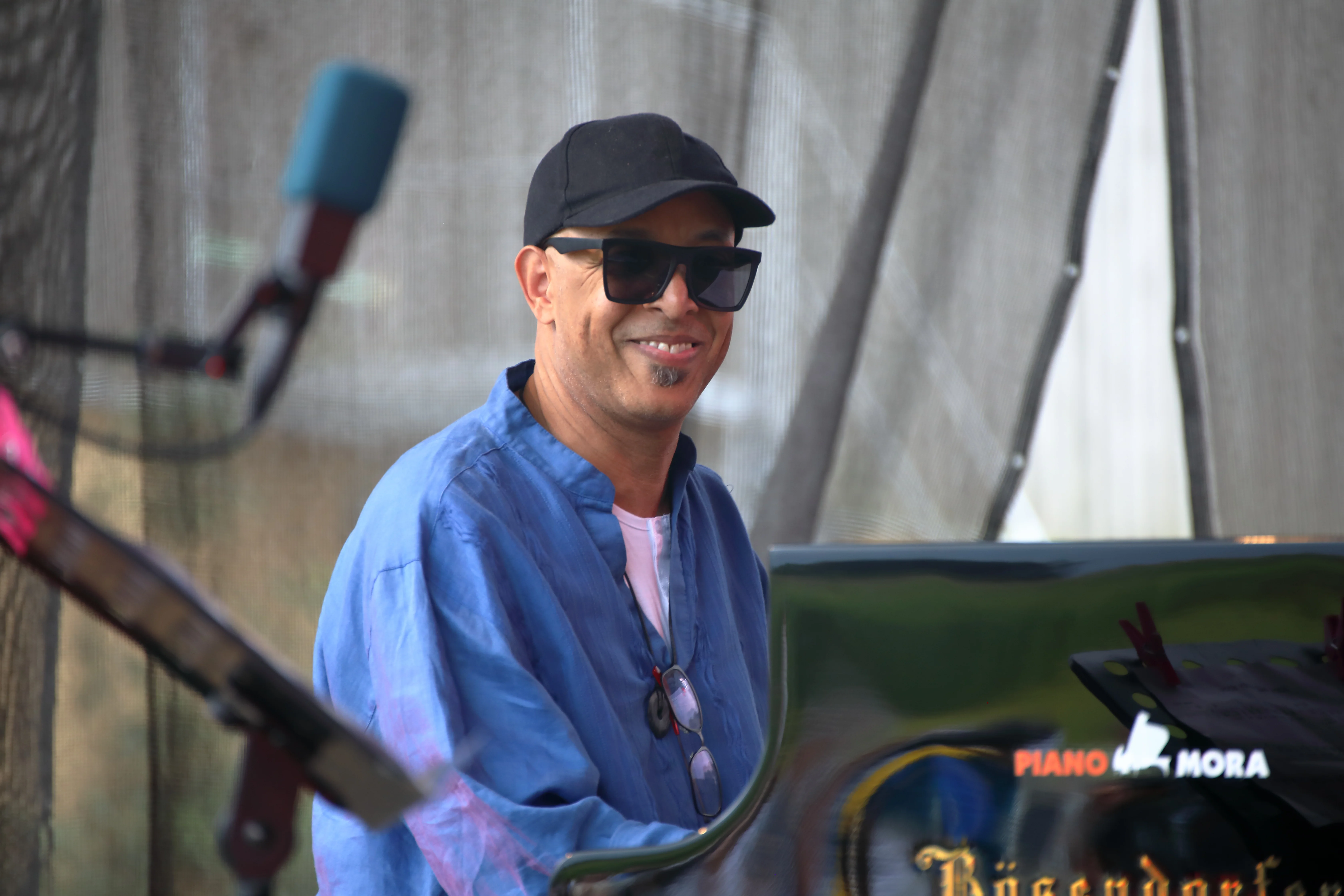
Image from Wikipedia
Image from Wikipedia
Carlton Holmes – Pianist, Composer, Pioneer of Contemporary Jazz
A Sound Poet Between Tradition and Innovation: The Fascinating World of Jazz Pianist Carlton Holmes
Born on August 21, 1964, in Michigan and raised in Seattle and Albuquerque, Carlton Holmes developed a distinctive musical voice at an early age. He began his musical training at the age of eight; after learning trumpet and drums, he discovered the piano at eleven – the instrument that would define his career as a pianist, composer, and bandleader. Since the mid-1980s, he has been shaping the New York jazz scene with a music career that consistently blends stage presence, sound culture, and artistic development. Holmes’ playing combines the energy of Post-Bop, the elegance of Modern Jazz, and a remarkable sensitivity to form, harmony, and timbre.
His journey is closely linked to the Manhattan School of Music, where he enrolled in 1986 and quickly immersed himself in the city’s vibrant scene. As a sought-after sideman and leader, he collaborated with key figures in jazz – an environment that sharpened his compositional thinking, improvisational language, and sensitivity to ensemble dynamics. Carlton Holmes embodies a jazz aesthetic that combines substance and storytelling: lyrical lines, analytical clarity of form, and a warm, dynamic soundscape.
Early Years and Education: From Prodigy to Mature Voice
By the age of 15, Holmes was performing professionally – a testament to his natural timing, harmonic understanding, and quick responsiveness within an ensemble. Awards as “Best Soloist” in All-State Jazz Band competitions highlighted his improvisational maturity early in his career. Moving to New York in 1986 marked a decisive step in his artistic development: master classes, jam sessions, and early tours shaped a pianist whose playing remained technically sophisticated while being narratively and melodically focused. His approach combines a refined touch with imaginative phrasing – the left hand structures, while the right hand tells a story.
These foundations also influenced his later work as a composer. Holmes writes themes that sing with melodic precision yet acquire depth through intricate chord connections, modal nuances, and rhythmic shifts. His discography and performances reveal how organically he intertwines composition and improvisation: motifs arise, are sequenced, reharmonized, and transformed into dialogic interactions within the ensemble.
Breakthrough in New York: “Young Lion” with a Great Ear
Holmes’ reputation quickly established itself in New York: As one of the “Young Lions,” he spent six years alongside legendary drummer Charli Persip and initiated a musical partnership with master drummer Michael Carvin that has lasted many years. During this phase, he refined his interaction with horn players and rhythm sections – playing on the edge between structural clarity and spontaneous interaction. At the same time, he worked in studios, writing for film, television, and Broadway, earning a reputation as a stylistically flexible yet distinctly jazz-oriented pianist with a unique sound.
His network includes icons like Max Roach, Branford Marsalis, Donald Byrd, and Dianne Reeves; he has also engaged with Lionel Hampton, Freddie Hubbard, Kenny Garrett, Terumasa Hino, Stevie Wonder, and others. These collaborations shaped Holmes’ aesthetic profile: a rhythmically dense yet permeable piano language that feels the pulse of tradition while seamlessly integrating modern forms, voicings, and metric accents. Sources confirm these milestones, placing Holmes at the center of the New York scene in the 1990s and 2000s.
In the Studio and on Tour: From Bill Kirchner to Cindy Blackman
Recordings with saxophonist Bill Kirchner (Trance Dance, 1990) and projects with Michael Carvin (Each One Teach One) showcase Holmes as a structurally aware team player who influences the sound balance and dramaturgy of an album. In 1995, he collaborated with Carlos Garnett (Resurgence), and by the late 1990s, he shaped Cindy Blackman’s Works On Canvas (1999). In Cindy Blackman’s ensembles, Holmes set standards as a pianist and keyboardist, blending post-bop lines with a modern, often electrified sound aesthetic. In this context, later works such as Someday… (2001) and Music for the New Millennium (2004) emerged, where Holmes shines not only in interpretation but also as a composer – with pieces like Eternal Justice and Theme to Ginger’s Rise.
These albums document Holmes’ maturity as a musician: sonically varied, compositionally engaged, and interactive within group dynamics. Critical receptions praised the coherence of the concepts and the intensity of interaction – a signature that clearly illustrates Holmes’ skill at the piano and his understanding of arrangement, form, and production. His discography further demonstrates his ability to organically connect various jazz idioms: from ballad culture and modal fields to swinging mid- and uptempo numbers, as well as funky, electric textures.
Leadership Work and Own Trio: You, Me and I
In 2010, Holmes released his trio album You, Me and I, which exemplifies his poetic side, narrative improvisation technique, and understanding of trio economy. The lineup with bass and drums creates space for flexible, breathing interplay: the pianist leads not authoritatively but opens musical spaces where melodic motifs, ostinato figures, and harmonic digressions can unfold. Critics praised the inspired repertoire choices and the trio’s ability to place virtuosity in the service of musical flow.
Holmes’ own writing is marked by clear melodic outlines, contrapuntal hints in the left hand, and a nuanced approach to pedal and dynamics. In production, he avoids sonic overload; instead, timbre and contour take center stage. The result is a modern piano trio that knows history but speaks in the present.
Style Profile: Sound, Form, Interaction
Holmes’ style combines a distinctive touch with sharpened harmonic listening. His chords range from modal floating to densely voiced, quartal structures; reharmonizations frequently rely on second and tritone relationships without sacrificing melodic readability. In improvisation, he favors motivic development – small cells are transformed, rhythmically displaced, sequenced, and contrasted. The right hand draws lines with melody and formal clarity; the left hand supports with walking figures, cluster near textures, or syncopated chord bursts.
In interplay with drums and bass, Holmes acts as a dramaturgical architect: tension arches are developed through register changes, density modulation, and dynamic terracing. In electric contexts, he expands the color spectrum with electric piano and synthesizer – always aiming to stage the composition and inspire the ensemble. This blend of expertise, historical context, and contemporary sound language demonstrates proficiency in composition, arrangement, and production.
Collaborations and Cultural Influence
Holmes’ significance is reflected in the quality of his collaborations. Alongside Cindy Blackman, he formed a modern, energetic jazz language over several albums, combining post-bop virtuosity with pointed sound aesthetics. Projects with Carlos Garnett linked the spiritual jazz tradition with a fresh, urban pulse. Working with figures like Branford Marsalis, Max Roach, or Donald Byrd bridges generations and styles – contributing to the vibrant lineage of jazz.
On stages in New York – from intimate concert formats to livestream settings – Holmes displayed a stage presence that creates closeness: he knows how to draw listeners into a musical dialogue, making spontaneous interactions audible while maintaining a clear dramaturgical line. In education, he conveys these principles in workshops and masterclasses: ear training, understanding of form, time concepts, sound. Thus, he shapes not only the stage but also the next generation of musicians.
Current Projects, Concerts, Repertoire (2023–2025)
Holmes remained present in recent years: With his trio, he honored the late Carlos Garnett in Brooklyn in 2023, linking to shared artistic milestones. In 2024/2025, he showcased his solo side in curated concert series while new constellations with local protagonists emerged in Europe. A quartet performance was announced for July 27, 2025, in Passau – a program that connects classics from the jazz canon, bossa novas, funky grooves, and ballads with original compositions. Such setlists reflect Holmes’ range: from Wayne Shorter tributes to originals that impress with lyrical core and rhythmic finesse.
Holmes’ repertoire remains intentionally permeable: standards as an open form field, originals as a dramaturgical thread, room for interaction as a hallmark. Thus, he remains an artist who weaves together the present and memory – acoustically, electrically, solo, in a trio, or in a quartet.
Discography – Selection and Context
As a leader, You, Me and I (2010) stands in focus: an album that presents the mature signature of the pianist – melodically grounded, rhythmically flexible, and sound-conscious in production. As a sideman/co-leader, the recordings with Cindy Blackman particularly shape his profile: Works On Canvas (1999) as a statement towards colorful, compositional-rich post-bop; Someday… (2001) as a concentrated quartet album with Holmes on piano; Music for the New Millennium (2004) as a spacious, sonically expansive production in which Holmes also sets compositional accents.
In addition, there are sessions and releases with Bill Kirchner, Michael Carvin, Carlos Garnett, and other New York protagonists. Critics have praised the conceptual coherence, the energy of the rhythm section, Holmes’ ability to condense thematic lines through color changes, and his sensitivity to dramaturgical arcs in the mentioned albums. Overall, this results in a portfolio that addresses both jazz connoisseurs and curious listeners seeking an accessible entry point.
Live Aesthetics and Pedagogy
Live, Holmes represents a sound-conscious, empathetic interaction. He manages dynamic transitions with subtle pedal usage, differentiated voicing, and a flexible sense of time that balances groove and freedom. His solo concerts exhibit the narrative quality of his playing; in a trio, he opens spaces, while in a quartet, he intensifies the call-and-response logic between piano and horns.
As a teacher and mentor, he systematically conveys this vocabulary: listening as a priority, form awareness as a guideline, technique as a means to serve expression. Workshops and masterclasses show Holmes as a reflective practitioner who equally attends to sound culture, phrasing, transcription techniques, voicing strategies, and ensemble communication. In doing so, he contributes to the cultural value of jazz – as a lively, shared practice.
Conclusion: Why Listen to Carlton Holmes Now – and Experience Live?
Carlton Holmes is a pianist who combines substance and beauty: a storyteller at the piano whose discography oscillates between trio intimacy and band-oriented energy; a composer who imbues motifs with harmonic depth; an improviser who integrates form and freedom. His music career stands for experience, expertise, and credibility: recordings with significant voices in jazz, continual artistic development, and a signature that balances recognizability and openness.
Those who love modern jazz will find in Holmes a music that moves and challenges, that respects tradition while shaping the future. Whether on solo tours, in a trio, or in a quartet – Carlton Holmes live means: interaction at eye level, an organic sound, and moments that resonate. Listen, discover, experience.
Official Channels of Carlton Holmes:
- Instagram: No official profile found
- Facebook: No official profile found
- YouTube: No official profile found
- Spotify: No official profile found
- TikTok: No official profile found
Sources:
- Wikipedia – Carlton Holmes
- Harlem Jazz Boxx – Artist Profile Carlton Holmes
- All About Jazz – Carlton Holmes
- Inntöne Festival Archive – Carlton Holmes Solo
- Soapbox Gallery – Carlton Holmes in Concert (Livestream 2020)
- Sistas’ Place – Carlton Holmes Trio (2023)
- Apple Music – Carlton Holmes: You, Me and I (2010)
- Wikipedia – Cindy Blackman: Someday… (with Carlton Holmes)
- Wikipedia – Cindy Blackman: Music for the New Millennium (with Carlton Holmes)
- hey.bayern – Carlton Holmes Quartet (Passau, July 27, 2025)
- Jazzword – Artist Index: Carlton Holmes
- Wikipedia: Image and Text Source