
Gabriel Fauré
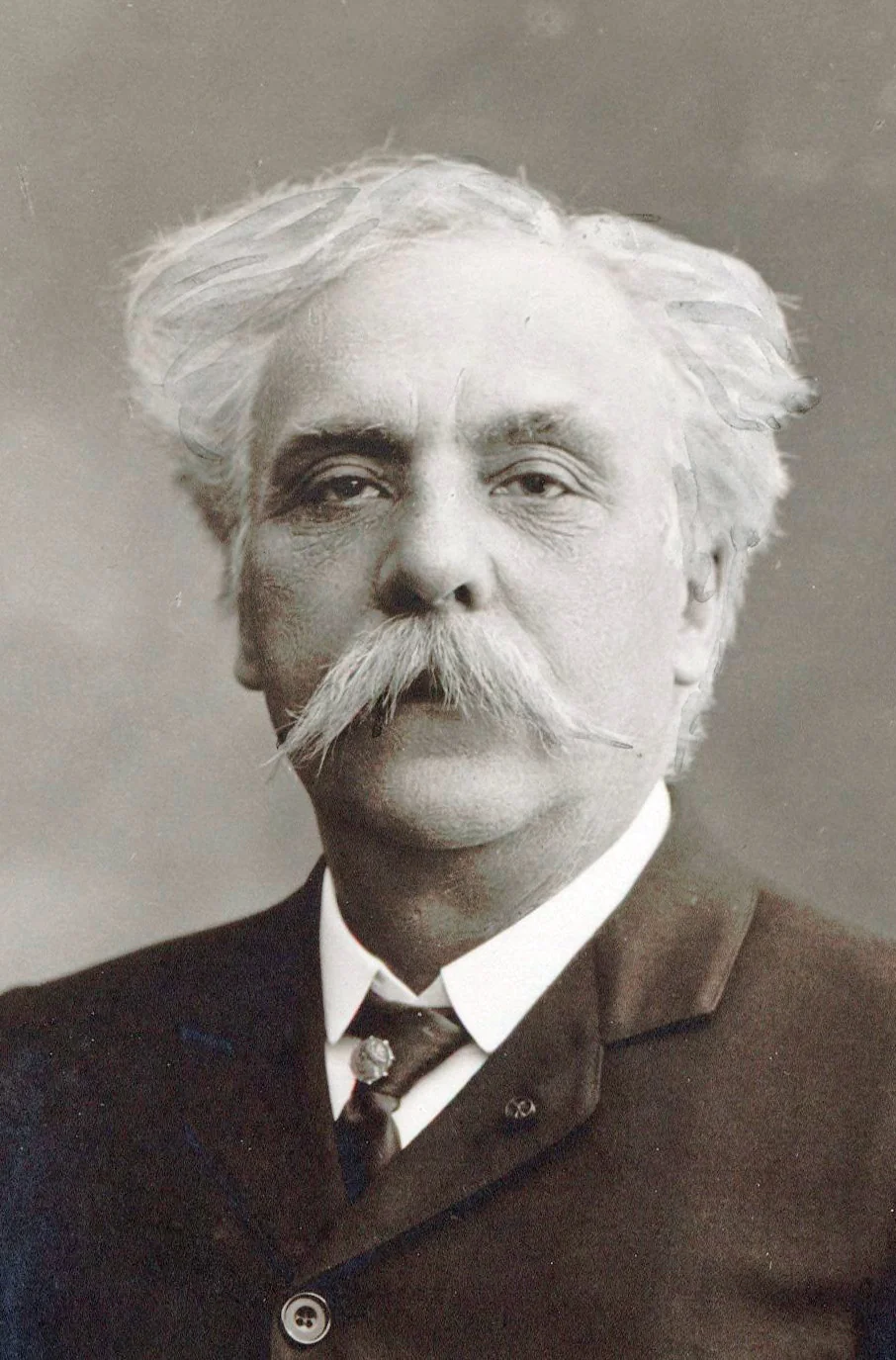
Image from Wikipedia
Image from Wikipedia
Gabriel Fauré – Architect of French Modernity between Romanticism and Belle Époque
A composer whose quiet revolution prepared the language of modern music
Gabriel Urbain Fauré (May 12, 1845, Pamiers – November 4, 1924, Paris) shaped the music history of the Fin de Siècle with an unmistakable signature: fragrance-free charm, restrained melancholy, and bold yet subtle harmonic structures. As a composer, educator, and director of the Paris Conservatory, he combined romantic tradition with a modern, diatonically rooted tonal language, thus opening a new horizon for French music. His students included Maurice Ravel, Nadia Boulanger, and George Enescu – names that testify to his influence well into the 20th century. His musical career spanned liturgically shaped beginnings, chamber music, vocal cycles, and a Requiem that remains one of the most performed sacred works today.
Early Years: From Choirboy to Protege of Saint-Saëns
Fauré, the youngest of six children, grew up at the foot of the Pyrenees. Early on, he displayed an exceptional sense of hearing and a sensitive perception of color. At the age of nine, he attended the École Niedermeyer in Paris, where he received strict training in church music. There, he met Camille Saint-Saëns, who not only imparted to him pianistic virtuosity and formal clarity but also familiarized him with the music of Liszt and Wagner. These influences manifested less in external pathos than in an internal broadening of harmony and modulation – the seeds of his later artistic development.
Paris and the Belle Époque: Organist, Choir Director, Composer
After serving as an organist and choir director—among others at the church of La Madeleine—Fauré emerged in the Paris music scene as a sensitive song composer and chamber music writer. His piano works from the 1870s and 1880s – Nocturnes, Barcarolles, and Impromptus – combine clear melodic lines with delicately shifted harmonies. The Requiem op. 48, begun in 1887 and initially conceived for a small ensemble, reveals a contemplative sound aesthetic, free from theatrical drama. Here, his compositional artistry is evident: subtle voice leading, floating tonality, organic form.
The Educator and Reformer: Professor (1896) and Director of the Paris Conservatory (1905)
In 1896, Fauré took on a composition class at the Paris Conservatory, and in 1905 he became its director. His leadership style promoted independence, strict craftsmanship, and personal voice – principles reflected in his students' artistic development. Stylistically, Fauré was not a dogmatist: he sought balanced innovation, modernized curricula, and strengthened chamber music. His stage presence as a pianist remained valued into old age, despite increasing deafness that increasingly isolated him. He only stepped down from office in 1920 – a retreat that created space for late masterpieces.
The Quiet Revolution: Harmony, Form, and the Art of Melody
Fauré's artistic development can be seen as a consistent refinement of harmony. While the early Mélodies (influenced by Gounod) are still more tonally anchored, song cycles from the 1890s onward exhibit striking unity and harmonic boldness: La bonne chanson op. 61 unfolds an expansive melodic architecture; L’horizon chimérique (1922) encapsulates a late idiom of ascetic density. In piano music, the Nocturnes and Barcarolles condense from decorative grace to concentrated, contrapuntally woven sound speech. His compositional technique often orbits the tonic, modulating through intermediaries and using seemingly simple chord connections for subtle color changes – composing “with light” rather than “with weight.”
Between Romanticism and Modernity: Chamber Music as a Core Element
Fauré's chamber music is the backbone of his discography: the two piano quartets op. 15 and op. 45, the violin sonatas op. 13 and op. 108, the cello sonatas op. 109 and op. 117, and the piano quintets op. 89 and op. 115. In these works, composition and arrangement condense into “speaking” instrumental voices; the piano acquires orchestral brilliance without virtuosity for its own sake. The late works – the Piano Trio in D minor op. 120 and the String Quartet in E minor op. 121 – resonate as distilled essences of his style: clarity, concentrated form, inner ardor.
Stage and Orchestra: Pénélope, Prométhée, Masques et bergamasques
Although opera was never his focal point, Fauré found a personally colored theatrical language with the lyrical drama Pénélope (1913), carried by singing lines and orchestral refinement. The stage music for Pelléas et Mélisande (1898) remains part of the repertoire to this day – especially the Sicilienne, whose graceful rhythm and transparent arrangement exemplify his sound economy. Masques et bergamasques (1919) evokes the spirit of the 18th century as a suite without ever stagnating in retro-stylization; it remains deeply his in its blend of elegance and subtle irony.
Requiem op. 48: “Lullaby of Death” – Versions and Reception
The Requiem in D minor op. 48, created between 1887 and 1890 and revised until 1900, exists in several versions: a chamber music version with small orchestra and organ, as well as a later symphonically expanded version. The seven-movement structure featuring the famous “Pie Jesu” and the peaceful “In Paradisum” has significantly influenced the sacred choral sound of the 20th century. Fauré dispenses with the “Dies irae” as a dramatic threat; instead, he unfolds a comforting, light-filled spirituality, the impact of which has been repeatedly affirmed in performance practices, editions, and recordings of the 20th and 21st centuries.
Discography Highlights: Mélodies, Piano Works, Chamber Music
Fauré's discography has been expanding for decades in breadth and depth. Particularly the Mélodies – such as “Après un rêve,” “Les berceaux,” and “Les roses d’Ispahan” – have a recording history that documents interpretive traditions from the Francophone school to internationally shaped song duos. The 13 Nocturnes and 13 Barcarolles form a panorama of pianistic richness: from pearl-like figurations to meditative inner tension. Chamber music recordings underscore the organic voice leading: violin sonatas and piano quintets reveal how precisely Fauré balances form and affect.
Critical Reception: Quiet Authority – Sustainable Cultural Influence
Even his contemporaries viewed Fauré as an authority without loudness: a renewer who respects forms and transforms them from within. Later music press and musicological literature recognize him as a hinge figure between romantic tradition and modern aesthetics. His artistic development – from early romantic lyricism to the abstract density of late works – has decisively shaped the discourse on French sound culture. In choral culture, the Requiem remains a focal point; in chamber music, his melodic economy continues to set standards for interpretation and programming.
Current Projects and New Releases: Commemoration, Box Set, Dialogues of the Present
For the 100th anniversary of his death in 2024, international festivals, universities, and ensembles are placing Fauré's music at the center of focus programs. Warner/Erato is releasing a 26-CD deluxe edition “The Complete Works” in October 2024, featuring historical rarities including recordings of the composer; curated booklets and renowned interpreters frame this showcase editorially. Contemporary artists are creating productive counterpoints: Brad Mehldau’s solo album “Après Fauré” (Nonesuch, May 2024) weaves late Nocturnes and his own pieces into a modern echo of Fauré's harmony. New orchestral and chamber music programs in Europe and the USA evidence the ongoing performance boom, from Requiem cycles to Mélodie evenings and Fauré centennial chamber concerts.
Genre, Style, Technique: Composition as the Art of Omission
Fauré's music avoids overload. Its authority lies in the control of means: differentiated dynamics, breathing phrasing, unobtrusive chromaticism. In composition, he leads voices so that sound space and linearity intertwine; the harmony utilizes second-related motions and mediant shifts as color filters, not effects. In the production of contemporary recordings, it becomes apparent how lightly scored arrangements enhance transparency – a reason why chamber music and choral recordings of his works are particularly compelling when they focus articulation and blending on cantability.
EEAT Compass: Experience, Expertise, Authority, Trustworthiness
Experience: Fauré's musical career, his stage presence as a pianist, and his role as an educator shaped generations. Specific career stations – organist at La Madeleine, professor in 1896, director in 1905 – mark a life path where artistic development and institutional reform intersect. Expertise: His discography, genre breadth, and technique (Mélodie, chamber music, piano works, arrangement) attest to his craftsmanship. Authority: Reception in music press, label monographs, and encyclopedias, as well as accolades from his students, confirm his status. Trustworthiness: The biographical data, work lists, version issues, and current projects mentioned are documented and verifiable in reputable sources.
Conclusion: Why Gabriel Fauré Remains Indispensable Today
Fauré makes the quiet significant: his music breathes, shines from within, and speaks with a voice that is devoid of pathos – yet still reaches deep within. Those who hear his Mélodies, the Nocturnes, or the Requiem experience an artistic development that leads from romantic warmth to modern clarity. His cultural influence continues in choral culture, piano tradition, and chamber music; his students carried forward the aesthetic renewal. Recommendation: Experience Fauré live – in choral concerts featuring the Requiem, in intimate song evenings, or in the concentrated energy of his chamber music. This music simultaneously opens ears and hearts.
Official Channels of Gabriel Fauré:
- Instagram: No official profile found
- Facebook: No official profile found
- YouTube: No official profile found
- Spotify: No official profile found
- TikTok: No official profile found
Sources:
- Wikipedia – Gabriel Fauré (German)
- Encyclopaedia Britannica – Gabriel Fauré
- Deutsche Grammophon – Gabriel Fauré: Biography
- jpc – Gabriel Fauré: The Complete Works (Erato, 26 CDs), Release Date 25.10.2024
- Apple Music – Brad Mehldau: Après Fauré (Nonesuch, 10.05.2024)
- Encyclopaedia Britannica – Requiem in D Minor, Op. 48 (Creation and Versions)
- concerti – Gabriel Fauré: Biography & Concert Dates
- HMT Leipzig – Fauré Centennial 2024 (Program Notice)
- Wikipedia: Image and Text Source