
Hildegard von Bingen
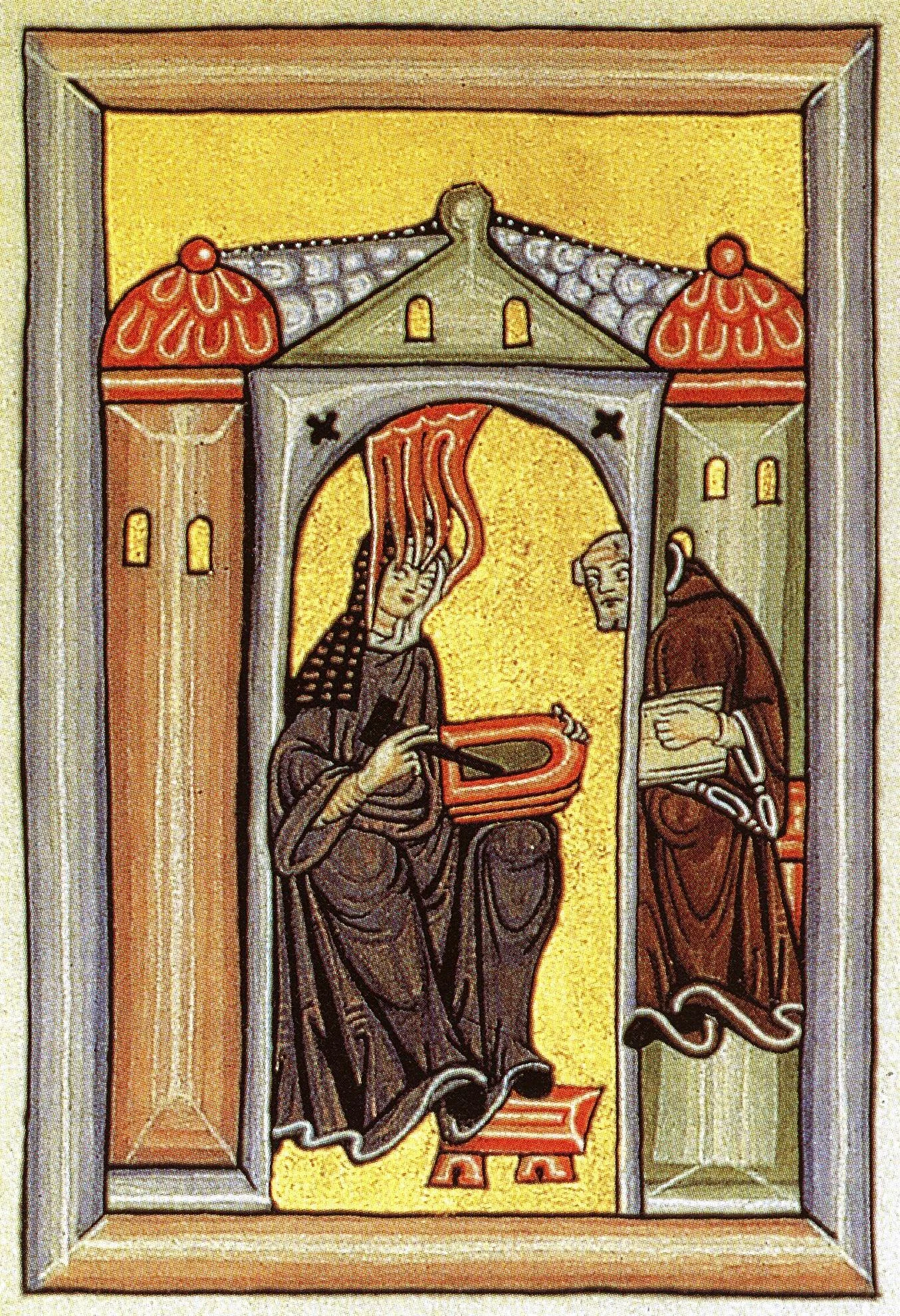
Image from Wikipedia
Image from Wikipedia
Hildegard of Bingen – Composer, Mystic, and Doctor of the Church
A visionary sound architect of the Middle Ages, whose music still shines today
Hildegard of Bingen (1098–1179) embodies in one person the roles of composer, Benedictine abbess, theologian, naturalist, and spiritual advisor. Her letters, visions, and songs shaped the spiritual culture of the 12th century and continue to form an extraordinary oeuvre of high artistic and spiritual density. As one of the earliest known female composers in Europe, she created a distinct musical language that bridges liturgical song, poetic imagery, and theological symbolism. In 2012, she was declared a Doctor of the Church by the Roman Catholic Church – a rare title that underscores her lasting authority in faith and culture.
Early Years, Formation, and Artistic Development
Born in Bermersheim vor der Höhe near Alzey and given to a religious community at an early age, Hildegard developed a strong awareness of monastic practice, spiritual discipline, and the role of music in the Divine Office. In 1136, the community of Disibodenberg chose her as magistra; later, she founded her own women’s monastery, Rupertsberg, near Bingen. These biographical milestones mark not only her path to spiritual leadership but also the beginning of a medieval music career: composition, performance practice with the convent, and the integration of poetry, theology, and sound within a lived liturgy. Her artistic development intertwines vision and composition – text and melody emerge as a unity.
Visionary Writing and Music as Theology in Tones
Hildegard's grand visions – collected in works like Scivias – unfold a cosmological understanding in which music appears as a reflection of divine order. In her poetics, she refers to sound as an expression of the "harmony of celestial appearances." This theological aesthetic permeates her compositions: texts filled with dense metaphor connect creation, salvation history, and Mariology with a clear spiritual ethos. As an advisor, she corresponded with popes and emperors; her public preaching and pastoral travels testify to her authority and stage presence in a metaphorical sense – a strong, charismatic voice that intertwined spiritual life, ethics, and artistic practice.
Composition and Repertoire: Symphonia and Ordo Virtutum
The core corpus of her music bears the title Symphonia armonie celestium revelationum – antiphons, responsories, sequences, and hymns with texts of her own composition. Distinctive features of her style include a wide ambitus, boldly structured melodic arcs, rich melisma, and a modal aesthetic that expands the liturgical framework. A singular masterpiece is the Ordo Virtutum: a spiritual music drama whose 82 melodies depict the struggle of the anima with personified virtues and the devil in dramatic form. As an early example of liturgical drama, it unites composition, dramaturgy, role characterization, and spiritual pedagogy, and is considered one of the oldest fully preserved musical moralities.
Transmission and Sources: Rupertsberg Codex and Dendermonde Codex
Hildegard's works have survived in impressive manuscripts. The Rupertsberg Codex compiles – with the exception of her natural science and medical texts – her major writings and forms an iconographically rich source of her theology. For music, the Dendermonde Codex is central: it preserves a large portion of the Symphonia and documents the notated practice of her songs. In research, these codices are regarded as authoritative references for reconstruction, editions, and performance practice. They provide insight into notational forms and the monastic workshop where text composition, musical arrangement, and editing took place.
Performance Practice: Sound, Ensemble, and Liturgical Space
Hildegard's music is designed as monophonic and rooted in the monastic liturgy. Her melodic rhetoric utilizes keys and finalis references from the medieval modal system, shapes differentiated phrasing arcs, and bestows special resonance to central words – such as nature-related, mariological, or cosmic metaphors – through melismas. In practice, the chants unfold a meditative density in the resonant space of church and the Divine Office. The combination of syllabic clarity in verse segments and melismatic elaboration culminates in a distinctive sound image: contemplative yet expressive; ascetic in structure yet rich in melodic imagination.
Discography, Editions, and Modern Reception
Since the 20th century, Hildegard’s work has inspired numerous ensembles, editions, and recordings. Discographic overviews and edition series document the variety of interpretative approaches – from strictly liturgical styles to sonically expanded projects. New releases continually draw on the Dendermonde tradition; specialized choirs and vocal ensembles present her responsories and antiphons in historically informed performance practices. Recent albums and curated compilations show how enduring her music remains for contemporary listeners – from pure vocal sound to conceptual projects that translate her melodies into contemporary soundscapes.
Cultural Influence: From Medieval Mysticism to the Present
Hildegard's sound aesthetics influence not only the music history of the Middle Ages but also contemporary culture. Composers, vocal ensembles, sound artists, and producers worldwide draw upon her poetic symbolism, modal tensions, and the close connection between text and tone. Concerts, festivals, and albums set her songs in dialogue with new music, ambient, improvisation, or sound art – a testament to the transhistorical effectiveness of her theology of music. Press contributions emphasize that her 900-year-old chants resonate equally in the experimental scene and the choral landscape – a cultural echo that strengthens her authority on issues of spirituality, aesthetics, and women’s voices in music history.
Authority and Church Recognition: Doctor of the Church since 2012
With her elevation to Doctor of the Church in 2012, Hildegard's teachings and spiritual work received recognition on a worldwide ecclesiastical level. The papal documents honor her eloquence, visionary theology, and contributions to the renewal of spiritual life. This distinction, shared by only a few other women in church history, confirms the lasting relevance of her writings and her sound theology. For the reception of her music, this means: her compositions are not merely art historical documents but educational pieces of spiritual experience – music as living theology.
Science, Natural Science, and Lingua Ignota
In addition to music, Hildegard authored natural science and medical compendiums, reflecting on ethics, cosmology, and healing arts. Her pragmatic observations connect concepts of the body, healing, and spiritual care – a holistic approach that has garnered considerable attention in research and popular receptions. Notably, her Lingua Ignota, an experimental vocabulary, reflects the richness of her symbolic language and underscores her creative intelligence beyond classical genre boundaries. Altogether, these works demonstrate her interdisciplinarity and deepen the understanding of her music as part of a larger, coherent worldview.
Style Analysis: Text Setting, Form, and Musical Semantics
Her compositions are based on her own poetry; the prosody governs the melodic flow. Motifs are semantically charged – natural images like “viriditas” (green power) appear as ascending lines, Marian symbolism receives floating melismas, and Christ mysticism condenses in climactic points. Formally, Hildegard works with responsorial structures, repetition formulas, and free, recitative-like declamation. The avoidance of polyphonic texture directs attention to timbre, texture, and resonance of space. In modern recordings, interpreters focus on the notational details of the codices, on late medieval neumes, and on a contemplative, sustainable tempo.
Reception in the Present: Projects, Concerts, and New Contexts
In the 21st century, Hildegard's music is experiencing a vital renaissance: new albums, thematic concert programs, and interdisciplinary projects relate her songs to contemporary compositional languages and sound spheres. Reports from the music press and radio broadcasts highlight the sustainable appeal of her "soundscapes" between liturgy and vision. Workshops and concert series open the access to notation, modes, and singing techniques for both amateurs and professionals; ensembles from Belgium, Germany, and the USA present cyclic programs based on the hours of the Dendermonde Codex. These activities anchor her music in today's cultural landscape and evidence its reach far beyond church boundaries.
Conclusion: Why Hildegard of Bingen Resonates Today
Hildegard of Bingen fascinates because she unites artistic development, spiritual experience, and culture-shaping authority. Her discography continues to grow; editions and research deepen the understanding of her compositions, while concerts and new albums keep her music alive. Those who experience her chants live – in sacred spaces or concert halls – encounter music that invites contemplation while also electrifying emotionally. These sound worlds, created in the 12th century, resonate directly with the present: precise in form, expansive in expression, luminous in message. Recommendation: Listen to Hildegard's music in historically informed performance – and, if possible, attend a concert or Divine Office where her antiphons and responsories fill the space.
Official Channels of Hildegard of Bingen:
- Instagram: No official profile found
- Facebook: No official profile found
- YouTube: No official profile found
- Spotify: No official profile found
- TikTok: No official profile found
Sources:
- Wikipedia – Hildegard of Bingen
- Vatican – Apostolic Letter on the Elevation of Hildegard to Doctor of the Church (2012)
- City of Bingen – Hildegard von Bingen: Prophetess and "Emperor's Whisperer"
- Hildegard Publishing Company – Resource Page
- Medieval.org – Hildegard von Bingen: Discography Overview
- Wikipedia – Hildegard von Bingen (German)
- Ziereis Faksimiles – Rupertsberg Codex
- Wikisource – Miniature from the Rupertsberg Codex (Scivias)
- Wikipedia – Dendermonde Codex
- KAXE – Under the Spell of Hildegard: Electric Fields (2025)
- The Guardian – Why a 12th-Century Nun is a Name in Experimental Music (2025)
- Berlin's German Symphony Orchestra – Program Booklet with References to Dendermonde/Wiesbaden
- Psallentes – Hours of Hildegard: The Dendermonde Codex
- Apple Music – Wege zu Hildegard von Bingen (Compilation)
- iMusic – Vox Cosmica (Hirundo Maris, 2024)
- Hildegard Publishing – Ordo Virtutum (Edition)
- OrdoVirtutum.de – Background on the Ordo Virtutum
- Bistum Limburg – Pilgrimage and Relics Celebration in Eibingen
- Wikipedia: Image and Text Source