
Marie Luise Kaschnitz
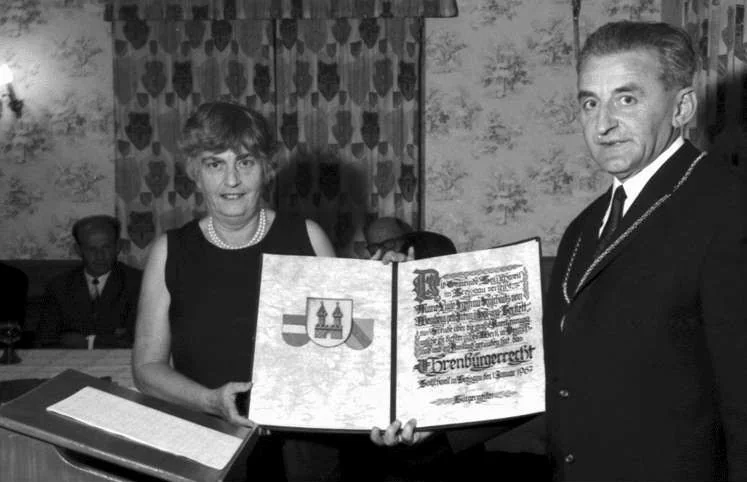
Image from Wikipedia
Image from Wikipedia
Marie Luise Kaschnitz – one of the most striking voices of German post-war literature
Between Memory, Loss, and Poetic Clarity
Marie Luise Kaschnitz, born on January 31, 1901 in Karlsruhe and died on October 10, 1974 in Rome, is considered one of the most significant German writers of the 20th century. Her oeuvre includes short stories, novels, essays, and poems; in literary history, she is recognized as a defining voice of the post-war period. The biographical stages of her life, from a bourgeois-conservative background to an international perspective shaped by travel and literary observation, are reflected in a language that combines vulnerability, intellectual alertness, and formal precision. ([ebsco.com](https://www.ebsco.com/research-starters/biography/marie-luise-kaschnitz))
Biography and Artistic Influence
Kaschnitz grew up in a conservative environment and did not receive a university education; instead, she was trained early on as a bookseller and worked as a teenager in a publishing house in Munich. This early proximity to the book market, editing, and the literary scene laid the groundwork for her later mastery of language, where observation, reflection, and an awareness of form come together. Later, marriage, travel, and engagement with European culture shaped her view of history and the present. ([ebsco.com](https://www.ebsco.com/research-starters/biography/marie-luise-kaschnitz))
Her husband, Guido Kaschnitz von Weinberg, introduced her to a culturally and historically charged environment, which she did not use merely as a decorative backdrop, but as a resonant space for literary experience. Especially her engagement with Rome, with places, memories, and traces of past civilizations, became an important impetus for her prose and poetry. Kaschnitz wrote not from the distance of a mere observer, but from an existential closeness to themes of transience, guilt, and inner home. ([de.wikipedia.org](https://de.wikipedia.org/wiki/Marie_Luise_Kaschnitz?utm_source=openai))
The Literary Breakthrough
Her first novel Liebe beginnt was published in 1933 and marked the beginning of a long, independent career. After the war, with texts such as Totentanz und Gedichte zur Zeit from 1947, she became an author whose writing responded directly to the experience of historical destruction. These texts are exemplary of a post-war literature that does not offer simple reconciliation but instead makes the psychological scars of the time visible. ([de.wikipedia.org](https://de.wikipedia.org/wiki/Marie_Luise_Kaschnitz?utm_source=openai))
From 1947 to 1948, Kaschnitz served as a co-editor of the monthly magazine Die Wandlung. This points to her role in a literary new beginning, where language became not only expression but an ethical instrument. Her career developed in this context into an authorship that had far-reaching impacts beyond individual works, significantly shaping the German-speaking literature of the post-war years. ([de.wikipedia.org](https://de.wikipedia.org/wiki/Marie_Luise_Kaschnitz?utm_source=openai))
Key Works and Thematic Lines
Central works include her early novel and above all short stories and poetry collections such as Lange Schatten, Wohin denn ich, Ferngespräche, Engelsbrücke, and Beschreibung eines Dorfes. The DNB also lists numerous other texts and readings, confirming the breadth of her oeuvre. Kaschnitz worked with short forms, essayistic condensation, and poetic prose that often revolves around memory, grief, identity, and the fragility of everyday life. ([de.wikipedia.org](https://de.wikipedia.org/wiki/Ferngespr%C3%A4che?utm_source=openai))
In her poetry, the tension between personal experience and the general human condition is particularly pronounced. The poetry collection documented by the German National Library, Überallnie, featuring selected poems from 1928 to 1965, shows how consistently Kaschnitz worked on an unmistakable poetic voice. Her poems combine vivid precision with intellectual openness; they seem calm, yet within that calm lies great emotional intensity. ([d-nb.info](https://d-nb.info/953166724/04))
Style, Language, and Literary Signature
Kaschnitz's style is characterized by a clear, often simple diction, which has a significant impact because of this very quality. She did not favor ornamental excess but instead preferred a controlled, sensitive language, where each word aims at inner tension. Critical secondary literature describes her work as writing that interweaves past, present, and future visions, giving damaged life a precise form. ([planetlyrik.de](https://www.planetlyrik.de/wp-content/uploads/2024/10/Munzinger-Online-KLG-%E2%80%93-Kritisches-Lexikon-zur-deutschsprachigen-Gegenwartsliteratur-Marie-Luise-Kaschnitz.pdf))
Particularly striking is her ability to translate existential experiences into unspectacular situations. Whether in short stories, poems, or essayistic texts: Kaschnitz does not seek loud effects, but concentrated condensation. Her literary development shows an author who never allowed herself to be restricted to a single tone but adapted the form to the material, thereby gaining immense stylistic credibility. ([de.wikipedia.org](https://de.wikipedia.org/wiki/Ferngespr%C3%A4che?utm_source=openai))
Acknowledgment, Awards, and Critical Reception
In 1955, Kaschnitz received the Georg-Büchner-Preis, one of the most important literary awards in the German-speaking world. Later documentation in research and the literary field shows that her work continues to be intensely received, from biographical studies to scholarly analyses of her poetics. The recurring engagement with her texts demonstrates that her themes are not historically resolved but still belong at the center of literary debates. ([de.wikipedia.org](https://de.wikipedia.org/wiki/Marie_Luise_Kaschnitz?utm_source=openai))
The critical reception particularly highlights her post-war poetry, her short prose, and her essayistic power. In reviews and research contributions, she is read as an author who shaped a literature of precise observation from a damaged era. Her cultural significance lies not only in individual titles but in the overall image of a writer who has provided a distinctive, humane, and reflective voice to the German literary canon. ([planetlyrik.de](https://www.planetlyrik.de/wp-content/uploads/2024/10/Munzinger-Online-KLG-%E2%80%93-Kritisches-Lexikon-zur-deutschsprachigen-Gegenwartsliteratur-Marie-Luise-Kaschnitz.pdf))
Cultural Influence and Impact
Kaschnitz has shaped German-speaking literature primarily through her sensitivity to memory, loss, and inner home. Her work resonates with readers because it never considers the private in isolation but always places it in larger historical and moral contexts. This connection between intimacy and temporal diagnosis makes her an author of enduring relevance. ([de.wikipedia.org](https://de.wikipedia.org/wiki/Marie_Luise_Kaschnitz?utm_source=openai))
The institutional memory of her is also strong: a literary prize bears her name, emphasizing her lasting significance in the cultural memory. Thus, Kaschnitz remains not only a historical figure but a living reference for poetic accuracy, stylistic integrity, and literary responsibility. ([en.wikipedia.org](https://en.wikipedia.org/wiki/Marie_Luise_Kaschnitz_Prize?utm_source=openai))
Conclusion: Why Marie Luise Kaschnitz Continues to Fascinate Today
Marie Luise Kaschnitz impresses with a body of work that combines psychological depth with linguistic discipline. Her texts read like precisely observed life protocols from an author who translated the fractures of the 20th century into a lasting poetic form. For those who experience literature as a space for insight, Kaschnitz offers an impressively clear, humanly dense, and still moving voice. Those encountering her texts live in readings, discussions, or literary programs discover an author whose presence remains extraordinarily strong even beyond the pages. ([de.wikipedia.org](https://de.wikipedia.org/wiki/Marie_Luise_Kaschnitz?utm_source=openai))
Official Channels of Marie Luise Kaschnitz:
- Instagram: No official profile found
- Facebook: No official profile found
- YouTube: No official profile found
- Spotify: No official profile found
- TikTok: No official profile found
Sources:
- Wikipedia - Marie Luise Kaschnitz
- LEO-BW - Marie Luise Kaschnitz, a Biography
- German National Library - Marie Luise Kaschnitz: Überallnie
- German National Library - Work Record: Der Geiger
- EBSCO Research Starters - Marie Luise Kaschnitz
- Munzinger Online / Critical Lexicon on Contemporary German Literature - Marie Luise Kaschnitz
- German Digital Library - Marie Luise Kaschnitz: a Biography
- Wikipedia: Image and text source