
Sławomir Mrożek
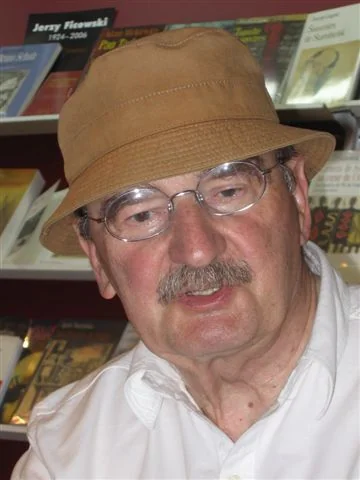
Image from Wikipedia
Image from Wikipedia
Sławomir Mrożek – the Master of the Grotesque, the Theater of the Absurd, and Literary Compression
A Polish Classic Between Satire, Exile, and World Literature
Sławomir Mrożek (* June 29, 1930 in Borzęcin near Kraków; † August 15, 2013 in Nice) is considered one of the defining Polish authors of the 20th century. He was a writer, playwright, satirist, draftsman, and one of those rare voices whose work had an impact far beyond national literature. His plays and stories combine political sharpness, absurd comedy, and precise observation of human weaknesses into a distinctive literary cosmos. (en.wikipedia.org)
Biographical Background and Early Influences
Mrożek grew up in a time when Poland was marked by war, post-war order, and ideological upheaval. These experiences formed the resonance chamber for his later writing, which reveals authoritarian systems, societal conformity, and the ridiculousness of political rituals with a sharp eye. In biographies and portraits, he is described as an author who derived literary form from the everyday life under Stalinism and the absurd reality of communist Poland. (culture.pl)
Before his ultimate establishment as a playwright, Mrożek worked as a journalist, draftsman, and prose author. This versatility shapes the elegance of his language as well as the visual clarity of his scenes. His early satirical texts and short stories already exhibit the compression that would later characterize his stage works: concise, pointed, and ruthlessly precise. (culture.pl)
The Breakthrough: From Satirist to Internationally Demanded Playwright
Mrożek’s international breakthrough came primarily with his plays. Particularly highlighted are Policja (1958), Męczeństwo Piotra Oheya (1959), Na pełnym morzu (1961), Karol (1962), Zabawa (1963), and Czarowna noc (1963), which were translated into other languages early on. His works were associated with the Theater of the Absurd and made him one of the most well-known Polish dramatists of his time. (britannica.com)
With Tango, he achieved a piece of extraordinary longevity in 1964. The drama is among his most performed works and is read as a key text in literary and theater history because it presents generational conflict, shifts in power, and societal wildness in a highly comic yet dark form. In international reception, Tango stands as a synonym for Mrożek's ability to translate philosophical conflicts into dramatic precision. (britannica.com)
Exile, Distance, and the View on Power
In 1963, Mrożek emigrated from Poland and lived in several countries, including France, Italy, the USA, and Mexico, before returning to Kraków in 1996. Exile sharpened his view on ideology, identity, and political language. Cultural platforms like Culture.pl emphasize that he was already internationally known before his emigration and was read in German and French translation. (culture.pl)
This distance from his homeland did not make his plays any less Polish; rather, they became more universal. Mrożek observed systems from the outside and exposed their mechanisms with a mixture of irony, coldness, and formal elegance. In works like Emigranci (1974), Ambasador (1984), and Portret (1987), political allegory merges with existential comedy. (britannica.com)
Body of Work and Dramatic Signature
Mrożek's body of work includes short stories, satires, drawings, and numerous plays that have been discussed in Poland as well as internationally. His texts operate with parables, exaggerations, masks, and the systematic distortion of everyday logic. This creates a dramatic language in which the comedic often borders on threat, and the absurd is never merely play. (culture.pl)
Critics regularly highlight his mastery in handling dialogue, pace, and dramatic compression. His characters often miss each other in conversation, thereby revealing themselves; power appears as a social habit, not just as a political system. This clarity has made Mrożek an author whose plays remain vibrant on stages throughout Europe and beyond. (britannica.com)
Style, Motifs, and Literary Significance
Sławomir Mrożek's style blends grotesque elements, satire, and the theater of the absurd with remarkable linguistic economy. Instead of grand psychological excursions, he relies on precise placements, sharp turns, and symbolic constellations. His works function like intellectual trapdoors: seemingly light, yet highly complex and rich in cultural undertones. (culture.pl)
Recurring motifs include authority, alienation, belonging, language as an instrument of power, and the fragility of social order. In scholarly commentary and cultural portals, Mrożek is thus described as one of the cleverest unmaskers of the reality of communist Eastern Europe. His texts serve as both time documents and universal parables about human self-deception. (culture.pl)
Critical Reception and Cultural Influence
The international reception was notable early on. Britannica points out that several of his major plays were translated into English, while other sources emphasize his enduring stage presence in Europe. Particularly, Tango became a classic, permanently anchoring Mrożek's name in the canon of world literature. (britannica.com)
The literary critical classification is also clear-cut: Mrożek belongs to the Theater of the Absurd, without ever being mere imitation. His plays possess a distinctive Eastern European perspective in which political experience, irony, and formal rigor create their own aesthetic tensions. This is where his historical significance lies: he wrote not only about his epoch but about the mechanics of power itself. (encyclopedia.com)
Current Reception and Contemporary Interpretation
Even though Sławomir Mrożek has not been alive since 2013, his work remains relevant. Cultural institutions, theaters, and literary portals continue to point to his enduring relevance, and new publications, translations, and commemorative formats keep the engagement with his oeuvre alive. In this sense, Mrożek is not an author of the past but a contemporary author with historical depth. (culture.pl)
His texts appeal to readers who appreciate literary precision, intellectual sharpness, and political ambiguity. Those who read Mrożek or experience him on stage encounter an author who uses the absurd not as an escape but as a method of understanding. This is exactly what makes his art so fascinating even today. (culture.pl)
Conclusion: Why Sławomir Mrożek Continues to Captivate
Sławomir Mrożek remains intriguing because he makes visible, with literary precision, how power, language, and society interconnect. His plays are acerbic, comical, melancholic, and intellectually electrifying all at once. Those who discover his works do not merely engage in classic preservation but encounter an author whose outlook on the world remains strikingly contemporary. His texts deserve the stage, discussion, and renewed readings. (britannica.com)
Official Channels of Sławomir Mrożek:
- Instagram: no official profile found
- Facebook: no official profile found
- YouTube: no official profile found
- Spotify: no official profile found
- TikTok: no official profile found
Sources:
Upcoming Events

ArtEast Theater | POLICE
Theater Performance POLICE – Sławomir Mrożek