
Walter Gropius
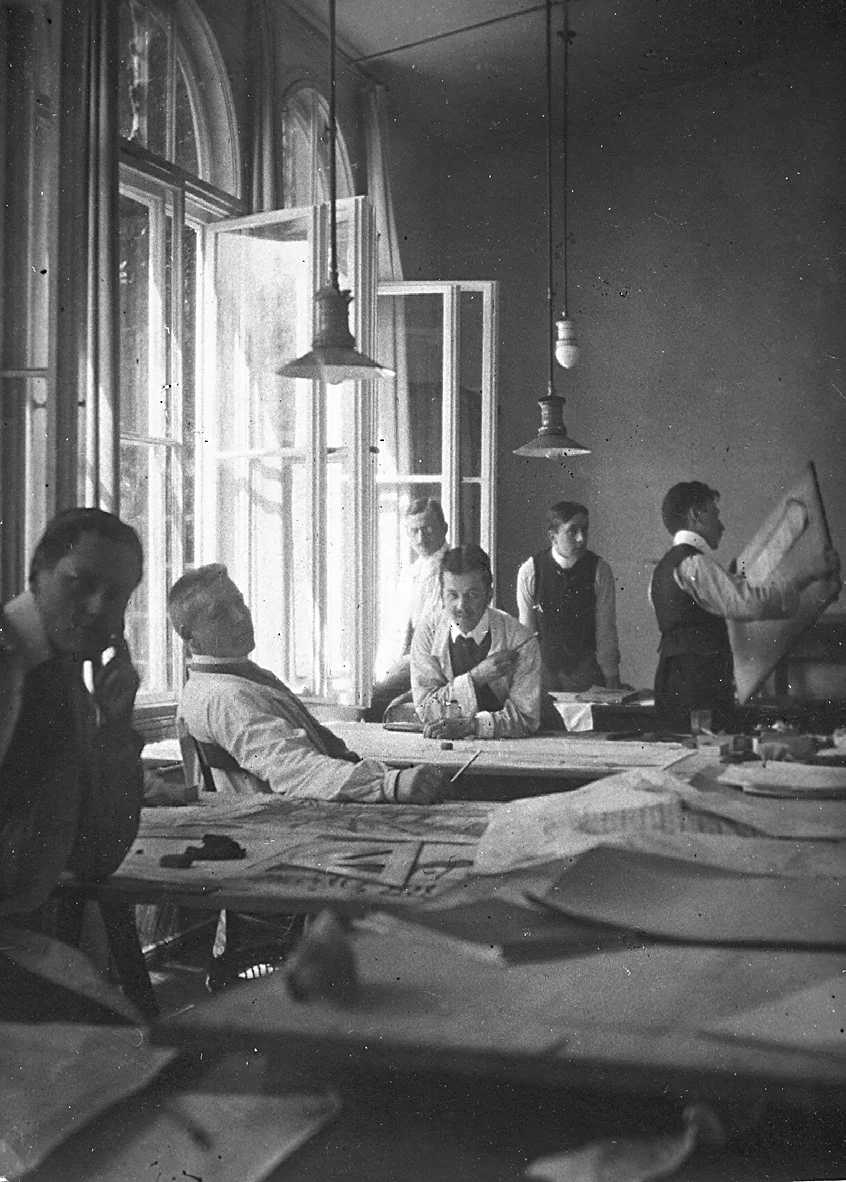
Image from Wikipedia
Image from Wikipedia
Walter Gropius – Architect of the 20th Century, Founder of the Bauhaus, Visionary of Modern Building
From the Son of an Architect in Berlin to a Global Designer: Life, Work, and Legacy of Walter Gropius
Walter Adolf Georg Gropius (born May 18, 1883 in Berlin; died July 5, 1969 in Boston, Massachusetts) is regarded as one of the most influential architects and cultural designers of the 20th century. As the founder of the Bauhaus, he shaped a school of thought and design whose principles – functionality, reduction, and honesty in materials – continue to influence architecture, design, and urban planning today. His artistic development ranged from his apprenticeship with Peter Behrens through groundbreaking industrial buildings to a professorship at Harvard, where he shaped generations of architects as a teacher and visionary.
Biographical Beginnings: Education, Werkbund, and the Impulse for Modernity
Growing up in an architect family, Gropius studied architecture in Munich and Berlin-Charlottenburg, leaving school without a degree and gathering formative practical experience in Peter Behrens' office. This early phase of his music career – translated into architecture as a formative work phase – sharpened his understanding of composition, proportion, and industrial production. In 1911, he joined the Deutscher Werkbund and advocated for prefabrication and rational building methods. In this artistic development, he combined craftsmanship traditions, new materials such as steel and glass, and a clear, constructive design language into a distinctive architectural language.
Breakthrough with Industrial Buildings: Fagus Factory and the Werkbund Exhibition
The breakthrough for Gropius came alongside Adolf Meyer: the Fagus Factory in Alfeld (1911) is considered an icon of early modernism – a radical arrangement of glass curtain walls, delicate supports, and an unprecedented transparency. The model buildings for the Werkbund exhibition in Cologne (1914) demonstrated how industrial building and aesthetic clarity could combine to create a compelling overall concept. These projects anchored Gropius in the "discography" of modernity – a work biography of milestones that anticipated the later Bauhaus pedagogy.
The Bauhaus (1919–1928): Pedagogy as Artistic Production
In 1919, Gropius founded the Staatliches Bauhaus in Weimar. His arrangement of preliminary courses, workshops, and interdisciplinary collaboration challenged the previously dominant Beaux-Arts tradition. The "production" of the Bauhaus – textiles, typography, furniture, architecture – arose from the integration of material study, craftsmanship, and industrial logic. Under educators such as Johannes Itten, Paul Klee, Wassily Kandinsky, László Moholy-Nagy, and Josef Albers, Gropius established a learning environment where composition and function became inseparable. In 1925 the school moved to Dessau, where Gropius realized the school building and the master houses (1925–1926) as a built manifestation of the Bauhaus idea.
Coming to Dessau, Siemensstadt, Farewell: Architecture as Teamwork
The Bauhaus buildings in Dessau, with their flat roofs, horizontal window bands, and open floor plans, mark a peak of the International Style. After resigning as director (1928), Gropius returned to practice. In Berlin, he became involved in housing projects such as in Siemensstadt (1929–1930). Stylistically, he remained immune to dogmatism: for him, the methodical, social, and constructive appropriateness of each project mattered – architecture as a precise "capture" of the needs of a society in transition.
Exile and Harvard (1934–1952): Chair, Theory, and The Architects Collaborative
The political situation during the Nazi regime forced Gropius into exile in 1934, initially to Great Britain (including with Maxwell Fry, Impington Village College, 1936). In 1937, Gropius moved to Harvard University (Cambridge, Massachusetts), became head of the architecture department in 1938, and influenced a curriculum shift toward interdisciplinary design processes. He became a US citizen in 1944. In 1946, he founded The Architects Collaborative (TAC) with former students – a revolutionary "collective" that understood the design process as team composition and operated internationally.
Key Works: From Alfeld to Athens, from Dessau to Cambridge
Key works include: Fagus Factory (1911), Bauhaus Dessau with Master Houses (1925–1926), Siemensstadt Housing Estate (1929–1930), Gropius House in Lincoln, Massachusetts (1938) as a personal manifesto of modern living, the Harvard University Graduate Center (1949–1950), and the US Embassy in Athens (1960, with TAC). These "tracks" of his work biography form a consistent discography of building: clearly composed volumes, precise details, spatially defining material dramaturgies, and a production that aesthetically enhances industrial standards.
Gropius House (1938): A Living Laboratory as a Teaching Piece
The Gropius House combines New England tradition (wood, brick, fieldstone) with innovations such as glass blocks, acoustic plaster, and chrome railings. Furniture designed by Marcel Breuer, carefully positioned window bands, and landscaping that integrates indoor and outdoor spaces make the house a vivid teaching example for functional beauty. Even decades after Gropius' death, the location – now operated as a museum – conveys his pedagogical maxim: architecture as a lived cultural practice that combines everyday life, comfort, and constructive logic into a harmonious composition.
Style, Method, Influence: Bauhaus as an Attitude Rather than a Style Template
Gropius rejected rigid style templates. His "genre" is the method: research on materials, serial logic, precise details, teamwork. This led to buildings whose aesthetics arose from construction, light management, and usage. The artistic development of the Bauhaus proceeds from expressive experimentation to industrial prototyping – not as a contradiction, but as the maturation of a program that connects theory and practice. In this perspective, production becomes a pedagogical act: every joint, every profile, and every facade is part of a didactic arrangement, introducing users to a modern way of living.
Reception, Critique, Awards: From Werkbund to Global Public
Contemporary criticism recognized Gropius' industrial buildings as a turning point; today, architectural historical canon positions him alongside Le Corbusier, Frank Lloyd Wright, and Mies van der Rohe as a pioneer of modernity. Museums, archives, and universities keep his work present; his influence is visible in curricula, research projects, and restorations. Dessau continues to attract design travelers exploring the Bauhaus building, the master houses, and the collections – a sustained public success of modernity as a travel culture that makes architectural history tangible on site.
Transatlantic Trail: Teaching as a Catalyst for Modernity
At Harvard, Gropius shifted the focus from the genius individual author to collaborative design practice. The founding of TAC professionalized this approach: planning as orchestrated teamwork with specialists in construction, building technology, urban design, and landscaping. His presence as a speaker, teacher, and curator became a lasting force: Gropius’ method systematically included social, technological, and ecological parameters in the design – an early blueprint for today’s integral planning and sustainable building.
Cultural Influence: Modernity as a Way of Life
The Bauhaus influenced not only architecture but also everyday culture: furniture, graphics, textiles, ceramics. Gropius’ thinking created a visual grammar of modernity that normalized the handling of space, light, materials, and mass production. The master houses in Dessau and the Gropius House in Massachusetts serve as living archives of this attitude. They show how composition and use intertwine, how the spatial "timbre" – the light atmosphere, the tactile quality of a handrail, the rhythm of window bands – shapes our well-being.
Current Resonances (2025–2026): Bauhaus Sites, Restorations, Competitions
Even today, Gropius' work remains present: The Bauhaus Archive / Museum of Design in Berlin is renovating and expanding the house designed by Gropius in a heritage-conscious manner. In Dessau, exhibitions and programs mark the hundredth anniversary of the Bauhaus site and demonstrate ongoing international appeal. The Gropius House in Lincoln revitalizes engagement with modern building culture through programs, digital tours, and – in the spirit of an open workshop – architectural competitions for infrastructural additions that bring together accessibility, design quality, and the Bauhaus ethos.
Legacy: A School for Life
Gropius' legacy is most potent where design is understood as an exploratory process. The Bauhaus as an educational institution changed curricula worldwide: starting with materials, thinking systemically, designing in teams. His "discography" – from the Fagus Factory to Dessau to Harvard – remains a precise score of modern architecture, in which every building task is newly composed yet reveals a recognizable attitude: honesty of means, clarity of order, dignity of the everyday.
Conclusion: Why Walter Gropius Inspires Today
Walter Gropius fascinates because he understands architecture as a social art. He stages space as an experience, not as a pose. His artistic development – from industrial construction to educational reform, from a sole author to a collective – showcases a cultural creator who defends principles rather than forms. Those wishing to grasp modernity beyond buzzwords should experience his places: the transparent Bauhaus Dessau, the finely composed privacy of the Gropius House, the urban clarity of the Harvard Graduate Center. Experienced live, the silent yet compelling dramaturgy of this work unfolds – an invitation to understand modern architecture as a humane practice.
Official Channels of Walter Gropius:
- Instagram: No official profile found
- Facebook: No official profile found
- YouTube: No official profile found
- Spotify: No official profile found
- TikTok: No official profile found
Sources:
- Encyclopaedia Britannica – Walter Gropius
- Encyclopaedia Britannica – Harvard years of Walter Gropius
- Wikipedia – Walter Gropius (German)
- Bauhaus-Archiv / Museum für Gestaltung – About us
- Historic New England – Gropius House
- American Archive of Public Broadcasting – Who is; Walter Gropius (1968)
- Wallpaper – Gropius House design competition (2025)
- The Guardian – 100 years of Bauhaus in Dessau (2025)
- Wikipedia: Image and text source
Upcoming Events
Experience Glass Cathedral Amberg – Public Tour
Experience Glass Cathedral Amberg: Walter Gropius' Last Building – Public Tour
Public tour: Experience Glass Cathedral Amberg
Public Tour: Experience Glass Cathedral Amberg (Walter Gropius)
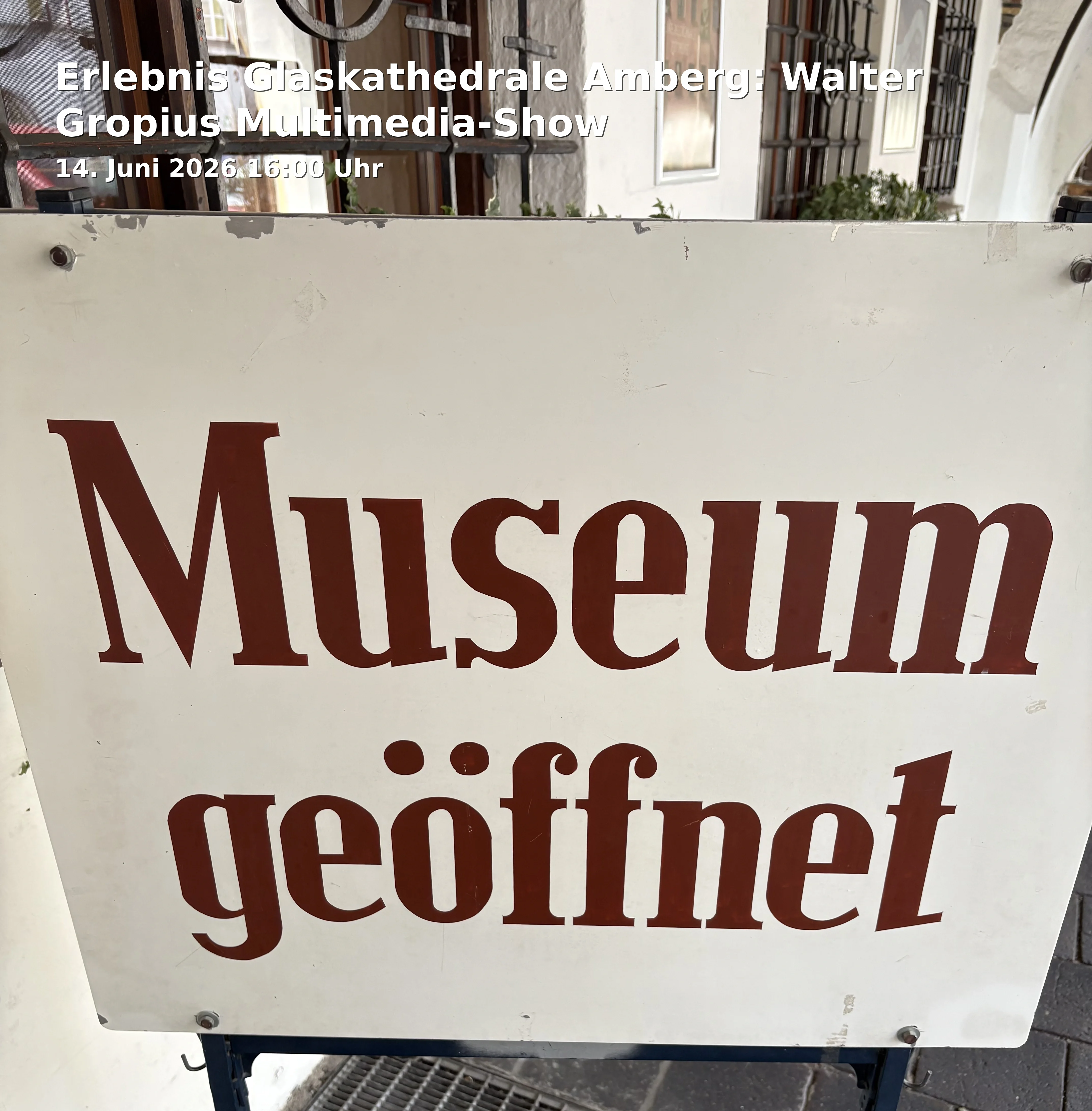
Experience Glass Cathedral Amberg: Walter Gropius Multimedia Show
Experience Glass Cathedral Amberg
Experience Glass Cathedral Amberg: Walter Gropius' Last Bauhaus Work
Glass Cathedral Amberg – Experience Walter Gropius' Last Work
Experience Glass Cathedral Amberg: A Walk Through Its History